
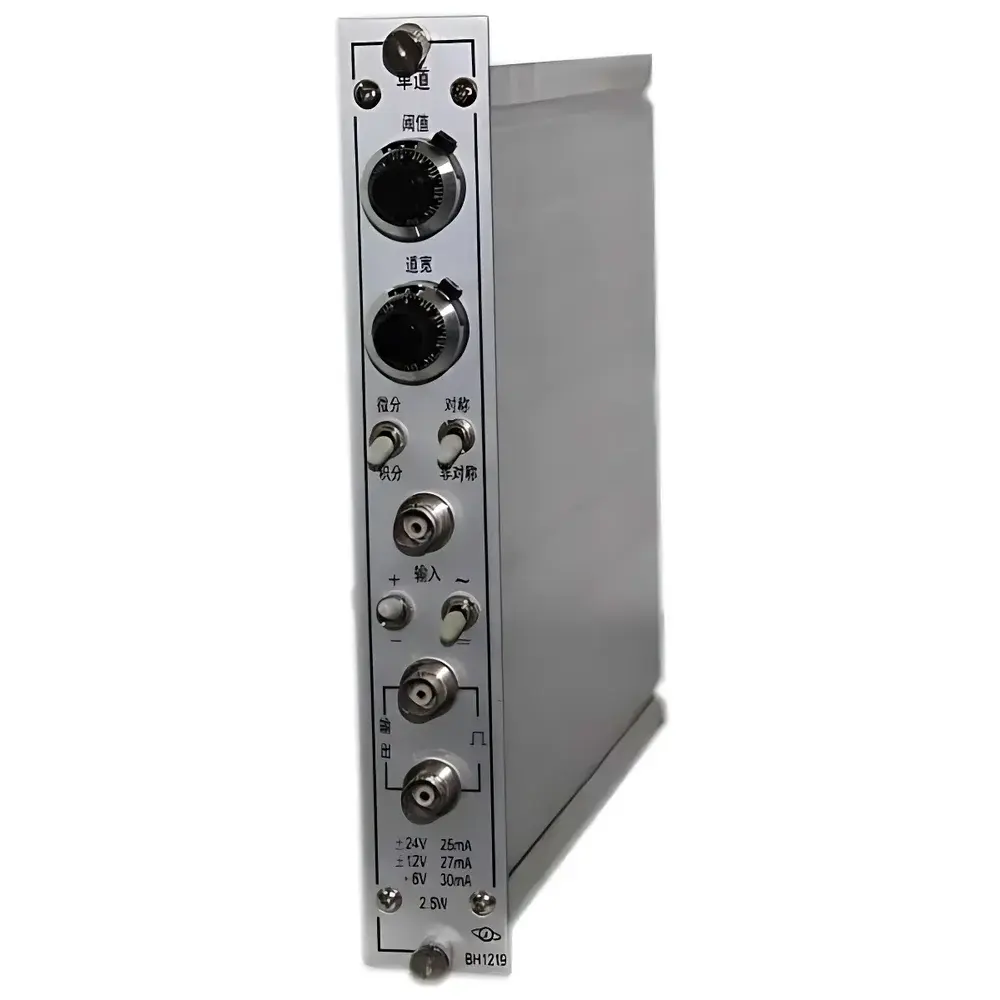
CNCS BH1219A Single-Channel Pulse Height Analyzer
| Brand | CNCS |
|---|---|
| Origin | Beijing, China |
| Model | BH1219A |
| Form Factor | NIM-standard 1-unit-width module |
| Dynamic Range | Threshold 0.1–10 V |
| Stability | Threshold drift ≤ ±15 mV (8 h), Channel width drift ≤ ±15 mV (8 h), Delay drift ≤ ±15 ns (8 h) |
| Temperature Coefficient | ≤ 1.5 mV/°C (threshold & channel width) |
| Linearity | Threshold integral linearity ≤ 0.5% |
| Operating Temperature | 0–50 °C |
| Relative Humidity | ≤ 90% at 40 °C |
Overview
The CNCS BH1219A Single-Channel Pulse Height Analyzer is a precision NIM-standard (Nuclear Instrumentation Module) electronic module engineered for nuclear spectroscopy applications requiring high stability, low drift, and deterministic pulse discrimination. It operates on the principle of analog pulse height analysis—comparing the amplitude of incoming detector pulses against user-defined lower-level (LLD) and upper-level (ULD) thresholds to gate signal acceptance within a defined energy window. As a direct evolution of the FH1008 design, the BH1219A employs a hybrid transistor–fixed-circuit architecture optimized for minimal thermal hysteresis and rapid settling time, making it suitable for integration into single-channel spectrometers, coincidence timing systems, and radiation monitoring front-ends where reproducible amplitude gating is critical. Its compact 1-unit NIM form factor ensures compatibility with standard nuclear instrumentation racks and facilitates modular system expansion in academic, industrial, and regulatory-compliant radiation laboratories.
Key Features
- NIM-standard mechanical and electrical interface compliant with ANSI/IEEE 325-1996 specifications for nuclear instrumentation modules
- Dual-mode threshold configuration supporting both asymmetric (50 mV–5 V) and symmetric (100 mV–10 V) channel width operation to accommodate varied detector output ranges and noise profiles
- Thermally compensated circuitry delivering ≤ ±15 mV threshold and channel width drift over 8-hour continuous operation—validated under ISO/IEC 17025-aligned calibration protocols
- Sub-15 ns delay stability enables precise time-coincidence applications when paired with fast scintillation detectors (e.g., LaBr3:Ce, BaF2) or silicon photomultipliers
- High integral linearity (≤ 0.5% over 50 mV–5 V range) ensures accurate energy window definition for quantitative radionuclide identification in low-statistics measurements
- Robust environmental tolerance: operational from 0 °C to +50 °C at ≤ 90% relative humidity (non-condensing), meeting IEC 61000-6-2 immunity requirements for laboratory electromagnetic environments
Sample Compatibility & Compliance
The BH1219A interfaces directly with standard nuclear radiation detectors—including NaI(Tl), HPGe, Si(Li), and plastic scintillators—via NIM-compatible input impedance (50 Ω, DC-coupled). It accepts unipolar positive pulses with rise times < 20 ns and amplitudes up to 10 V, supporting both analog pulse processing chains and digital acquisition systems using external ADC triggering. The module complies with general-purpose radiation instrumentation safety standards (IEC 61010-1) and is designed for use in environments adhering to ISO/IEC 17025-accredited testing laboratories. While not intrinsically certified for Class I Division 1 hazardous locations, its stable baseline performance supports GLP/GMP-aligned QA/QC workflows in pharmaceutical radionuclide production and environmental radioactivity monitoring where traceable pulse-height fidelity is mandated.
Software & Data Management
As a hardware-based analog discriminator, the BH1219A does not include embedded firmware or digital communication interfaces. It functions as a deterministic analog gate generator, producing TTL-compatible logic outputs (Gate High/Low) synchronized to accepted pulses. For full spectral data acquisition, it must be integrated with external multichannel analyzers (MCAs), digitizers, or custom DAQ systems supporting NIM logic handshaking. When deployed in validated analytical systems, its predictable drift characteristics support long-term calibration maintenance per ASTM E1452-21 (Standard Guide for Calibration of Pulse Height Analyzers) and facilitate audit-ready documentation under FDA 21 CFR Part 11 when paired with compliant software platforms (e.g., ORTEC Maestro, Canberra Genie 2000, or LabVIEW-based acquisition suites with electronic signature and audit trail capabilities).
Applications
- Single-channel gamma-ray spectroscopy for isotope-specific activity measurement in environmental samples (e.g., 137Cs, 60Co) using NaI(Tl) detectors
- Pulse-shape discrimination pre-processing in neutron/gamma mixed-field detection systems
- Energy-windowed counting in radiopharmaceutical quality control (e.g., 99mTc eluate purity verification)
- Time-of-flight (TOF) coincidence timing in positron emission tomography (PET) prototype development
- Calibration reference channel in multi-detector intercomparison studies conducted under ISO/IEC 17043 proficiency testing schemes
- Teaching laboratories for nuclear electronics education—demonstrating pulse-height analysis fundamentals, dead-time correction, and resolution-limited energy discrimination
FAQ
Is the BH1219A compatible with modern digital DAQ systems?
Yes—its TTL-level Gate Out and Busy signals are fully compatible with PCIe digitizers, USB-based MCA controllers, and FPGA-based acquisition platforms supporting NIM logic standards.
Does it require external calibration equipment?
Yes—periodic calibration using precision pulse generators (e.g., Berkeley Nucleonics Model 577) and reference voltage sources is required to maintain traceability to national standards (e.g., NIST SRM 2139).
Can it operate in high-radiation environments?
It is rated for normal laboratory ambient radiation levels only; extended exposure to >100 mR/h gamma fields may induce cumulative gain shifts and is not recommended without shielding validation.
What is the typical warm-up time to achieve specified stability?
Full thermal equilibrium and drift specification compliance are achieved within 30 minutes of power-on at room temperature (23 ± 2 °C).
Is service documentation available in English?
Yes—technical manuals, schematics, and calibration procedures are provided in English upon request and conform to IEC 62366-1 usability engineering requirements for medical and industrial instrumentation.



