
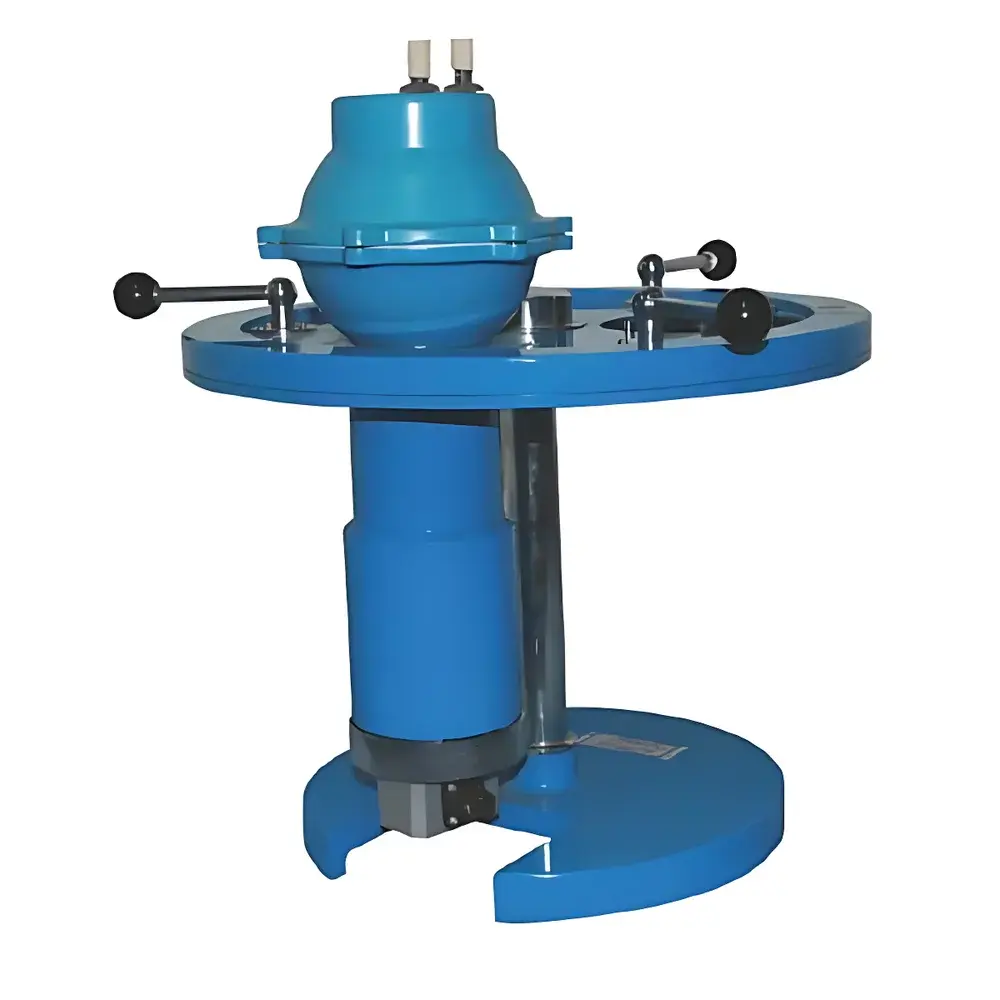
CNCS FD125 Radon-Thoron Analyzer
| Brand | CNCS (China Nuclear Control System) |
|---|---|
| Origin | Beijing, China |
| Model | FD125 |
| Detection Principle | ZnS(Ag)-based Scintillation Counting |
| Measurement Targets | Radon-222 (²²²Rn), Thoron-220 (²²⁰Rn), and Radium-226 (²²⁶Ra) in air, water, ore, and underground environments |
| Scintillation Chamber | Dual hemispherical acrylic chambers coated with ZnS(Ag) |
| Background Count Rate | ≤100 cps (unexposed chamber) |
| Leak Rate | ≤1.33×10³ Pa/10 min at residual pressure of 1.33×10⁴ Pa |
| Repeatability Error | ≤±10% under optimal conditions |
| Environmental Operating Range | 0–45°C, up to 95% RH |
| Power Supply | +9–10 V DC for amplifier |
| Weight | 16 kg (excluding scaler unit) |
Overview
The CNCS FD125 Radon-Thoron Analyzer is a laboratory-grade scintillation-based radiation measurement instrument engineered for precise quantification of radon-222 (²²²Rn), thoron-220 (²²⁰Rn), and radium-226 (²²⁶Ra) activity in environmental and geological samples. It operates on the principle of alpha-particle-induced scintillation in zinc sulfide doped with silver (ZnS(Ag)), a well-established detection method referenced in ISO 11665-2:2021 (Measurement of radioactivity — Radon-222 — Part 2: Integrated measurement methods for determining average activity concentration) and ASTM D3648-16 (Standard Practices for Measurement of Radioactivity). The analyzer employs two identical hemispherical acrylic scintillation chambers—each internally coated with a uniform layer of ZnS(Ag)—mounted on a manually operated 3-position rotating carousel. This mechanical design enables sequential sample interrogation without system shutdown, supporting unattended multi-sample workflows in field-deployed or fixed-lab settings. Unlike passive diffusion-based detectors, the FD125 utilizes active sampling protocols—including timed accumulation (for radon) and depressurization-assisted extraction (for thoron)—to achieve high sensitivity and temporal resolution in low-concentration matrices such as groundwater, mine air, and uranium/thorium-bearing ores.
Key Features
- Triple-chamber carousel mechanism: One chamber positioned directly above the photomultiplier tube (PMT) for real-time counting; two additional chambers remain light-shielded and ready for rapid exchange—minimizing downtime between measurements.
- ZnS(Ag) scintillation detection: Optimized for alpha-particle energy discrimination; provides high intrinsic efficiency for ²²²Rn (5.49 MeV) and ²²⁰Rn (6.29 MeV) decay emissions.
- Controlled accumulation protocol: For radium analysis, 1-hour radon emanation followed by 100-second counting yields a calibration coefficient of ~1.4 × 10⁻¹³ g Ra per count—traceable to NIST-traceable radium standards.
- Thoron-specific depressurization mode: Continuous vacuum extraction over 300 seconds enables reliable detection of ≥0.03% thorium content in 1 g mineral samples—aligned with IAEA Technical Reports Series No. 472 on uranium and thorium assay.
- Low-background architecture: Intrinsic chamber background ≤100 counts per second (cps) ensures high signal-to-noise ratio in sub-Bq/m³ environments.
- Hermetic chamber integrity: Sealed acrylic chambers maintain residual pressure ≥100 mmHg (1.33 × 10⁴ Pa); leakage ≤10 mmHg (1.33 × 10³ Pa) over 10 minutes—validated per ISO 9917-1 for sealed radiation detector housings.
- Environmental resilience: Certified performance across 0–45°C and up to 95% relative humidity; ≤±10% measurement deviation at 35 ± 2°C / 95 ± 3% RH; ≤±15% at operational extremes.
Sample Compatibility & Compliance
The FD125 supports direct measurement of gaseous radon/thoron from air and soil gas probes, aqueous samples (via emanation flask coupling), and solid ore specimens (crushed and sealed in emanation vessels). Its methodology complies with key regulatory frameworks governing environmental radiation monitoring, including EPA Method 912.0 (Radon-in-water by liquid scintillation), ISO 11665-4:2018 (Active sampling for radon in air), and national standards GB/T 14583-93 and HJ 61-2021 (China’s technical specifications for environmental radioactivity monitoring). While not intrinsically 21 CFR Part 11-compliant (as it lacks digital audit trail functionality), its analog signal path and manual operation are fully compatible with GLP-aligned laboratory procedures when paired with validated external scalers and documented chain-of-custody protocols.
Software & Data Management
The FD125 is an analog front-end instrument requiring integration with an external pulse scaler (sold separately) for count registration and time-gated acquisition. Raw data—comprising count rate, integration time, chamber position, and ambient temperature/humidity logs (if externally recorded)—are exported via RS-232 or USB-to-serial interface for post-processing in third-party platforms such as OriginLab, MATLAB, or custom Python-based analysis pipelines. Calibration coefficients (e.g., radium sensitivity factor, thoron extraction efficiency) are stored in user-maintained lookup tables. No proprietary firmware or embedded OS is present; all configuration and timing parameters are set via front-panel potentiometers and mechanical timers—ensuring long-term serviceability and avoidance of software obsolescence risks.
Applications
- Geological exploration: Quantitative assessment of uranium and thorium mineralization potential in core samples and drill cuttings.
- Mine safety monitoring: Real-time radon/thoron concentration profiling in underground ventilation shafts and stopes per ICRP Publication 137 guidance.
- Drinking water compliance: Detection of dissolved radon in groundwater supplies below WHO reference level of 100 Bq/L.
- Building material screening: Evaluation of radon exhalation rates from granite, phosphogypsum, and fly ash-based construction products.
- Research laboratories: Fundamental studies on radon progeny equilibrium, thoron decay chain kinetics, and emanation coefficient modeling.
FAQ
Is the FD125 suitable for continuous unattended operation?
No—it requires manual chamber rotation and periodic scaler readout; however, its 3-chamber carousel allows semi-automated batch processing with minimal operator intervention.
Does the instrument include a built-in scaler or data logger?
No—the FD125 is a dedicated scintillation detection head only; a separate pulse scaler (e.g., ORTEC ASC-10 or equivalent) must be procured for count accumulation and timing control.
Can it differentiate between radon-222 and thoron-220?
Yes—through protocol selection: 100-second counting after 1-hour accumulation isolates ²²²Rn; 300-second counting under continuous depressurization resolves ²²⁰Rn due to its 55.6 s half-life.
What maintenance is required for the ZnS(Ag) coating?
The coating is permanently bonded to the acrylic chamber interior and requires no routine servicing; avoid exposure to solvents, UV irradiation, or abrasive cleaning agents to preserve scintillation efficiency.
Is factory calibration traceable to national standards?
Yes—each unit ships with a calibration certificate referencing radium-226 and thorium-232 standard sources traceable to CNIM (China National Institute of Metrology) and cross-verified against IAEA RGU-1 reference material.







