
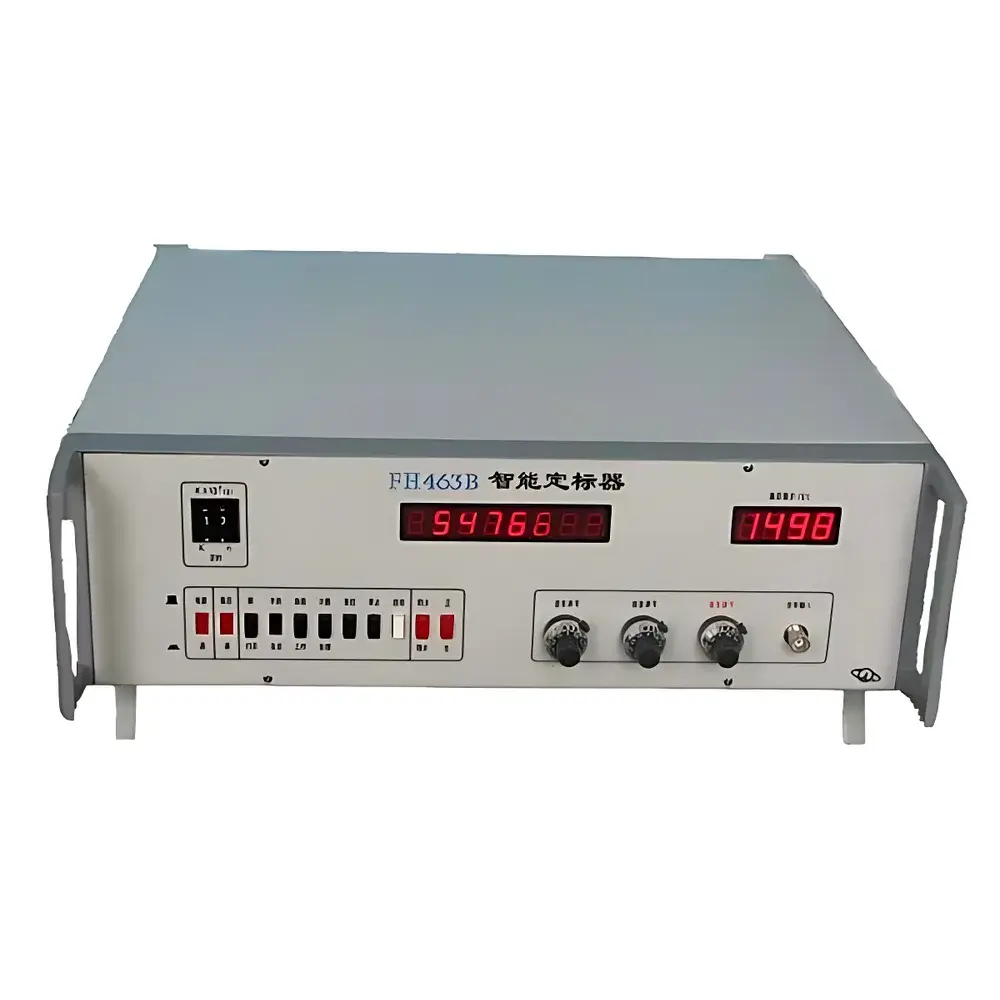
CNCS FH463B Intelligent Scalar Analyzer
| Brand | CNCS (China Nuclear Control System) |
|---|---|
| Origin | Beijing, China |
| Model | FH463B |
| Input Impedance | 1 kΩ |
| Input Coupling | AC |
| Pulse Width Range | 0.1 µs – 100 µs |
| Dead Time | ≤200 ns |
| Threshold Range | 0.1 V – 5.0 V (adjustable, linearity deviation ≤±0.5%) |
| Window Width Range | 0.1 V – 3.0 V |
| Polarity | Positive or Negative (input & HV output) |
| Timing Range | K×10ⁿ s (K = 1–9, n = 0–6) |
| Max Count Rate | ≤4.5 MHz |
| Max Count Capacity | 1.5×10⁷ − 1 |
| HV Output Range | ±50 V to ±1500 V (±10 V resolution, stability ≤±0.3% over 8 h after 30-min warm-up) |
| HV Current Limit | ≤600 µA |
| HV Ripple | ≤50 mV RMS |
| HV Temp. Coefficient | ≤±0.05 %/°C |
| Discriminator Temp. Coefficient | ≤±3 mV/°C |
| Low-Voltage Outputs | ±10 V, +5 V |
| Communication Interface | RS-232 (9600 baud, pinout: 3-TXD, 5-GND) |
| Operating Temperature | 5–40 °C |
| Relative Humidity | ≤90% at 30 °C |
| Power Supply | 220 V ±10%, 50 Hz |
Overview
The CNCS FH463B Intelligent Scalar Analyzer is a precision nuclear instrumentation module engineered for quantitative radiation detection and pulse-height spectroscopy in laboratory, educational, and field-deployable nuclear measurement applications. Built around a microprocessor-controlled single-channel analyzer (SCA) architecture, the FH463B functions as both a high-speed scalar and an energy-discriminating pulse processor. It operates on the principle of pulse-height analysis—comparing incoming analog pulses from radiation detectors (e.g., GM tubes, NaI(Tl) or plastic scintillators) against user-defined voltage thresholds and window widths—to isolate events within specific energy windows. This enables selective counting of α, β, γ, and X-ray emissions while rejecting noise and low-energy background. Its integrated high-voltage (HV) supply—with digitally monitored, continuously adjustable polarity and fine-resolution output—ensures optimal detector biasing across diverse probe configurations. Designed for traceable, repeatable measurements, the FH463B supports statistical evaluation of count data—including standard error calculation—and interfaces directly with PCs for long-term data logging and post-acquisition analysis.
Key Features
- Embedded 8-bit microcontroller for real-time pulse counting, statistical processing (mean, standard deviation), and automatic printout via built-in thermal printer
- Integrated single-channel analyzer with three operational modes: “Differential” (for basic pulse-height spectrum acquisition), “Narrow Window” (peak search and identification), and “Wide Window” (background suppression and gross count optimization)
- Programmable discrimination threshold (0.1–5.0 V, ≤±0.5% linearity) and adjustable window width (0.1–3.0 V), both temperature-compensated (≤±3 mV/°C)
- Ultra-low dead time of ≤200 ns and maximum input count rate up to 4.5 MHz—enabling accurate measurements under high-flux conditions
- Stabilized bipolar HV supply (±50 V to ±1500 V, ±10 V resolution) with ≤50 mV RMS ripple, ≤±0.3% 8-hour drift, and ≤±0.05 %/°C temperature coefficient
- Robust EMI/RFI mitigation circuitry, including active power-line filtering and shielded signal paths, ensuring reliable operation in electrically noisy environments
- RS-232 serial interface compliant with EIA/TIA-232-E standard (9600 baud, 8-N-1), supporting ASCII-based data streaming to Windows XP and later OS platforms using terminal emulation software
Sample Compatibility & Compliance
The FH463B is compatible with a broad range of radiation detectors requiring analog pulse output and external bias, including Geiger-Müller (GM) counters, organic and inorganic scintillation detectors (e.g., NaI(Tl), CsI(Tl), plastic), and proportional counters. Its AC-coupled 1 kΩ input impedance and configurable pulse polarity accommodate both positive- and negative-going signals from legacy and modern probes. While not certified to IEC 61000-4 electromagnetic compatibility standards out-of-box, its internal noise-reduction design aligns with general-purpose nuclear instrumentation best practices per IEC 60529 (IP20 enclosure rating) and ANSI N42.22-1995 guidelines for portable radiation survey instruments. Data integrity is maintained through deterministic timing control and hardware-based event validation—supporting GLP-aligned documentation when paired with validated PC-based acquisition software.
Software & Data Management
The FH463B does not include proprietary firmware-based software but delivers raw ASCII-formatted count data packets via RS-232, enabling integration with third-party analysis tools such as LabVIEW, Python (pySerial), MATLAB, or custom C/C++ applications. Each transmission includes timestamped counts, preset live time, real time, and HV status—facilitating synchronized multi-instrument experiments. The device supports manual or auto-triggered data dumps; no driver installation is required on Windows systems using standard COM port enumeration. For regulatory environments, users may implement audit-trail functionality externally by logging all serial I/O with metadata (operator ID, calibration date, environmental conditions). While the unit itself does not comply with FDA 21 CFR Part 11 electronic records requirements, its deterministic output format allows full traceability when deployed within validated workflows.
Applications
- Radiation safety monitoring in nuclear medicine departments, radiochemistry labs, and decommissioning sites
- Educational nuclear physics laboratories—teaching pulse processing, dead time correction, energy windowing, and statistical uncertainty propagation
- Environmental radioactivity screening (e.g., soil, water, air filters) using alpha/beta proportional counters or gamma scintillators
- Calibration verification of reference sources (²⁴¹Am, ¹³⁷Cs, ⁶⁰Co) via comparative counting and window-ratio analysis
- Low-background counting setups where wide-window mode reduces Compton continuum contribution in gamma spectrometry pre-screening
- Field-deployable contamination surveys when paired with ruggedized GM or ZnS(Ag) probes
FAQ
What detector types can be connected to the FH463B?
The FH463B accepts analog pulse outputs from GM tubes, scintillation detectors (NaI, plastic), and gas-filled proportional counters—provided they deliver TTL-compatible or NIM-level pulses with AC coupling and match the 1 kΩ input impedance.
Does the FH463B support USB connectivity?
No. It features only an RS-232 serial interface (DB9 male, pins 3 and 5 assigned to TXD and GND). A USB-to-RS232 adapter may be used with appropriate drivers.
Can the high-voltage output be monitored remotely?
Yes—the HV value is displayed numerically on the front-panel digital meter and transmitted in real time via RS-232 as part of each data packet.
Is energy calibration traceable to national standards?
The FH463B itself does not perform absolute energy calibration; however, its linear threshold response (≤±0.5%) permits relative calibration using certified check sources, with traceability established through end-user metrology procedures.
What is the recommended warm-up time before critical measurements?
A minimum 30-minute warm-up is specified to ensure HV and discriminator stability—consistent with IEC 61577-1 recommendations for nuclear instrumentation.



