
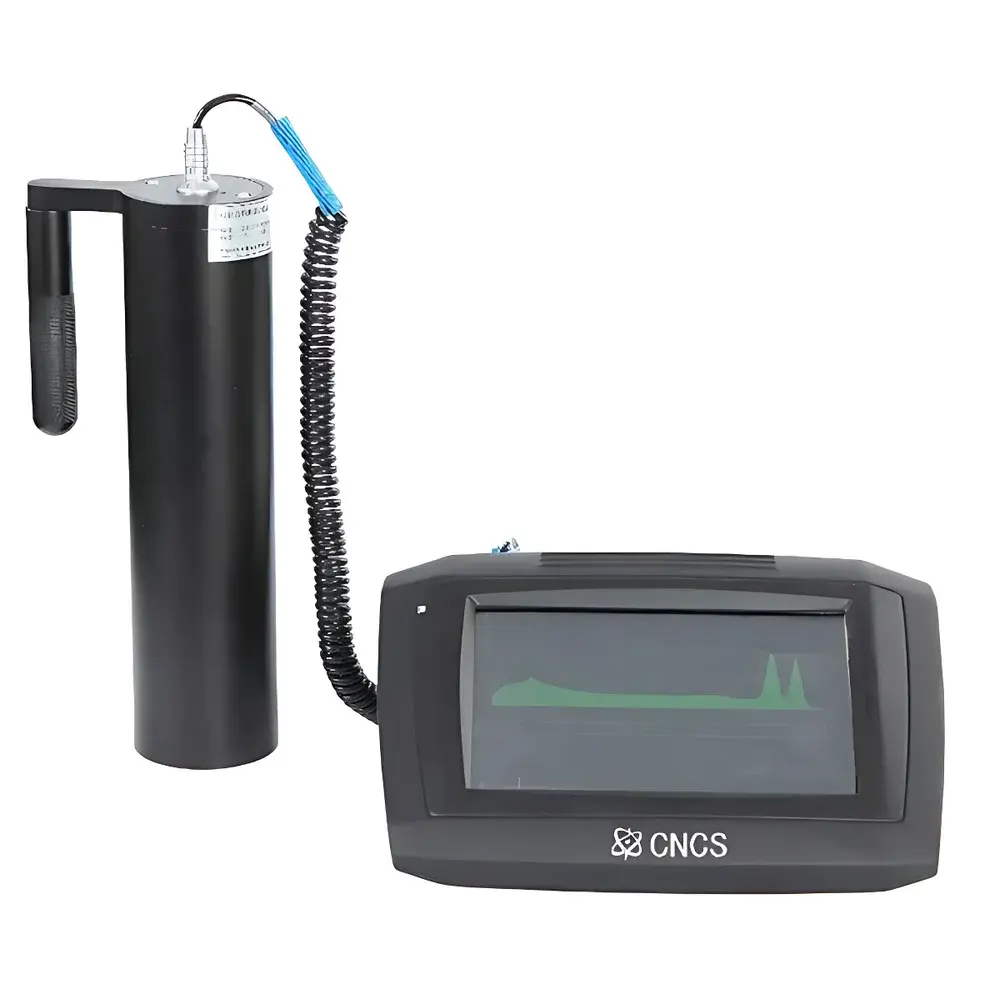
CNCS ZK1101 Portable Multi-Channel Gamma Spectrometer
| Brand | CNCS |
|---|---|
| Origin | Beijing, China |
| Manufacturer Type | Authorized Distributor |
| Product Category | Domestic |
| Model | ZK1101 Portable Multi-Channel Gamma Spectrometer |
| Instrument Type | Portable Gamma Spectrometer |
| Measurement Medium | Solid Samples |
| Detector Options | 2″ & 3″ NaI(Tl) Scintillation Detectors |
| Spectral Length | Software-Selectable (256, 512, 1024, or 2048 Channels) |
| Energy Resolution | ≤7% at 662 keV (¹³⁷Cs) |
| Channel Capacity | 2³²−1 (4,294,967,295 counts per channel) |
| Long-Term Stability | ≤1% channel shift over 8 h continuous operation |
| Battery Life | >8 h on integrated rechargeable Li-ion battery |
| Display | 7-inch capacitive touchscreen |
| Data Storage | MicroSD card (pre-installed, high-capacity) |
| Connectivity | USB 2.0 for PC data transfer |
| Software | Embedded real-time analysis firmware with lifetime free updates |
Overview
The CNCS ZK1101 Portable Multi-Channel Gamma Spectrometer is a field-deployable, self-contained gamma-ray spectroscopy system engineered for quantitative radionuclide identification and activity assessment in solid-phase environmental and industrial samples. Based on scintillation detection principles—specifically pulse-height analysis of gamma photons interacting with thallium-doped sodium iodide (NaI(Tl)) or cerium-doped lanthanum bromide (LaBr₃(Ce)) crystals—the ZK1101 converts incident radiation into measurable light pulses, which are digitized and histogrammed into energy-dispersive spectra. Unlike PC-dependent systems, the ZK1101 integrates a full-featured embedded spectrometry engine, enabling autonomous spectral acquisition, real-time peak search, nuclide library matching, and on-device ROI quantification without external computing hardware. Its design prioritizes operational robustness in uncontrolled field environments—including outdoor terrain, nuclear facility perimeters, waste storage yards, and construction material stockpiles—while maintaining metrological traceability to national calibration standards.
Key Features
- Self-contained operation: Fully functional gamma spectroscopy platform with onboard processing, eliminating dependency on laptops or tablets during measurement campaigns.
- Modular detector compatibility: Supports interchangeable 2″ and 3″ NaI(Tl) detectors for high-efficiency low-energy surveys, and 2″ LaBr₃(Ce) detectors for improved energy resolution and timing performance in mixed-field scenarios.
- Configurable spectral acquisition: Selectable channel depths (256, 512, 1024, or 2048) optimize memory usage and statistical precision based on counting rate and required energy resolution.
- Real-time spectral stabilization: Automatic gain stabilization (AGS) compensates for temperature-induced drift and photomultiplier tube aging, ensuring ≤1% channel shift over 8-hour continuous operation.
- Intuitive human-machine interface: 7-inch capacitive touchscreen with responsive GUI supports gesture-based zoom (linear/logarithmic), dynamic ROI definition, and touch-driven spectrum navigation.
- Dual-mode acquisition logic: User-selectable fixed-duration counting, total-count threshold termination, or continuous streaming—enabling adaptive deployment across variable background conditions.
- Comprehensive peak analytics: Automated calculation of centroid position, FWHM, net area, background-subtracted counts, peak asymmetry, and resolution metrics per defined ROI.
Sample Compatibility & Compliance
The ZK1101 is validated for direct measurement of solid matrices including soil cores, concrete fragments, rubble, building materials (e.g., granite, fly ash bricks), and sealed radioactive sources. It does not support liquid or gaseous sample geometries without ancillary shielding or collimation fixtures. All spectral processing algorithms comply with IEC 62327:2017 (Hand-held instruments for photon-emitting radionuclides) and align with ISO 20042:2019 (Radiation protection — Measurement of radioactivity in the environment — Gamma-ray spectrometry). The embedded nuclide identification engine references the IAEA NuDat 3.0 database and supports customizable user libraries compliant with national regulatory reporting formats (e.g., China’s GB 6566–2010 for building material radioactivity limits). Firmware architecture includes audit-trail logging per GLP/GMP-aligned workflows, with timestamped metadata for each acquired spectrum.
Software & Data Management
The ZK1101 runs a Linux-based real-time OS with proprietary spectrometry firmware supporting lossless spectrum export in standard IEEE 1252-compliant .cnf format and ASCII-compatible .txt exports. Data is stored on pre-installed industrial-grade MicroSD cards (≥32 GB), with automatic file rotation and cyclic overwrite protection. USB 2.0 interface enables direct connection to Windows/macOS/Linux hosts for batch transfer and offline analysis using third-party tools (e.g., Genie 2000, GammaVision, or custom Python-based spectral libraries). All firmware and analysis modules receive lifetime free updates via secure HTTPS download—no subscription model or license key required. Update packages undergo SHA-256 integrity verification and include versioned changelogs referencing NIST-traceable calibration adjustments and algorithm refinements.
Applications
- Environmental radiological monitoring: Rapid screening of surface soils, sediments, and vegetation for anthropogenic (¹³⁷Cs, ⁶⁰Co) and natural (⁴⁰K, ²²⁶Ra, ²³²Th series) radionuclides.
- Nuclear facility safeguards: In-situ verification of spent fuel cask integrity, decommissioning waste characterization, and routine perimeter contamination surveys.
- Construction material compliance: On-site verification of specific activity thresholds per GB 6566–2010 and EU Council Directive 2013/59/Euratom Annex XIII.
- Geological prospecting: Field mapping of uranium/thorium anomalies and potassium-rich mineral deposits using gross count and spectral shape analysis.
- Radiological emergency response: First-responder triage of unknown sources, rapid isotope discrimination, and dose-rate estimation from spectral shape parameters.
- Regulatory inspection: Mobile auditing of scrap metal yards, landfill sites, and recycling facilities for orphan source detection.
FAQ
Does the ZK1101 require external software to perform nuclide identification?
No. All spectral analysis—including peak search, energy calibration, library matching, and activity calculation—is executed onboard. External software is optional and used only for advanced reporting or archival integration.
Can the instrument operate while charging?
Yes. The ZK1101 supports concurrent operation and battery charging via its DC input port, with no interruption to data acquisition or display functionality.
Is the energy calibration traceable to national standards?
Yes. Factory calibration is performed using certified reference sources (¹³⁷Cs, ⁶⁰Co, ²²Na) traceable to CNIM (China National Institute of Metrology). Users may perform field recalibration using any two-point source method with documented reference energies.
What spectral formats are supported for export?
IEEE 1252 (.cnf), ASCII tab-delimited (.txt), and PNG snapshot exports (with scale bars and metadata overlays) are natively supported.
How is long-term stability verified during operation?
The AGS algorithm continuously monitors the 662 keV photopeak of background ¹³⁷Cs (or user-defined reference peak) and applies real-time DAC correction. Drift history is logged and viewable in the diagnostics menu.







