
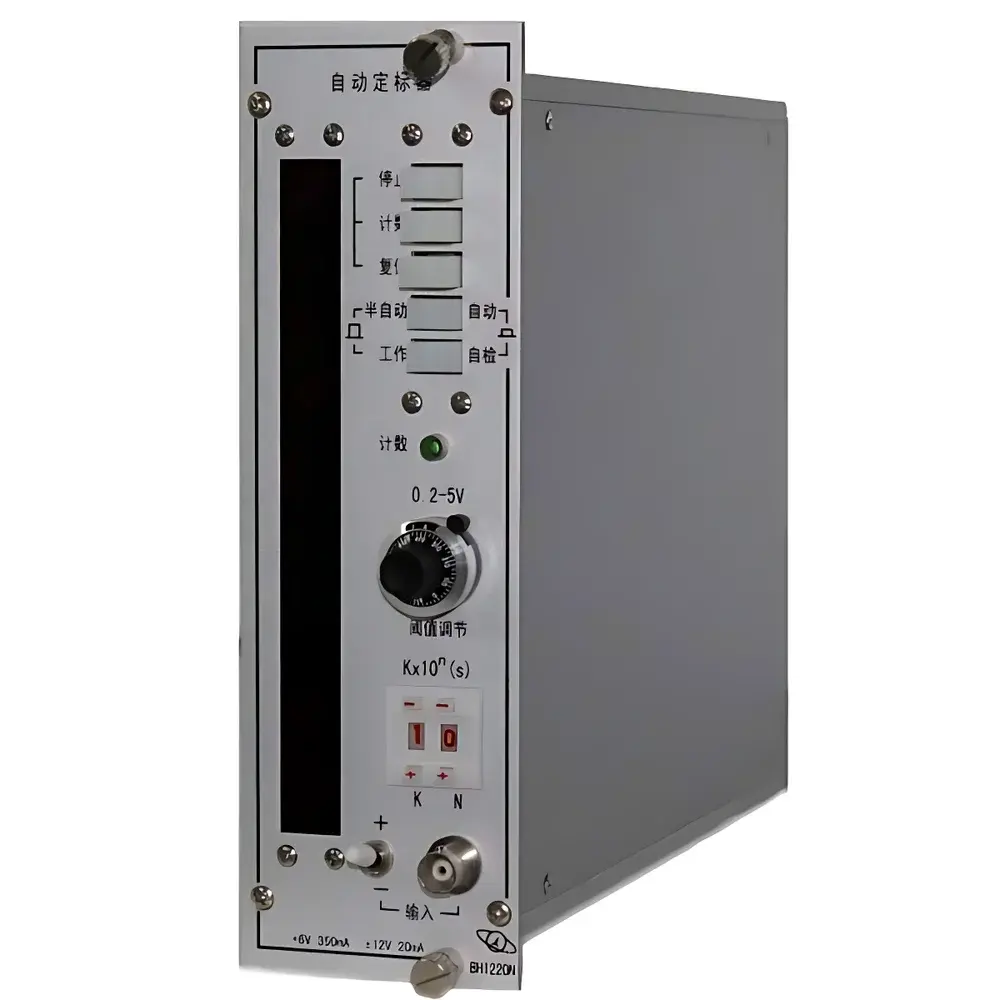
CNMC BH1220 Automatic Pulse Scalermeter
| Brand | CNMC (China Nuclear Control System) |
|---|---|
| Origin | Beijing, China |
| Model | BH1220 |
| Form Factor | 2-unit NIM Standard Module |
| Discrimination Threshold Range | 0.2–5 V |
| Input Polarity | Positive or Negative (Front & Rear Panel Inputs) |
| Input Pulse Width | 0.1–100 µs |
| Dead Time (Dual-Pulse Resolution) | ≤300 ns |
| Timing Range | K×10ⁿ (K = 1–9 |
| Maximum Counting Rate | ≥2 MHz |
| Overload Capacity of Discriminator | 5× nominal threshold |
| Count Capacity | 10⁷ – 1 |
| Max Instantaneous Power Consumption | 2.7 W |
| Operating Temperature | 0–50 °C |
| Relative Humidity | ≤90% at +40 °C |
Overview
The CNMC BH1220 Automatic Pulse Scalermeter is a precision nuclear instrumentation module engineered for high-fidelity pulse counting and spectral gating in radiation measurement systems. Designed as a direct successor to the FH1011A, it conforms strictly to the NIM (Nuclear Instrumentation Module) standard—2-unit width (8.7 cm × 22.1 cm), compatible with industry-standard NIM bins and power supplies (±12 V, ±24 V). Its core function is digital pulse scaling and time-gated accumulation of ionizing radiation events detected by scintillation, gas-filled, or semiconductor detectors. The device operates on the principle of fast pulse discrimination and synchronous digital counting, enabling accurate quantification of α, β, and γ radiation fluxes when paired with appropriate detector assemblies and high-voltage bias units. Unlike general-purpose digital counters, the BH1220 integrates hardware-level dead-time correction logic and threshold-stable discriminators optimized for low-jitter, high-repetition-rate nuclear signals—making it suitable for laboratory spectroscopy, environmental monitoring calibration chains, and QA/QC protocols in radiological health physics.
Key Features
- NIM-standard 2U form factor with front- and rear-panel BNC inputs for flexible system integration in modular counting setups
- Adjustable voltage discriminator (0.2–5 V) with 5× overdrive tolerance, ensuring stable pulse rejection under signal amplitude drift or EMI transients
- Sub-microsecond timing resolution: dual-pulse resolving time ≤300 ns supports accurate coincidence/anti-coincidence measurements
- Wide input pulse width compatibility (0.1–100 µs) accommodates both fast plastic scintillators and slower NaI(Tl) decay profiles
- Programmable timing base: K×10ⁿ (K = 1–9; n = 0–4) enables precise gate durations from 100 ms to 90,000 s—critical for background subtraction and decay curve fitting
- High-throughput counting architecture: ≥2 MHz maximum input rate with full 7-digit counter (10⁷ – 1), minimizing count loss in high-activity scenarios
- Thermally robust design: validated for continuous operation across 0–50 °C ambient range and up to 90% RH at +40 °C, meeting IEC 61000-6-2 immunity requirements
Sample Compatibility & Compliance
The BH1220 interfaces seamlessly with common radiation detection platforms—including α-spectrometry systems using PIPS detectors, β-counting gas-proportional counters, and γ-ray scintillation spectrometers equipped with PMT or SiPM readouts. It complies with NIM standard ANSI/IEEE 315-1975 for mechanical and electrical interface specifications. While not intrinsically certified for safety-critical applications, its design aligns with functional safety expectations outlined in IEC 61508 (SIL 1) for non-safety-related measurement subsystems. For regulated environments (e.g., ISO/IEC 17025-accredited labs), traceable calibration of the discriminator threshold and timing base is recommended using NIST-traceable pulse generators and reference sources (e.g., ²⁴¹Am, ⁹⁰Sr/⁹⁰Y, ¹³⁷Cs). The unit supports GLP-compliant workflows through external logging of preset timing parameters and manual counter reset timestamps.
Software & Data Management
The BH1220 operates as a standalone hardware scaler and does not include embedded firmware or USB/Ethernet connectivity. Data acquisition relies on external control via TTL-compatible gate and reset lines, allowing integration with programmable logic controllers (PLCs), data acquisition cards (e.g., National Instruments PXI), or custom LabVIEW/Python-based automation scripts. Users typically record counts per preset interval into CSV or HDF5 files for post-processing in MATLAB, ROOT, or ORTEC Maestro-compatible analysis suites. For auditability, timestamped metadata (start time, gate duration, threshold setting) must be logged externally—consistent with FDA 21 CFR Part 11 requirements when used in regulated pharmaceutical or environmental testing laboratories.
Applications
- Calibration and verification of alpha/beta/gamma survey meters and dose calibrators in nuclear medicine departments
- Background radiation monitoring in low-background laboratories (e.g., underground facilities or shielded caves)
- Half-life determination experiments in undergraduate and graduate nuclear physics teaching labs
- Quality assurance of radioactive source strength in industrial radiography and well-logging equipment maintenance
- Time-resolved activity measurements in radiochemical separation validation (e.g., generator elution kinetics)
- Multi-channel scaling in coincidence counting systems for positron annihilation lifetime spectroscopy (PALS)
FAQ
Is the BH1220 compatible with modern PC-based DAQ systems?
Yes—via TTL-level gate, reset, and busy signals; requires external digitization of count outputs using a counter/timer card or microcontroller interface.
Does it support automatic threshold optimization or energy calibration?
No—it is a fixed-threshold scaler only; energy calibration must be performed externally using reference sources and pulse-height analysis tools.
Can it be rack-mounted in non-NIM enclosures?
Only if the enclosure provides compliant ±12 V/±24 V NIM power distribution and mechanical alignment for 2U modules; adapter brackets may be required.
What is the typical uncertainty contribution of its timing base to activity measurements?
When calibrated against a GPS-disciplined oscillator, timing uncertainty is <10 ppm per hour; uncalibrated units contribute ±0.1% systematic error over 1-hour gates.
Is firmware upgrade capability available?
No—the BH1220 contains no programmable memory or field-upgradable components; all functionality is implemented in discrete logic and analog circuitry.





