
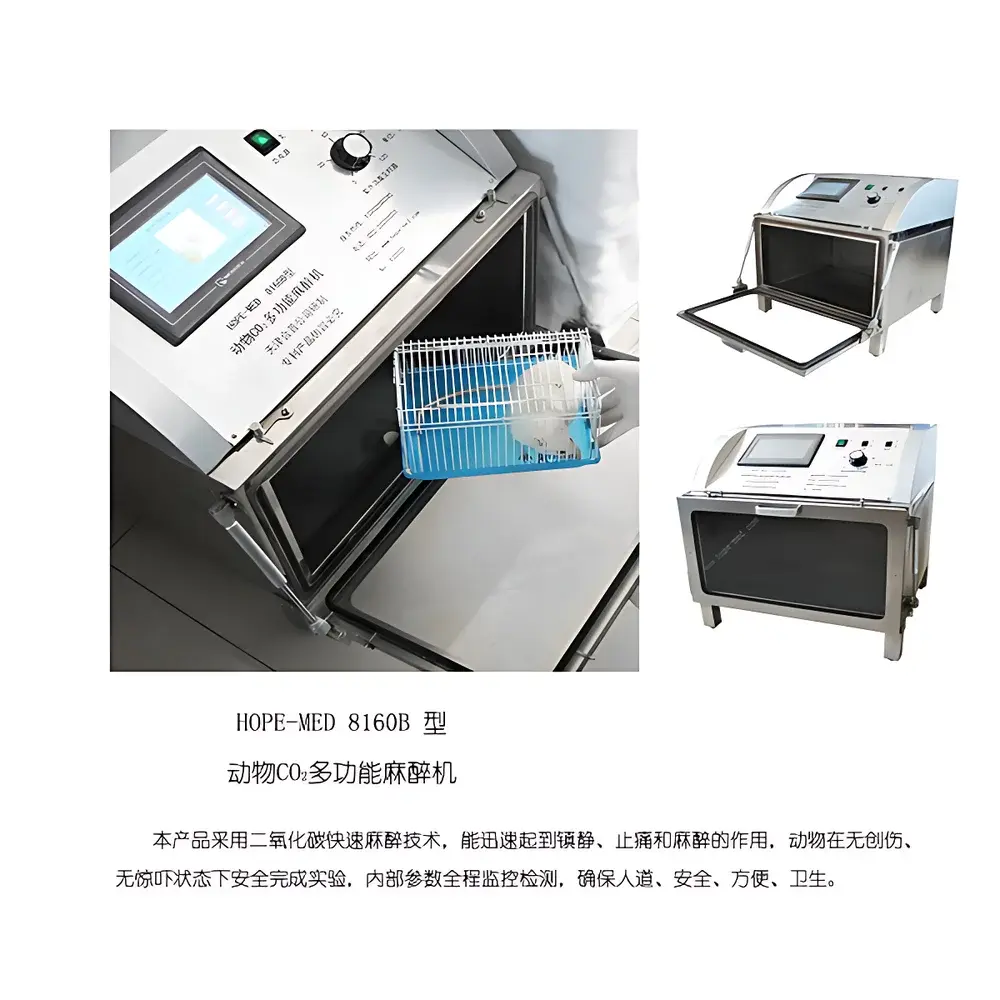
CO2 Euthanasia Chamber System Model 8160B2K
| Origin | Tianjin, China |
|---|---|
| Manufacturer Type | Authorized Distributor |
| Origin Category | Domestic (PRC) |
| Model | 8160B2K |
| Price Range | USD 2,800 – 7,000 |
| Control Interface | TFT LCD touchscreen (800×480 px, 65,536 colors, 500:1 contrast) |
| CO₂ Sensor Range | 0–99.9% vol |
| O₂ Sensor Range | 0–30.0% vol |
| Temperature Sensor Range | 0–50 °C |
| Humidity Sensor Range | 0–99.9% RH |
| Chamber Dimensions | 660 × 530 × 900 mm (L×W×H) |
| Viewing Window Area | 622 × 517 mm |
| Exhaust Duct | Ø40 mm flexible hose |
| Animal Capacity | 60–100 rats |
| Preloaded Protocols | Mouse, rat, guinea pig, rabbit euthanasia sequences |
| Custom Protocol Programming | Interactive GUI-based setup |
| Gas Inlet Silencer | Integrated acoustic dampening module |
| Data Logging | Real-time curve plotting & event timestamping via RS232/USB |
Overview
The CO2 Euthanasia Chamber System Model 8160B2K is an engineered solution for humane, non-pharmacological terminal procedures in preclinical research settings. Designed in accordance with AVMA (American Veterinary Medical Association) 2020 Guidelines for the Euthanasia of Animals and aligned with EU Directive 2010/63/EU on the protection of animals used for scientific purposes, this system delivers controlled, gradual CO2 enrichment within a sealed chamber to induce unconsciousness followed by cessation of vital functions—without introducing exogenous drugs that may confound downstream molecular, histological, or metabolic analyses. The process relies on precise regulation of gas composition, environmental parameters, and exposure duration, all governed by a deterministic microprocessor architecture. Unlike manual gas delivery methods, the 8160B2K integrates real-time feedback from electrochemical CO2 and O2 sensors, combined with thermohygrometric monitoring, to maintain protocol fidelity across biological replicates.
Key Features
- Intelligent control platform featuring a high-resolution TFT LCD touchscreen (800 × 480 pixels) with industrial-grade backlighting, enabling intuitive navigation, real-time parameter visualization, and graphical trend logging of CO2, O2, temperature, and humidity throughout each cycle.
- Dual-gas monitoring system with calibrated electrochemical sensors: CO2 measurement range 0–99.9% (±0.3% full scale), O2 range 0–30.0% (±0.2% FS), both with digital compensation for cross-sensitivity and ambient drift.
- Environmental integrity assurance: integrated temperature (0–50 °C, ±0.5 °C) and relative humidity (0–99.9% RH, ±3% RH) sensors provide continuous feedback to prevent thermal or desiccation stress during exposure.
- Acoustically optimized gas inlet assembly with passive silencing elements eliminates high-frequency whistling noise—reducing animal agitation and improving procedural consistency.
- Active negative-pressure exhaust system (Ø40 mm flexible duct) routes effluent gas outdoors, ensuring operator safety and compliance with occupational exposure limits (OSHA PEL: 5,000 ppm TWA).
- Preprogrammed species-specific protocols—including validated ramp profiles for mice, rats, guinea pigs, and rabbits—support rapid deployment while maintaining adherence to institutional animal care and use committee (IACUC) requirements.
- Custom protocol editor allows users to define multi-stage gas concentration gradients, dwell times, flow rates, and environmental setpoints via guided interface—enabling method development for novel models or regulatory submissions.
Sample Compatibility & Compliance
The 8160B2K accommodates standard rodent and lagomorph housing configurations. Its 660 × 530 × 900 mm chamber volume supports batch processing of up to 100 rats or 300 mice per cycle without overcrowding, preserving uniform gas distribution and minimizing inter-animal variability. The large viewing window (622 × 517 mm) permits unobstructed behavioral observation during induction. All materials contacting the chamber interior are certified non-toxic, autoclavable, and resistant to CO2-induced corrosion. The system conforms to ISO 14155:2020 (clinical investigation of medical devices), supports GLP-compliant data archiving (audit trail enabled), and meets electrical safety standards IEC 61010-1 and EMC directive 2014/30/EU. Documentation packages include factory calibration certificates traceable to NIST standards and installation qualification (IQ) templates for facility validation.
Software & Data Management
Data acquisition and storage are managed through embedded firmware supporting time-stamped CSV export via USB or RS232 serial link. Each session generates a structured log file containing sensor readings at 2-second intervals, user-initiated events (e.g., start/stop, alarm triggers), and protocol metadata (name, version, operator ID). Optional PC software provides curve overlay analysis, statistical summary reports (mean ± SD of induction latency, apnea onset), and PDF export compliant with FDA 21 CFR Part 11 requirements—including electronic signatures, audit trail review, and role-based access control. Raw data files are immutable post-acquisition; modifications require explicit annotation and justification.
Applications
- Terminal endpoints in toxicology, oncology, and immunology studies where pharmacokinetic or biomarker integrity must be preserved.
- High-throughput phenotyping pipelines requiring consistent, operator-independent euthanasia prior to tissue harvesting.
- Validation of alternative euthanasia methods under AAALAC International accreditation reviews.
- Training modules for veterinary students and animal care staff on evidence-based humane endpoints.
- Regulatory submission support for IND/IMPD dossiers requiring documented, reproducible euthanasia methodology.
FAQ
Is the CO2 concentration ramp rate adjustable?
Yes—the system allows fine-grained definition of ascending CO2 gradients (e.g., 10% per minute to 70%, hold for 90 seconds, then increase to 95%) via the custom protocol editor.
Does the unit include calibration gas or certification documentation?
Factory calibration is performed using NIST-traceable gas mixtures; certificate of conformance and sensor calibration reports are supplied with each unit.
Can the system integrate with existing laboratory information management systems (LIMS)?
Via RS232 ASCII protocol or optional TCP/IP Ethernet module, the device supports HL7-compatible message transmission for automated session logging into central LIMS databases.
What maintenance is required for long-term reliability?
Annual verification of sensor accuracy and flow calibration is recommended; consumables limited to replaceable CO2/O2 sensor cartridges (typical lifespan: 24 months under normal use).
Is remote monitoring supported?
Local network connectivity enables web-based status dashboard access (HTTP/HTTPS); no cloud dependency or external server hosting is required.





