
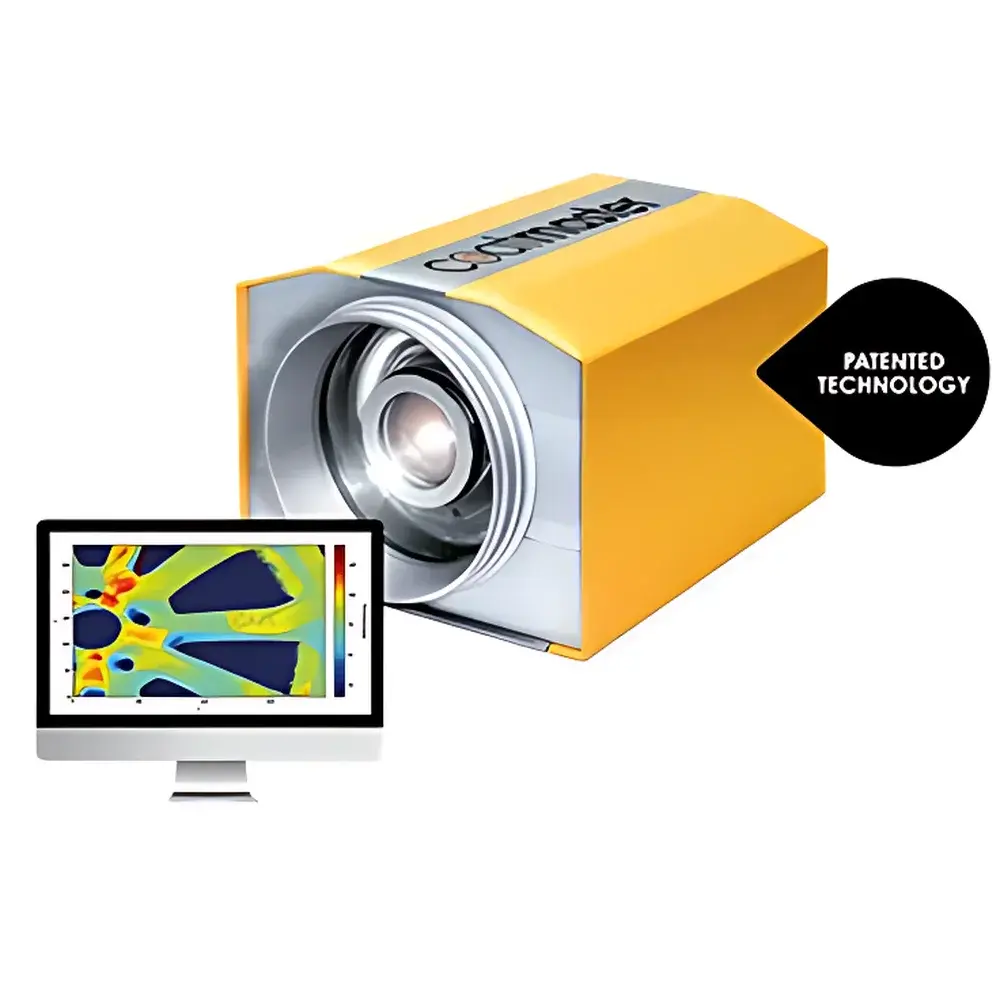
Coatmaster 3D Non-Contact Online Thickness Gauge for Colored Automotive Paint Coatings
| Brand | Coatmaster |
|---|---|
| Origin | Switzerland |
| Model | 3D |
| Measurement Principle | Pulsed Photothermal Infrared Thermography |
| Non-Contact Distance | ≥100 mm |
| Tolerance to Standoff Variation | ±10 mm |
| Maximum Tilt Angle Tolerance | ±45° |
| Surface Geometry Compatibility | Complex Curved & Freeform Surfaces (Including Edges, Recesses, and Contours) |
| Color Independence | Full Spectral Neutrality (Valid for All Pigmented Coatings, Including White, Metallic, and Pearlescent Finishes) |
| Spot Size | 1–10 mm Diameter |
| Thickness Range | 1–1000 µm (Dry Film) |
| Single-Measurement Duration | <300 ms |
| Conveyor-Compatible Dynamic Measurement | Yes |
| Data Output Interface | SPS, EtherNet/IP, OPC UA |
| Compliance | Designed for Integration into ISO/TS 16949 & IATF 16949 Compliant Automotive Paint Lines |
| Software Certification | Audit-Ready Data Logging per FDA 21 CFR Part 11 & GLP/GMP Traceability Requirements |
Overview
The Coatmaster 3D is a non-contact, real-time online thickness gauge engineered specifically for the precise, in-line measurement of colored automotive paint coatings on dynamically moving car bodies. Unlike conventional eddy-current or magnetic induction gauges—which are limited to metallic substrates and fail on non-conductive primers or topcoats—the Coatmaster 3D employs pulsed photothermal infrared thermography (PPIT). In this method, a calibrated, short-duration light pulse uniformly heats the coating surface; an integrated high-speed infrared detector captures the transient surface temperature decay at standoff distances ≥100 mm. Because thermal diffusion time through the coating layer is directly correlated with its thickness and thermal diffusivity, proprietary physics-based algorithms reconstruct dry-film thickness from the temporal profile of surface cooling—without physical contact, surface preparation, or color calibration. This principle enables robust, absolute thickness quantification across fully cured, semi-cured, and even tack-free wet-film stages—making it uniquely suitable for early-process feedback control in automotive OEM paint shops.
Key Features
- True non-contact operation at ≥100 mm working distance—eliminates risk of coating damage, contamination, or mechanical interference with robotic spray paths
- Insensitivity to surface curvature, tilt (±45°), vibration, and positional drift—validated on A-pillars, door sills, fenders, and engine hoods with compound radii down to 50 mm
- Color-agnostic performance: no recalibration required for white, black, metallic, or effect pigments—achieved via broadband optical excitation and spectral-insensitive thermal detection
- High-speed single-point measurement (<300 ms) synchronized to conveyor motion—enables full-body scanning at line speeds up to 8 m/min
- Modular 3D mapping capability: configurable field-of-view (1–10 mm spot), adjustable spatial resolution (down to 0.1 mm/pixel), and seamless stitching of multi-sensor arrays
- Industrial-grade enclosure rated IP65, EMI-hardened for integration adjacent to high-voltage electrostatic spray booths and robot controllers
Sample Compatibility & Compliance
The Coatmaster 3D is validated for use on steel, aluminum, and galvanized substrates coated with cathodic electrophoretic primer (E-coat), PVC sealants, mid-coats, basecoats (including waterborne acrylics and solvent-borne urethanes), and clearcoats. It complies with automotive OEM process validation requirements per VDA 240, GMW14872, and Ford WSS-M2P175-B2. All thickness data records include embedded metadata: timestamp, sensor ID, standoff distance, ambient temperature, and measurement confidence index—ensuring full traceability for IATF 16949 internal audits and Tier-1 supplier PPAP submissions. The system supports electronic signature workflows aligned with FDA 21 CFR Part 11 and EU Annex 11 for regulated quality documentation.
Software & Data Management
Coatmaster Control Suite provides real-time visualization of thickness distribution maps overlaid on CAD-matched vehicle body geometry. Statistical process control (SPC) dashboards display Cpk, Ppk, and trend charts per panel zone (e.g., hood center vs. edge). Raw thermal decay curves, thickness histograms, and CSV/Excel exports are automatically archived with SHA-256 hash integrity verification. Integration with MES platforms (e.g., Siemens Opcenter, Rockwell FactoryTalk) is achieved via native SPS, EtherNet/IP, and OPC UA servers—enabling closed-loop feedback to robotic spray parameters (e.g., gun distance, fluid pressure, fan width) without custom middleware.
Applications
- Real-time monitoring of E-coat film build uniformity during curing oven entry—preventing underfilm defects and reducing rework
- Basecoat thickness control on curved surfaces where conventional probes cannot maintain consistent angle or pressure
- Clearcoat optimization for gloss consistency and UV resistance—especially critical for high-gloss black and pearlescent finishes
- Statistical analysis of thickness variation across production batches for APQP Stage 3 validation
- Root-cause analysis of orange peel, sagging, or edge thinning using spatially resolved thickness gradients
- Validation of automated spray robot path accuracy via post-application thickness deviation heatmaps
FAQ
Does the Coatmaster 3D require calibration against reference standards for each new color or substrate?
No. Its photothermal principle is inherently independent of optical reflectance and absorptance—calibration is performed once per coating chemistry family (e.g., acrylic urethane basecoat) using certified NIST-traceable thickness standards, not per-color.
Can it measure over masking tapes or temporary protective films?
Yes—provided the tape thickness is <50 µm and thermally conductive enough to allow detectable surface temperature modulation; typical PET-based masking tapes meet this criterion.
Is the system compatible with existing PLC-controlled paint lines?
Yes. It supports deterministic cyclic data exchange via SPS (Siemens S7-compatible) and EtherNet/IP, with sub-10 ms cycle times for integration into high-speed motion control loops.
How is measurement uncertainty quantified and reported?
Each measurement includes a confidence metric derived from signal-to-noise ratio, thermal decay curve fit residual, and standoff distance stability—reported as expanded uncertainty (k=2) per ISO/IEC 17025 guidelines.
What maintenance is required for long-term operational reliability?
Annual factory recalibration of the IR detector and optical alignment; no consumables or user-serviceable parts. The LED excitation source has >20,000 hours MTBF.



