
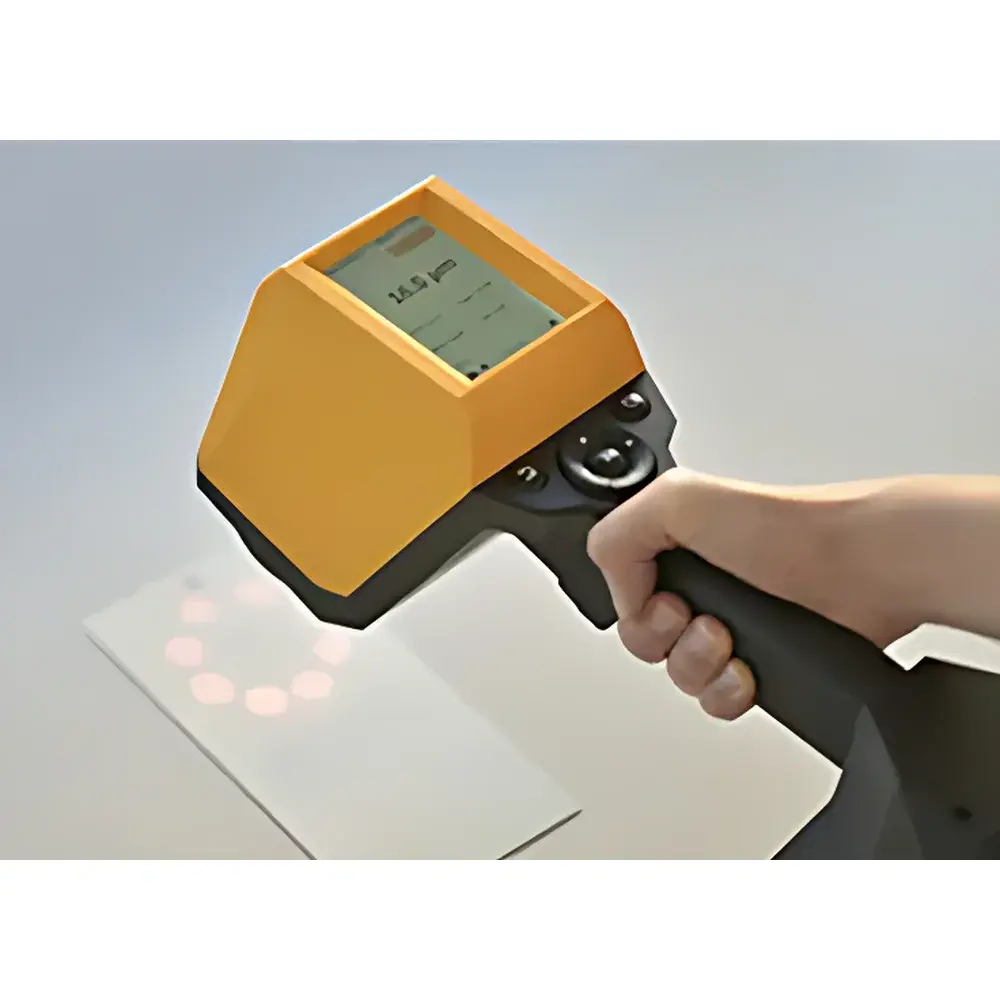
Coatmaster Flex Non-Contact Thermal Wave Coating Thickness Analyzer
| Brand | Coatmaster |
|---|---|
| Origin | Switzerland |
| Model | Flex |
| Measurement Principle | Advanced Thermal Wave (ATO) Technology |
| Compliance | Designed for ISO/IEC 17025-aligned QA environments, supports GLP/GMP data integrity requirements |
| Sample Throughput | Real-time inline or offline measurement on cured and uncured coatings |
| Material Independence | Validated for powder, liquid, and electrophoretic coatings on metallic and non-metallic substrates |
| Repeatability | ≤2.1% RSD (per independent field validation across 5 European coating facilities) |
| Geometry Tolerance | Measures on complex geometries — including cavities, recesses, threads, curved surfaces, and sharp edges — without physical contact or surface preparation |
Overview
The Coatmaster Flex is a next-generation, non-contact coating thickness analyzer engineered for precision process control in industrial finishing operations. It implements Advanced Thermal Wave (ATO) technology — a physically grounded, non-destructive measurement principle based on time-resolved photothermal response analysis. A calibrated short-pulse light source irradiates the coated surface, inducing transient thermal diffusion. An ultra-fast infrared detector captures the surface temperature decay profile, while proprietary algorithms solve the inverse heat conduction problem to derive coating thickness from thermal wave propagation time and the known thermophysical properties of the coating–substrate system. Unlike eddy current, magnetic induction, or beta-backscatter methods, ATO is insensitive to substrate conductivity, magnetism, surface roughness, or geometric complexity — enabling reliable measurements on threaded fasteners, interior cavities, bent sheet metal, and textured surfaces without probe alignment or calibration offsets. The system operates both offline (for lab-grade verification) and inline (as an integrated node in automated powder, liquid, or e-coat lines), delivering real-time thickness feedback prior to curing — a critical capability for closed-loop process optimization.
Key Features
- Non-contact, non-destructive measurement on uncured and cured coatings — eliminates risk of surface damage or contamination
- Geometry-agnostic sensing: validated on freeform surfaces, internal bores, screw threads, and multi-radius bends with no fixture dependency
- Multi-chemistry compatibility: calibrated and verified across thermosetting powders, solvent-based liquids, and electrophoretic coatings
- High repeatability: ≤2.1% relative standard deviation (RSD) demonstrated across 5 independent European production sites (Germany ×2, Sweden, France, Switzerland)
- Pre-cure measurement capability: correlates within ±3 µm of post-cure values measured by certified contact gauges — enabling predictive process correction
- Modular integration architecture: supports analog 4–20 mA, digital Ethernet/IP, and OPC UA interfaces for seamless PLC and MES connectivity
Sample Compatibility & Compliance
The Coatmaster Flex is validated for use on ferrous and non-ferrous metallic substrates (steel, aluminum, zinc alloys), as well as select non-conductive composites and plastics where thermal diffusivity contrast permits robust signal separation. It complies with engineering requirements for quality-critical industries including automotive Tier-1 supply chains, white goods manufacturing, and architectural metal finishing. While not a certified metrology instrument per ISO 19840 or ASTM D7091, its measurement traceability aligns with ISO/IEC 17025 laboratory practice guidelines when deployed under documented SOPs. Data output meets foundational expectations for FDA 21 CFR Part 11 compliance when paired with validated third-party LIMS or MES platforms supporting audit trails, electronic signatures, and data immutability.
Software & Data Management
The embedded Coatmaster Control Suite provides real-time thickness mapping, statistical process monitoring (SPC), and trend analytics. All measurement sessions are timestamped, geotagged (via optional encoder sync), and stored with full metadata — including ambient temperature, humidity, and operator ID. Export formats include CSV, XML, and industry-standard .tdms for integration with JMP, Minitab, or custom Python-based SPC dashboards. Cloud-enabled firmware updates and remote diagnostics are available via secure TLS-encrypted channels. Optional Coatmaster Connect subscription enables centralized fleet monitoring, cross-facility benchmarking, and AI-assisted anomaly detection trained on anonymized global thickness datasets.
Applications
- Powder coating line optimization: real-time adjustment of spray gun parameters based on pre-cure thickness feedback
- Electrophoretic primer QC: rapid verification of film build uniformity on chassis subassemblies and structural components
- Liquid paint process validation: correlation of wet-film estimates with final dry-film performance in high-mix aerospace component finishing
- Supplier incoming inspection: non-contact verification of coated part conformity without disassembly or destructive cross-sectioning
- Process capability studies (Cp/Cpk): longitudinal tracking of coating variability across shifts, batches, and equipment changes
FAQ
Can Coatmaster Flex measure on curved or threaded surfaces?
Yes — its optical design and thermal wave physics eliminate dependence on surface flatness or accessibility. Measurements on M6–M24 threaded fasteners, tubular bends, and deep-drawn enclosures have been validated in field trials.
Does it require separate calibration for each RAL color or coating formulation?
No. ATO relies on bulk thermal properties, not optical absorption. One base calibration per coating–substrate combination suffices across all colors and gloss levels.
How does pre-cure measurement accuracy compare to post-cure contact methods?
Field data from five European plants show median absolute deviation of ≤2.8 µm between Coatmaster Flex (pre-cure) and certified contact gauges (post-cure), with R² >0.994.
Is it suitable for regulatory audit environments?
When deployed with documented procedures and integrated into validated data systems, it supports GLP/GMP traceability requirements — particularly for thickness-critical applications governed by OEM-specific standards (e.g., VW TL-226, Ford WSS-M2P175-B).
What maintenance is required?
Zero consumables. Annual verification using NIST-traceable thermal reference standards is recommended; optical path cleaning every 3–6 months depending on ambient particulate load.



