
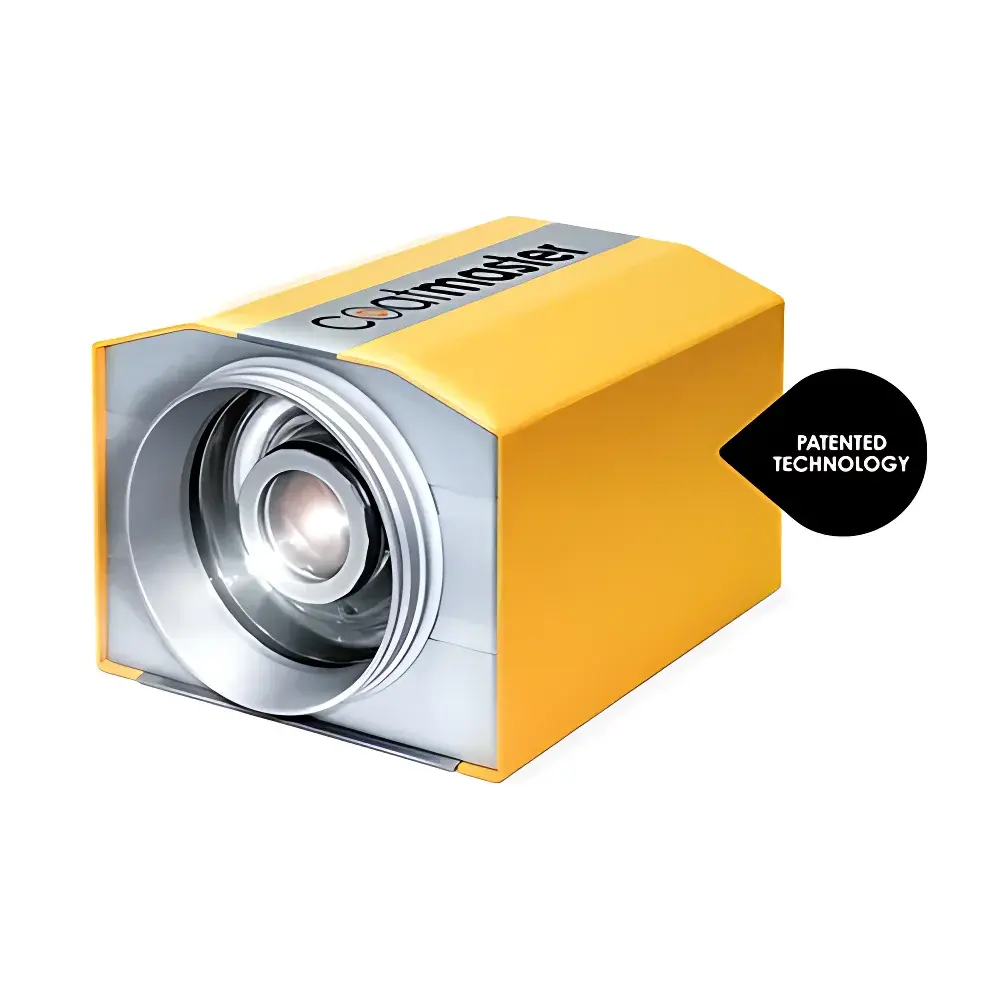
Coatmaster FLEX/INLINE/3D Online Non-Contact Thermal-Optical Thickness Gauge for Enamel Coatings
| Brand | Coatmaster |
|---|---|
| Origin | Switzerland |
| Model Series | FLEX, INLINE, 3D |
| Measurement Principle | Active Thermographic Optical (ATO) |
| Compliance | Designed for ISO/IEC 17025-aligned QC environments |
| Software | Coatmaster Control Suite with audit trail, data export (CSV, XML), and real-time SPC integration |
| Output | Real-time thickness values (µm), temperature decay curves, statistical process reports |
| Interface | Ethernet/IP, OPC UA, analog 4–20 mA optional |
| Mounting | Flexible integration into conveyor lines, robotic arms, or fixed gantries |
| Sample State | Wet, uncured, powder, or partially sintered enamel coatings |
Overview
The Coatmaster FLEX/INLINE/3D Online Non-Contact Thermal-Optical Thickness Gauge is an industrial-grade, real-time measurement system engineered for in-line quantification of enamel (vitreous enamel) and other functional coatings during production. Unlike conventional eddy-current or magnetic induction gauges—which require fully cured, conductive substrates—the Coatmaster employs Active Thermographic Optical (ATO) technology to measure coating thickness on wet, uncured, or semi-sintered surfaces without physical contact or surface preparation. The system operates on the principle of photothermal transient thermography: a computer-controlled pulsed light source delivers controlled thermal excitation to the coating surface; a high-speed infrared detector captures the resulting surface temperature decay profile at microsecond resolution; and proprietary algorithms reconstruct coating thickness from the thermal diffusion time constant, which correlates directly with thermal diffusivity and layer geometry. This physics-based approach enables traceable, non-destructive measurement of enamel layers on steel, cast iron, or aluminum substrates—regardless of curvature, edge geometry, or internal cavity access—making it uniquely suited for continuous enamel lining processes used in domestic appliance manufacturing (e.g., ovens, cooktops, baking trays).
Key Features
- Non-contact, non-destructive ATO measurement of wet, uncured, and powder-based enamel coatings—no calibration required per substrate geometry
- Real-time thickness output at up to 10 Hz sampling rate, synchronized with line speed and PLC triggers
- Multi-model platform architecture: FLEX (modular benchtop integration), INLINE (conveyor-integrated), and 3D (multi-axis robotic scanning for complex geometries)
- Robust optical design with industrial-grade IR optics, ambient-light rejection filters, and temperature-stabilized detector housing
- Integrated thermal reference compensation for ambient drift, humidity, and substrate thermal mass variation
- Compliance-ready software architecture supporting 21 CFR Part 11 audit trails, electronic signatures, and configurable user roles
Sample Compatibility & Compliance
The Coatmaster system is validated for enamel coatings applied via electrostatic powder spraying, dip coating, or flow coating onto ferrous and non-ferrous substrates. It accommodates curved surfaces (R ≥ 15 mm), internal cavities (via fiber-coupled probe options), sharp edges, and multi-radius geometries common in oven cavity panels and bakeware. Measurement range spans 50–800 µm with repeatability ≤ ±2 µm (k=2) under controlled line conditions. The system meets requirements for GLP-compliant quality control environments and supports documentation workflows aligned with ISO 9001:2015, IATF 16949, and EN ISO 2360 (non-magnetic coating thickness on non-conductive substrates). No sample preparation, masking, or destructive cross-sectioning is required—eliminating operator bias and enabling 100% in-process inspection.
Software & Data Management
Coatmaster Control Suite provides full-cycle data governance: real-time SPC dashboards (X-bar/R, Cpk, trend analysis), automated pass/fail flagging against user-defined tolerances, and timestamped archival of raw thermal decay curves, processed thickness maps, and environmental metadata. All measurement sessions are logged with operator ID, shift, job number, and equipment configuration. Data export conforms to ASTM E2918 and ISO/IEC 17025 reporting standards—including uncertainty budgets derived from thermal model sensitivity analysis. Integration with MES/SCADA systems is supported via OPC UA, Modbus TCP, and RESTful API interfaces. Audit logs retain immutable records of parameter changes, user logins, and report generation events—fully compliant with FDA 21 CFR Part 11 requirements for electronic records and signatures.
Applications
- Real-time monitoring of enamel powder deposition on oven liners and cooking surfaces prior to firing—enabling immediate correction of spray gun parameters, fluidization pressure, or electrostatic voltage
- Quantitative validation of coating uniformity across large-area panels (e.g., 1200 × 800 mm oven doors) without mechanical scanning artifacts
- Process qualification and capability studies for new enamel formulations or substrate pre-treatment protocols
- Root cause analysis of delamination, pinholing, or orange peel defects linked to sub-threshold wet-film thickness variation
- Supporting Industry 4.0 initiatives through closed-loop feedback to coating robots and adaptive process controllers
FAQ
How does ATO differ from traditional eddy-current or magnetic induction methods?
ATO measures thermal diffusion dynamics rather than electromagnetic coupling—making it applicable to non-conductive, non-magnetic coatings like enamel on steel, without requiring substrate conductivity or magnetic permeability.
Can the system measure on curved or recessed surfaces?
Yes. Optical line-of-sight design combined with adjustable focus and wide-angle IR detection enables accurate measurement on radii down to 15 mm, interior walls, and stepped features without repositioning.
Is calibration required for each part geometry or coating type?
No. The ATO algorithm uses first-principles thermal modeling and requires only initial material property inputs (coating thermal diffusivity, substrate emissivity); no empirical calibration curves or master parts are needed.
What level of integration is supported with existing factory automation?
Full PLC-level integration via Ethernet/IP and PROFINET; analog 4–20 mA output for legacy controllers; digital outputs for reject signaling and alarm triggering.
How is measurement uncertainty quantified and documented?
Uncertainty budgets are generated per measurement session using Monte Carlo simulation of thermal model parameters—reported alongside thickness values in CSV/XML exports and archived with full traceability.



