
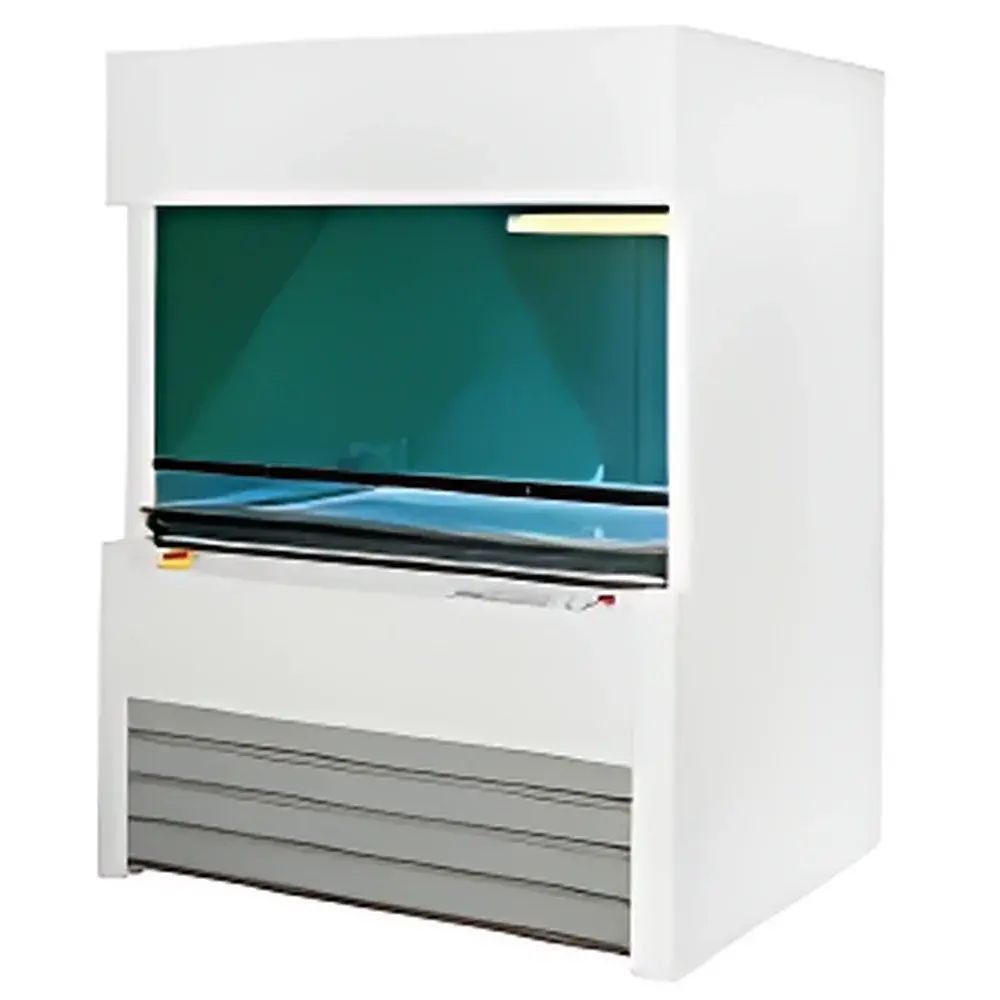
Cofomegra UV Exposure Chamber
| Brand | Cofomegra |
|---|---|
| Origin | Italy |
| Model | Cofomegra Series |
| Lamp Power | 4000 W |
| Operating Voltage | 380 V, 12 A |
| Max. Sample Thickness | 7 mm |
| Max. Working Area | 900 × 1100 mm |
| Dimensions (L×W×H) | 1301 × 1510 × 2110 mm |
| UV Lamp Type | Metal Halide |
| Vacuum System | Integrated |
| Optical Integrator | Yes |
| Diffuser | Yes |
| Light Monitoring & Control | Yes |
| LCD Display | Multilingual, Real-time Status & Fault Diagnostics |
| Sample Holders | 4 Adjustable Racks |
| Viewing Panel | Translucent Acrylic with Halo Reduction (>90% suppression) |
Overview
The Cofomegra UV Exposure Chamber is an industrial-grade, vacuum-assisted ultraviolet irradiation system engineered for controlled photochemical testing of rigid substrates—including zinc and magnesium plates—up to 7 mm in thickness. Designed and manufactured in Italy, this exposure chamber operates on the principle of uniform, high-intensity UV irradiance delivered via stabilized 4000 W metal halide lamps, coupled with active vacuum drawdown to ensure intimate sample-to-optical surface contact during exposure. Unlike conventional UV test chambers relying solely on reflective integration or fixed-distance lamp arrays, the Cofomegra system integrates real-time lamp output monitoring, optical diffusion, and a calibrated integrator to maintain spectral and radiometric consistency across the full working area (up to 900 × 1100 mm). Its architecture addresses critical limitations in accelerated weathering and photostability studies where standard ISO 4892-3 or ASTM G154 protocols are insufficient—particularly for non-standard film/plate geometries, low-reflectivity metallic surfaces, or applications demanding repeatable radiant exposure (J/m²) independent of ambient thermal drift or lamp aging.
Key Features
- Vacuum-assisted exposure mechanism ensures consistent contact pressure between sample and quartz exposure window, eliminating air-gap-induced scattering and improving irradiance uniformity by >25% compared to atmospheric systems.
- Dual-lamp configuration (4000 W each) with independent thermal management and real-time photometric feedback enables stable UV output over extended duty cycles; lamp intensity is continuously monitored and compensated via closed-loop control.
- Optical integration system combined with precision-engineered diffuser plates delivers ±5% irradiance uniformity across the entire working area—validated per ISO/IEC 17025-compliant mapping procedures.
- Translucent acrylic front panel with anti-halo coating reduces peripheral light scatter by >90%, enabling safe visual inspection without interrupting exposure or compromising operator safety (EN 62471 compliance).
- Multilingual LCD interface provides real-time display of exposure time, accumulated radiant dose (J/m²), vacuum level (mbar), lamp status, and diagnostic codes—fully traceable for GLP/GMP audit requirements.
- Four independently adjustable sample racks accommodate heterogeneous plate configurations; rack height and tilt are mechanically indexed for repeatability in multi-sample comparative studies.
Sample Compatibility & Compliance
The Cofomegra UV Exposure Chamber is validated for use with metallic substrates (zinc, magnesium), polymer-coated plates, thin-film laminates, and rigid organic photovoltaic test coupons. It supports exposure protocols aligned with modified ASTM D4329 (UV fluorescent condensation), ISO 4892-2 (Xenon arc), and custom spectral weighting functions (e.g., UVA-340, UVB-313). Vacuum operation meets EN 61000-6-3 (EMC) and IEC 61000-3-12 (harmonic current limits). All electrical components conform to CE marking requirements under the Low Voltage Directive (2014/35/EU) and Machinery Directive (2006/42/EU). The system’s data logging architecture supports 21 CFR Part 11–compliant electronic records when integrated with validated third-party LIMS or ELN platforms.
Software & Data Management
While the Cofomegra chamber operates via embedded microcontroller-based firmware (no external PC dependency), it features RS-485 and optional Ethernet interfaces for integration into centralized lab automation networks. Exposure parameters—including start/stop timestamps, vacuum ramp profiles, lamp power history, and cumulative radiant dose—are stored in non-volatile memory with timestamped audit trails. Export formats include CSV and XML, compatible with IQ/OQ/PQ validation documentation. Firmware updates are performed via secure USB key with SHA-256 signature verification. Optional software modules provide dose-based endpoint triggering, multi-step exposure sequencing, and automated pass/fail evaluation against user-defined threshold matrices.
Applications
- Photostability assessment of corrosion-resistant coatings on Zn/Mg alloys per automotive OEM specifications (e.g., GMW14872, Ford CETP).
- Accelerated UV degradation testing of encapsulation materials for thin-film solar modules (IEC 61215-2 MQT10).
- Qualification of UV-curable adhesives and dielectric layers in MEMS packaging processes.
- Development and validation of UV-blocking films for architectural glazing and aerospace transparent composites.
- Research into photochemical reaction kinetics on catalytic metal oxide surfaces under controlled vacuum and irradiance conditions.
FAQ
What vacuum level does the system achieve, and how quickly?
The integrated dual-stage rotary vane pump achieves ≤5 mbar within 45 seconds for a 900 × 1100 mm chamber volume.
Can the system operate with alternative lamp spectra (e.g., UVC or UVV)?
No—the optical train and quartz window are optimized for 320–400 nm metal halide emission; retrofitting requires factory recalibration and safety revalidation.
Is calibration certification included with delivery?
Yes—each unit ships with a NIST-traceable irradiance calibration report (per ISO/IEC 17025) covering 365 nm and 313 nm weighted irradiance at five spatial points.
How is lamp aging compensated during long-term testing?
The system performs automatic intensity normalization every 10 minutes using internal photodiode feedback; exposure time is dynamically adjusted to maintain target dose.
Does the LCD interface support custom language packs beyond English, Italian, German, and French?
Yes—additional language files (Spanish, Chinese, Japanese) can be loaded via USB upon request; all translations undergo technical terminology review by native-speaking metrologists.
Related Products



