
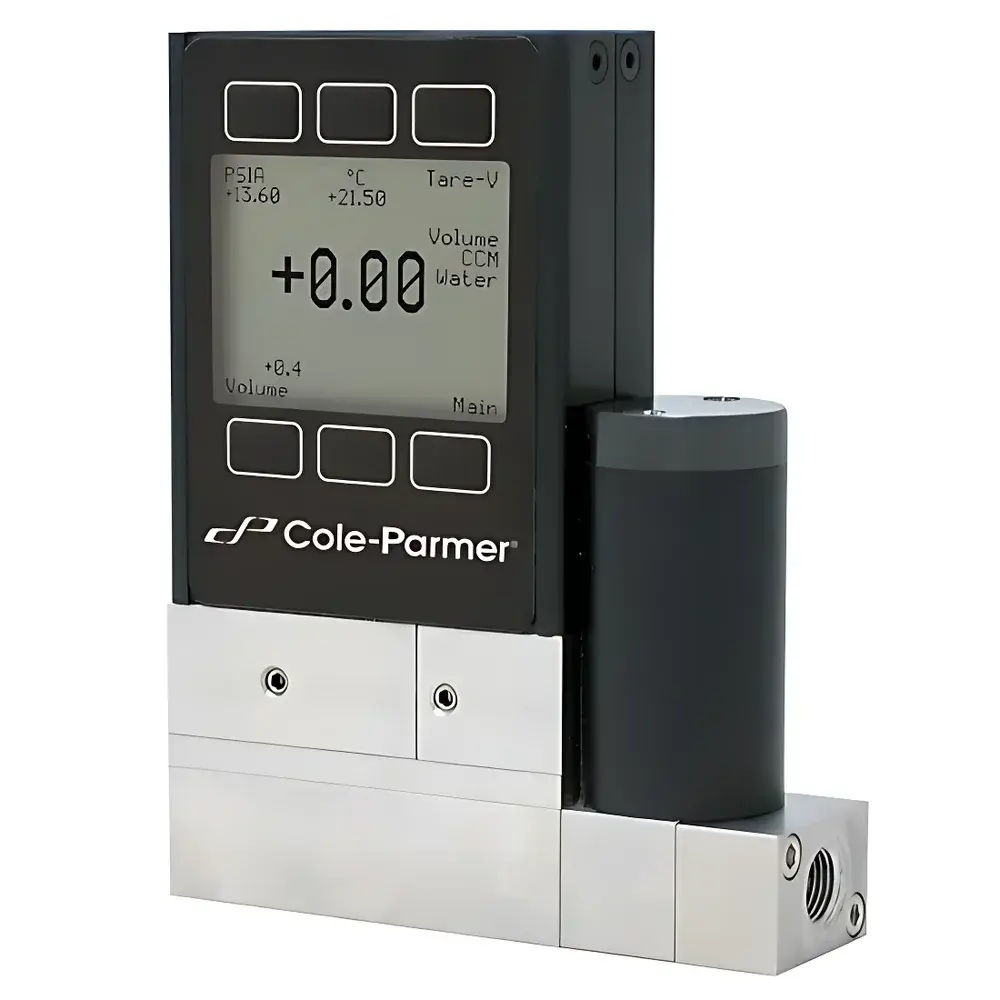
Cole-Parmer 0.05–5 LPM Gas Mass Flow Controller (Model Series with LFE Technology)
| Brand | Cole-Parmer |
|---|---|
| Origin | USA |
| Manufacturer Type | Authorized Distributor |
| Product Origin | Imported |
| Flow Range | 0.05–5 LPM |
| Accuracy | ±0.8% of reading, ±0.2% of full scale |
| Repeatability | ±0.2% |
| Response Time | ≤50 ms |
| Operating Temperature | −10 to 50 °C |
| Pressure Drop | Low (LFE-based) |
| Wetted Materials | 302/303/410 SS, Viton®, silicone RTV, glass-filled nylon, aluminum, brass, silicon, borosilicate glass |
| Process Connection | 1/8" NPT(F) |
| Control Output | 0–5 VDC, 4–20 mA optional |
| Communication Interface | RS-232 |
| Display | 7-line × 4-digit LCD (0.25" digit height) |
| Gas Compatibility | 30 standard gases including N₂, O₂, CO₂, H₂, He, Ar, CH₄, C₃H₈, SF₆, and more |
| Turndown Ratio | 100:1 |
| Certifications | NIST-traceable calibration certificate included |
| Power Supply | 120/230 VAC adapter included |
Overview
The Cole-Parmer 0.05–5 LPM Gas Mass Flow Controller is an engineered precision instrument designed for high-fidelity mass flow measurement and closed-loop control of gaseous media in laboratory, pilot-scale, and light industrial applications. Unlike thermal-based mass flow technologies, this controller employs a laminar flow element (LFE) — a precision-machined, capillary-type restriction that induces fully developed laminar flow across its internal geometry. Under laminar conditions, volumetric flow is directly proportional to the differential pressure drop (ΔP) across the element, enabling true mass flow calculation via the Hagen–Poiseuille equation when gas properties (viscosity, temperature, compressibility) are accounted for. The device integrates real-time temperature and pressure compensation, delivering traceable mass flow readings independent of upstream turbulence or piping configuration — eliminating the need for straight-run pipe requirements typical of orifice or turbine meters. Its sub-50 ms dynamic response and absence of warm-up delay make it suitable for transient process control, pulsed gas delivery, and rapid feedback loops in reaction monitoring, gas blending, and analytical sample introduction systems.
Key Features
- Laminar Flow Element (LFE) architecture ensures stable, low-pressure-drop measurement with no zero drift or thermal inertia
- ±0.2% repeatability and ±0.8% of reading / ±0.2% of full scale accuracy — validated per ISO 5167 and ASTM D3525 methodologies
- 100:1 turndown ratio (0.05–5 LPM), supporting both micro-flow calibration and higher-rate process delivery from a single unit
- Onboard PID controller enables autonomous setpoint regulation without external PLC intervention; setpoints adjustable via front-panel keypad, analog 0–5 V input, or RS-232 command
- Integrated 7-line × 4-digit LCD display with intuitive menu navigation — all configuration and diagnostics accessible without software
- Standard 0–5 VDC analog output and optional 4–20 mA current loop for integration into SCADA, DCS, or data acquisition systems
- NIST-traceable calibration certificate provided with each unit, compliant with ISO/IEC 17025 documentation standards
- Wide gas compatibility: pre-configured for 30 standard gases (including H₂, He, CO₂, O₂, CH₄, SF₆, and reactive species such as C₂H₂ and NH₃) with user-selectable gas tables
Sample Compatibility & Compliance
This controller accommodates a broad spectrum of non-corrosive and mildly corrosive gases, with wetted materials selected for chemical resistance and long-term stability: 302, 303, and 410 stainless steel for structural integrity; Viton® elastomers for seal resilience; borosilicate glass and silicon for optical and sensor elements; and glass-reinforced nylon for housing components. It operates reliably within −10 °C to +50 °C ambient and process temperature ranges, with maximum inlet pressure rated to 150 psig (10.3 bar). The device meets CE marking requirements for electromagnetic compatibility (EMC Directive 2014/30/EU) and low-voltage safety (LVD Directive 2014/35/EU). While not intrinsically safe certified, it may be deployed in Class I, Division 2 environments when installed per NEC Article 500 guidelines. All units ship with documentation supporting GLP and GMP-aligned validation protocols — including calibration history, material certifications, and installation qualification (IQ) checklists.
Software & Data Management
No proprietary software is required for basic operation; however, optional RS-232 connectivity supports ASCII command protocol (Cole-Parmer Standard Command Set) for remote configuration, real-time data streaming, and batch logging. Users may interface with LabVIEW™, Python (pySerial), MATLAB®, or custom SCADA platforms using documented register mapping and error-handling conventions. Firmware updates are performed via serial terminal; version history and release notes are published on Cole-Parmer’s technical support portal. Audit trails — including parameter changes, calibration events, and alarm logs — are stored in non-volatile memory and exportable via RS-232. For regulated environments, the device supports 21 CFR Part 11-compliant electronic record workflows when paired with validated third-party data acquisition software featuring electronic signatures and role-based access control.
Applications
- Gas blending and mixture preparation for environmental chamber testing and combustion studies
- Controlled gas dosing in catalytic reactor systems and plasma-enhanced chemical vapor deposition (PECVD)
- Carrier and purge gas regulation in GC, GC-MS, and FTIR sampling manifolds
- Leak testing and decay analysis in vacuum and pressurized subsystems
- Calibration transfer standards for secondary flow meters in metrology labs
- Bioreactor sparging and dissolved oxygen control in upstream bioprocessing
- Exhaust gas recirculation (EGR) simulation and emissions analyzer feed control
FAQ
Is this controller suitable for use with hydrogen or helium?
Yes — the device includes factory-loaded gas constants for H₂ and He and supports automatic viscosity/thermal conductivity compensation. Ensure proper sealing with Viton® or metal-seated fittings for high-diffusivity gases.
Can the flow range be extended beyond 5 LPM?
No — the LFE is mechanically calibrated for 0.05–5 LPM. For higher flows, consult Cole-Parmer’s 10–100 LPM LFE-based controllers (e.g., Model 32929-XX series).
Does the unit include a built-in power supply?
Yes — a universal 120/230 VAC switching power adapter (P/N 32929-89) is supplied standard; no external power module is required.
How is NIST traceability established?
Each unit ships with a calibration report referencing NIST Standard Reference Materials (SRMs) and documenting uncertainty budgets per ISO/IEC 17025 Annex A.2.
Is firmware upgrade capability available in the field?
Yes — firmware updates are delivered as ASCII hex files and applied via RS-232 using terminal emulation software; update logs are retained in device memory.
Related Products



