
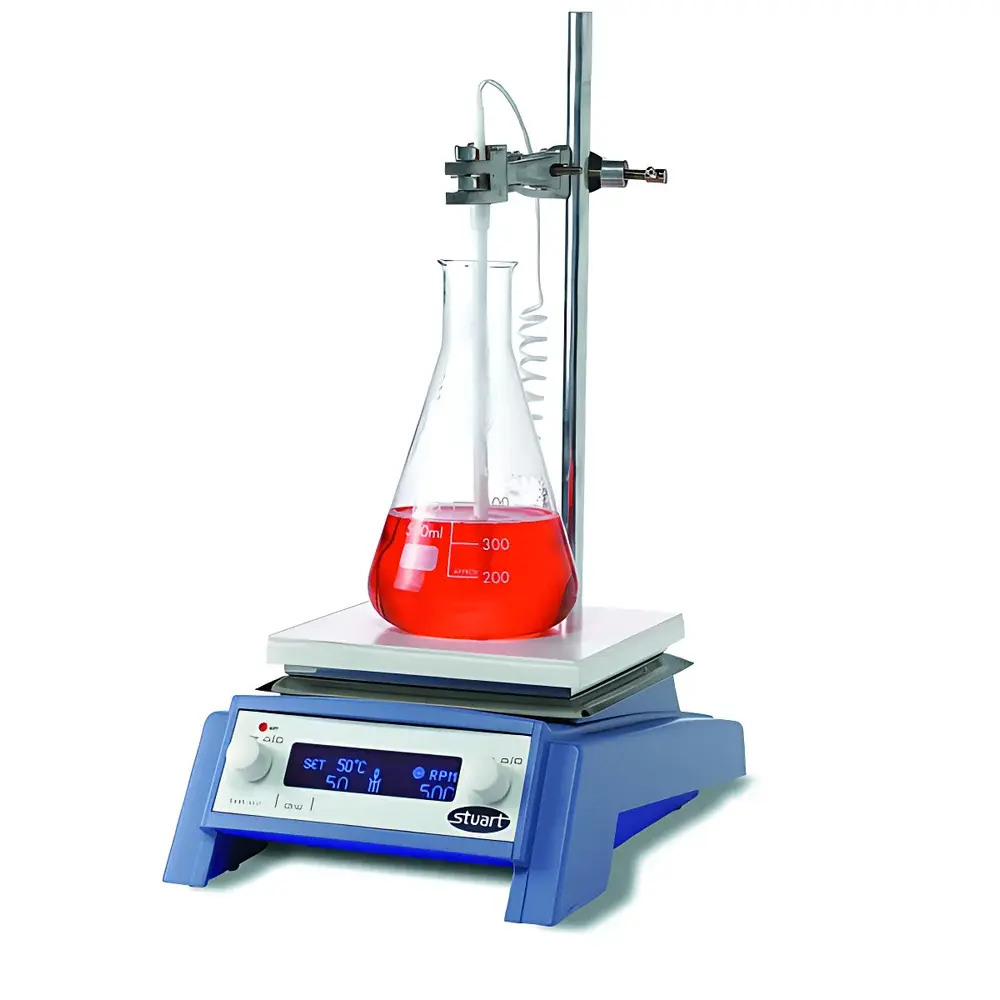
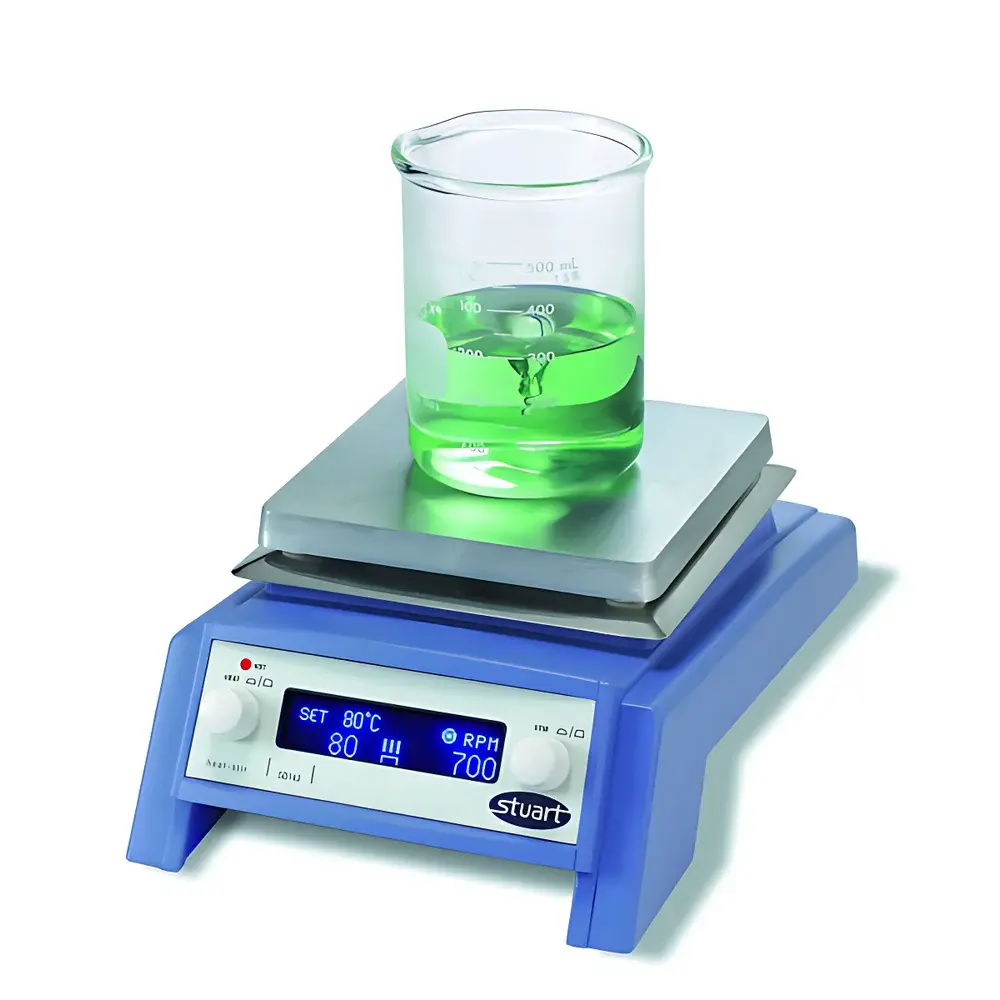
Stuart CD162/SD162 Digital Heating Magnetic Stirrer
| Brand | Stuart |
|---|---|
| Origin | United Kingdom |
| Model | CD162/SD162 |
| Instrument Type | Magnetic Stirrer |
| Max. Stirring Volume | 15 L |
| Speed Range | 200–1300 rpm |
| Temperature Control Range | 0–450 °C (CD162), 0–300 °C (SD162) |
| Heating Plate Material | Glass-Ceramic (CD162) / Aluminium-Silicon Alloy (SD162) |
| Heating Power | 500 W (CD162), 700 W (SD162) |
| Temperature Accuracy (with probe) | ±0.5 °C |
| Display Resolution | 1 °C |
| Plate Dimensions | 160 × 160 mm |
| Heating Area | 120 × 120 mm (CD162), 160 × 160 mm (SD162) |
| Weight | 3.4 kg |
| Dimensions (W × D × H) | 190 × 300 × 110 mm |
| Power Supply | 230 V, 50 Hz |
Overview
The Stuart CD162/SD162 Digital Heating Magnetic Stirrer is a precision-engineered laboratory instrument designed for simultaneous temperature control and magnetic agitation of liquid samples in research, quality control, and teaching laboratories. It operates on the principle of contactless rotational torque transfer via a rotating magnetic field generated beneath a thermally stable heating plate—enabling consistent mixing without mechanical shaft penetration. This configuration eliminates contamination risk, supports sealed-vessel operation, and ensures high reproducibility across repeated thermal and hydrodynamic protocols. The unit integrates a microprocessor-based control system that dynamically adjusts heating power based on real-time thermal gradient analysis—allowing adaptive ramping to minimize temperature overshoot and accelerate time-to-setpoint. Its dual-mode operation—probe-controlled liquid temperature regulation or direct plate surface temperature setting—provides flexibility for applications ranging from solution homogenization and reagent dissolution to controlled thermal activation of enzymatic reactions or polymerization studies.
Key Features
- Dual-model platform: CD162 features a chemically inert glass-ceramic top plate (max. 450 °C, 500 W); SD162 employs an aluminium-silicon alloy plate (max. 300 °C, 700 W) optimized for uniform thermal distribution and rapid response.
- High-resolution vacuum fluorescent display showing both setpoint and real-time measured temperature (±0.5 °C accuracy with included PTFE-coated stainless-steel probe).
- Intelligent thermal algorithm autonomously characterizes sample thermal mass and heat capacity (e.g., water vs. silicone oil) to optimize heating rate and suppress overshoot.
- Dedicated safety architecture: independent overtemperature cut-off circuit deactivates heating if plate temperature exceeds setpoint by >20 °C; visual “HOT” warning indicator flashes during elevated surface temperatures.
- Corrosion-resistant internal electronics with conformal coating ensure long-term reliability in humid or chemically aggressive environments.
- Stirring speed digitally adjustable from 200 to 1300 rpm with repeatable setpoint recall—critical for method standardization under GLP or ISO/IEC 17025-compliant workflows.
Sample Compatibility & Compliance
The CD162/SD162 accommodates vessels up to 15 L volume (e.g., beakers, flasks, crystallization dishes) and supports a broad range of solvents, aqueous buffers, viscous media (up to ~10,000 mPa·s), and low-volatility oils. Its sealed design and non-contact stirring mechanism comply with containment requirements for volatile or hazardous substances. The instrument meets IEC 61010-1:2010 safety standards for laboratory electrical equipment and incorporates design elements aligned with Good Laboratory Practice (GLP) and ISO/IEC 17025 documentation expectations—including auditable temperature setpoints, audible endpoint alerts, and stable thermal performance under continuous unattended operation (e.g., overnight synthesis or stability testing). Optional accessories—including SR1 support rods and calibrated temperature probes—enable traceable calibration per UKAS or NIST-traceable references.
Software & Data Management
While the CD162/SD162 operates as a standalone benchtop device with no embedded PC interface, its digital control architecture supports full manual protocol documentation and audit-ready recordkeeping. All temperature and speed parameters are retained on the VFD display during operation, enabling direct transcription into electronic lab notebooks (ELNs) or LIMS entries. The unit’s deterministic thermal response and fixed setpoint resolution (1 °C) facilitate precise method transfer between instruments and laboratories. For regulated environments requiring electronic records, users may integrate external data loggers (e.g., USB-connected thermocouple interfaces) compatible with FDA 21 CFR Part 11-compliant software platforms. Firmware-level security includes password-free but physically verifiable parameter locking—ensuring consistent operation across shifts without administrative overhead.
Applications
- Controlled dissolution testing of pharmaceutical formulations (aligned with USP and ).
- Preparation of homogeneous catalyst suspensions and nanoparticle dispersions in materials science.
- Thermal conditioning of culture media prior to sterile filtration or inoculation in microbiology labs.
- Heating and mixing of reagents in analytical sample preparation workflows (e.g., EPA Method 3005A acid digestion).
- Surface temperature control for microscopy slide warming, microarray hybridization, or PCB thermal profiling.
- Long-duration reaction monitoring under constant thermal and hydrodynamic conditions—validated for 72+ hour unattended operation.
FAQ
Can the CD162/SD162 operate without the temperature probe?
Yes. When the probe is disconnected, the unit defaults to plate surface temperature control mode—ideal for applications requiring precise hotplate surface heating rather than bulk liquid temperature regulation.
What is the maximum viscosity the stirrer can handle effectively at 1300 rpm?
Performance depends on vessel geometry and stir bar size, but typical operational limits extend to Newtonian fluids up to ~10,000 mPa·s when using appropriately sized magnetic stir bars (e.g., 40 mm elliptical bars) in 1–5 L volumes.
Is the unit compatible with 115 V / 60 Hz power supplies?
No. The CD162/SD162 is configured exclusively for 230 V, 50 Hz mains supply and requires a dedicated voltage converter for use in North American or Japanese laboratory networks.
How often should the temperature probe be recalibrated?
Stuart recommends annual verification against a NIST-traceable reference thermometer; more frequent checks are advised in GxP environments or following exposure to aggressive solvents or mechanical shock.
Does the instrument support external analog or digital communication protocols (e.g., RS-232, Modbus)?
No. The CD162/SD162 lacks built-in serial or network interfaces; integration with automated systems requires third-party data acquisition hardware and custom scripting.



