
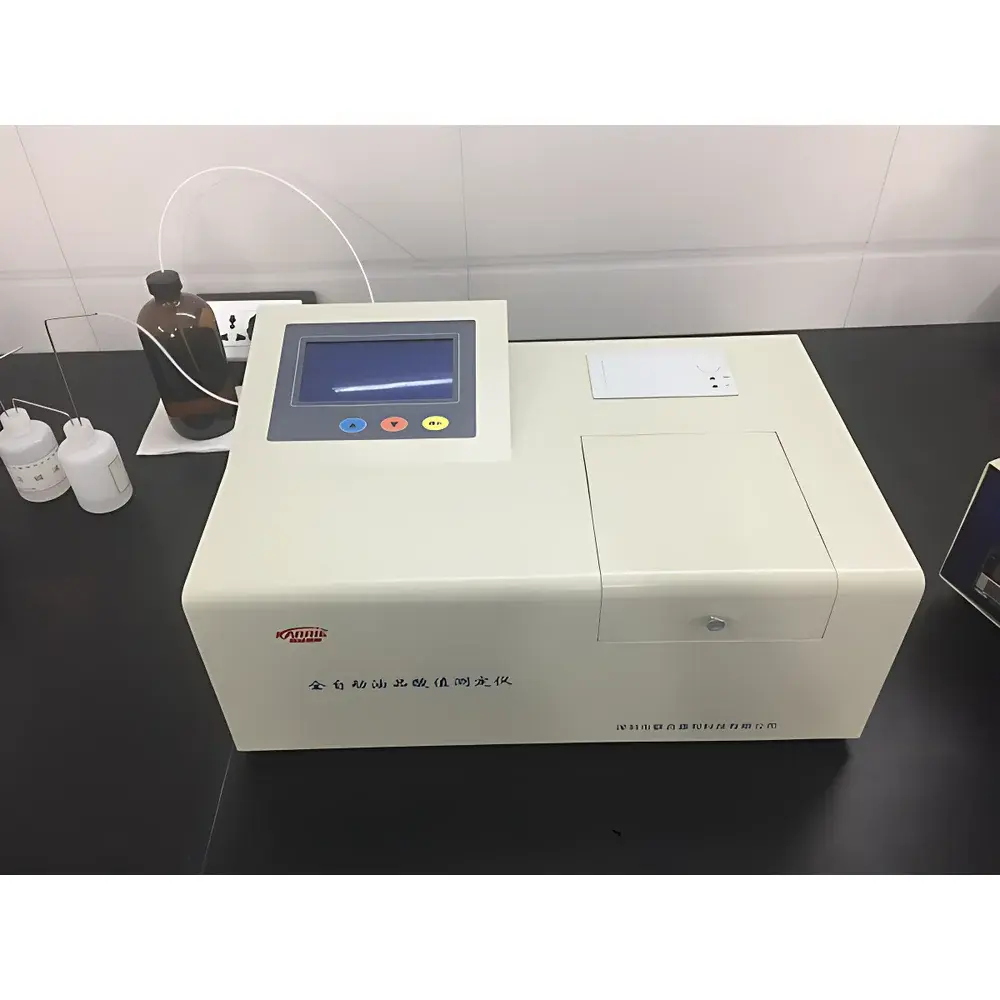
KA-131B Automatic Acid Number Analyzer by KARRIE
| Brand | KARRIE |
|---|---|
| Model | KA-131B |
| Measurement Principle | Potentiometric Titration (Neutralization Method) |
| Standard Compliance | GB/T 264–1983, GB/T 7599–1987, GB/T 7304–2000 |
| Measurement Range | 0.001–1.000 mg KOH/g |
| Accuracy | ±0.02 mg KOH/g (0.001–0.1), ±0.05 mg KOH/g (0.1–0.5), ±0.07 mg KOH/g (0.5–2.0) |
| Resolution | 0.001 mg KOH/g |
| Sample Capacity | 6-position auto-switching cup carousel |
| Display | 240×128 blue LCD |
| Printer | Thermal printer (40-character line) |
| Power Supply | AC 220 V ±10%, 50 Hz |
| Operating Temperature | −20 °C to +50 °C |
| Operating Humidity | ≤75% RH |
| Dimensions (L×W×H) | 440 × 280 × 200 mm |
| Weight | 10 kg |
| Power Consumption | 60 W |
| Data Storage | 260 test records |
| Auto-cleaning | Integrated tubing rinse cycle |
| Safety | Fully enclosed reagent handling, no operator exposure to titrants |
Overview
The KARRIE KA-131B Automatic Acid Number Analyzer is a dedicated benchtop instrument engineered for precise, reproducible determination of acid number in petroleum-based insulating oils, turbine oils, lubricants, and other hydrocarbon fluids. It operates on the principle of potentiometric titration—specifically, neutralization of acidic components with standardized potassium hydroxide (KOH) ethanol solution—under strict adherence to internationally referenced Chinese national standards: GB/T 264–1983 (determination of acid number of petroleum products), GB/T 7599–1987 (acid number of transformer oil), and GB/T 7304–2000 (potentiometric titration method for acid number in petroleum products and lubricants). Designed for high-throughput laboratory environments—including power generation facilities, military maintenance depots, petrochemical QC labs, and field-deployable testing units—the KA-131B integrates microprocessor-controlled fluidics, real-time endpoint detection, and closed-system reagent delivery to eliminate manual titration variability and human exposure to corrosive titrants.
Key Features
- Automated six-position sample carousel enabling unattended sequential analysis of up to six oil samples per batch—ideal for statistical assessment of repeatability and inter-sample comparison.
- Potentiometric endpoint detection using imported high-stability sensor components, ensuring consistent sensitivity across the full measurement range (0.001–1.000 mg KOH/g) without manual colorimetric interpretation.
- Integrated peristaltic pump system with programmable aspiration, dispensing, and stirring cycles—each step synchronized to ISO/IEC 17025-aligned timing protocols.
- Self-cleaning fluid path architecture: automatic post-titration rinse sequence prevents cross-contamination and crystallization-induced blockages in dosing lines and burette tips.
- Onboard thermal printer with 40-character line capacity delivers fully traceable hardcopy reports including date/time stamp, sample ID, measured acid number, standard deviation (if multiple replicates), and operator ID.
- Rugged industrial enclosure fabricated from electrostatically coated cold-rolled steel—resistant to solvent vapors, ambient humidity, and mechanical abrasion typical in utility substations or mobile maintenance trailers.
- Embedded self-diagnostic firmware performs pre-run system checks (electrode potential stability, pump occlusion, liquid level sensing) and logs fault codes for GLP-compliant troubleshooting.
Sample Compatibility & Compliance
The KA-131B is validated for use with mineral-based, synthetic, and bio-derived insulating oils; turbine oils per ASTM D664 and IEC 62021-1; and industrial lubricants meeting ISO 6293 specifications. Its measurement methodology aligns with the technical scope of GB/T 264, GB/T 7599, and GB/T 7304—standards harmonized with ISO 6618 (titrimetric methods for acid number) and referenced in China’s DL/T 706–2015 (guidelines for oil condition monitoring in power transformers). While not certified to FDA 21 CFR Part 11, its audit trail functionality—including timestamped raw data storage (260 entries), operator-initiated run IDs, and immutable result printouts—supports internal GLP/GMP documentation requirements in regulated utility and manufacturing settings.
Software & Data Management
The analyzer operates via an embedded real-time OS with menu-driven navigation on a 240×128 monochrome LCD interface. All parameters—including titrant concentration, blank correction offset, endpoint threshold voltage, and replicate count—are configurable and retained in non-volatile memory. Test results are stored locally with full metadata: sample identifier, calibration date, ambient temperature/humidity at time of analysis, and electrode response curve slope. Export is limited to printed output; however, the structured format (including mg KOH/g value, uncertainty band, and pass/fail flag relative to user-defined limits) facilitates manual entry into LIMS or Excel-based trending databases. Firmware updates are performed via USB port using vendor-supplied configuration utilities.
Applications
- Condition-based monitoring of in-service transformer oil to detect early-stage oxidation and sludge formation.
- Acceptance testing of new lubricants prior to commissioning in gas turbines and steam turbines.
- Quality control of base oils and finished formulations during refinery blending operations.
- Field diagnostics in remote substations where portable, low-power (<60 W), wide-temperature-range (−20 °C to +50 °C) operation is essential.
- Research applications requiring comparative acid number profiling across aging studies (e.g., accelerated oxidation per ASTM D2440).
FAQ
What titrant is used in the KA-131B, and how is its concentration verified?
The instrument uses standardized ethanolic potassium hydroxide (KOH) solution. Concentration must be verified externally using certified reference materials (e.g., benzoic acid) prior to system calibration, per GB/T 7304–2000 Section 6.2.
Can the KA-131B measure acid number in biodiesel or fatty acid methyl esters (FAME)?
No. Its validation scope is limited to petroleum-derived and synthetic hydrocarbon oils. FAME matrices require modified solvent systems and endpoint algorithms not supported by this platform.
Is electrode recalibration required between each sample?
No. The potentiometric sensor is stabilized during the initial system warm-up and remains valid for the entire analytical session unless a diagnostic fault is triggered or ambient conditions exceed specification limits.
How does the instrument handle viscous or particulate-laden oil samples?
Pre-filtration through a 5-µm membrane filter is mandatory. The system does not include inline filtration; undissolved solids may clog the micro-burette tip or interfere with endpoint detection.
Does the KA-131B support remote data retrieval or network connectivity?
No. It lacks Ethernet, Wi-Fi, or RS-232 interfaces. Data integrity relies on thermal printouts and onboard memory logging only.




