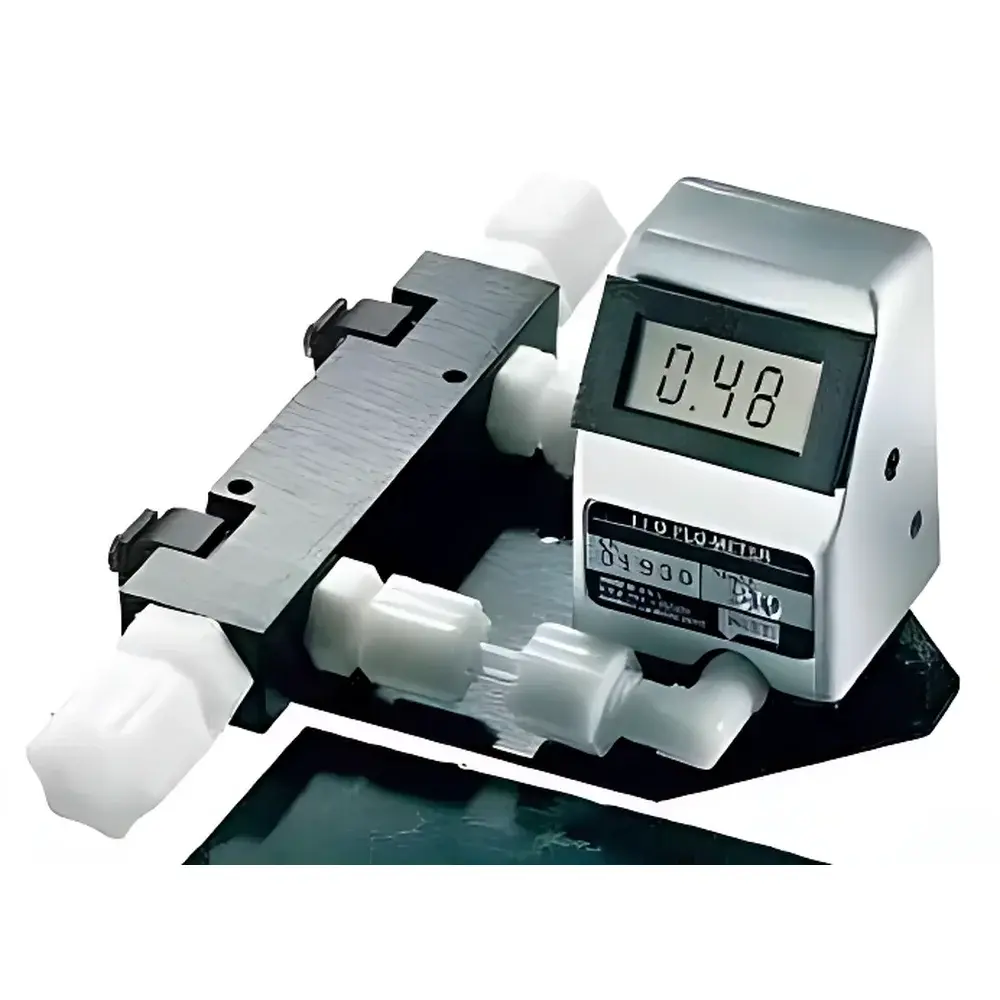
Cole-Parmer Model 32709-16 Turbine Flow Meter / Transmitter for Liquids and Gases
| Brand | Cole-Parmer |
|---|---|
| Origin | USA |
| Type | Differential Pressure-Based Turbine Flow Meter |
| Model | 32709-16 |
| Flow Range (Air) | 4–20 L/min |
| Flow Range (Liquid) | 0.5–5 L/min |
| Output | 0–5 VDC linear analog output |
| Display | 3.5-digit LCD |
| Wetted Materials | Ryton® PPS, glass, stainless steel, sapphire, Viton®, acetal, epoxy |
| Max Pressure (Brass Version) | 500 psi |
| Power | AC adapter or rechargeable battery (up to 20 h runtime) |
| Fluid Viscosity Limit | <10 cSt |
| Operating Temperature | 23 °C (calibration reference) |
| Gas Reference Conditions | 760 mm Hg, 23 °C |
| Connection | 3/8" OD tubing |
| Max Pressure Drop at Full Scale | 6 psi |
Overview
The Cole-Parmer Model 32709-16 is a compact, high-stability turbine flow meter engineered for precise volumetric flow measurement of low-viscosity liquids and clean, dry gases in laboratory, pilot-scale, and light industrial applications. Based on the principle of turbine rotation induced by fluid momentum transfer, the device converts rotational speed into a linear 0–5 VDC analog signal proportional to volumetric flow rate. Its rotor assembly—comprising a precision-balanced turbine mounted on sapphire jewel bearings—ensures minimal mechanical hysteresis and long-term repeatability. Calibration is traceable to NIST standards under defined reference conditions (23 °C, 760 mm Hg for air; 23 °C water for liquids), supporting metrological integrity in regulated environments. Unlike orifice or thermal mass flow meters, this turbine-based design delivers inherently linear response across its specified range without requiring complex compensation algorithms—making it suitable for integration into closed-loop control systems where analog signal fidelity and dynamic response are critical.
Key Features
- Compact form factor optimized for benchtop and inline mounting in space-constrained setups
- 3.5-digit backlit LCD display providing real-time flow readout in selectable units (mL/min or L/min)
- Linear 0–5 VDC analog output compatible with standard data loggers, PLCs, SCADA systems, and chart recorders
- Two material platform options: chemically resistant Ryton® PPS (polyphenylene sulfide) housing for aggressive solvents, or high-pressure brass construction rated to 500 psi
- Wetted components include sapphire bearings, borosilicate glass flow tube, 316 stainless steel shaft, and Viton® or acetal seals—selected for low outgassing and compatibility with USP Class VI–compliant applications
- Rechargeable battery operation (up to 20 hours) with optional AC adapter for continuous duty
- Differential pressure drop maintained ≤6 psi at full-scale flow, minimizing system backpressure impact
Sample Compatibility & Compliance
This flow meter is validated for use with transparent, low-viscosity fluids (<10 cSt), including deionized water, alcohols, acetone, hexane, and other non-corrosive organic solvents. For gas service, it is rated for clean, dry air and inert gases (e.g., N₂, Ar, He) free of particulates or condensable vapors. The Ryton® PPS variant (Model 32709-16) meets ASTM D5204 for polymer chemical resistance and exhibits excellent dimensional stability across 0–50 °C ambient operating range. While not intrinsically safe, the device complies with CE electromagnetic compatibility directives (2014/30/EU) and RoHS 2011/65/EU. It supports GLP-compliant workflows through stable analog output and documented calibration traceability; however, it does not provide FDA 21 CFR Part 11–compliant audit trails or electronic signatures—data integrity must be ensured at the acquisition layer (e.g., via validated data logger firmware).
Software & Data Management
The Model 32709-16 operates as a standalone analog transducer with no embedded firmware or digital communication protocol (e.g., Modbus, HART). All data acquisition and storage must be performed externally using third-party hardware. When interfaced with a calibrated analog input module (e.g., National Instruments USB-6009 or Keysight 34972A), users can achieve ±0.5% full-scale accuracy in flow quantification, assuming proper signal conditioning and 16-bit ADC resolution. Raw voltage output maps linearly to flow rate per factory calibration coefficients supplied with each unit. For trending and archival, users commonly employ LabVIEW, MATLAB, or Python-based logging tools that support timestamped CSV export—enabling alignment with ISO/IEC 17025 documentation requirements when paired with controlled environmental monitoring.
Applications
- Continuous monitoring of solvent delivery in HPLC auxiliary lines or reagent dispensing systems
- Verification of purge gas flow rates in glovebox inerting or GC carrier gas lines
- Calibration transfer between primary standards (e.g., bell prover) and field instruments
- Leak testing of microfluidic manifolds via differential flow decay analysis
- Process validation of low-flow bioreactor sparging or perfusion media exchange
- Educational demonstrations of laminar vs. turbulent flow regimes using Reynolds number correlation
FAQ
Is the Model 32709-16 suitable for measuring viscous oils or slurries?
No. It is strictly limited to fluids with kinematic viscosity below 10 cSt at 23 °C. Higher viscosities cause excessive drag, nonlinear response, and bearing wear.
Can this meter be used for compressed air at 100 psi?
Yes—but only with the brass-bodied variant (e.g., Model 32709-36). The Ryton® PPS version (32709-16) is rated for ambient-pressure gas service only.
Does it require periodic recalibration?
Annual recalibration is recommended for GLP/GMP applications. Drift typically remains within ±1% FS/year under stable operating conditions.
What is the minimum detectable flow rate?
The lower limit of reliable measurement is approximately 5% of full scale (i.e., 0.2 L/min for the 4–20 L/min air range), constrained by signal-to-noise ratio and bearing stiction.
Is the LCD display visible under low-light conditions?
Yes—the integrated backlight enables legible reading in dim laboratory environments, though it is not sunlight-readable.