
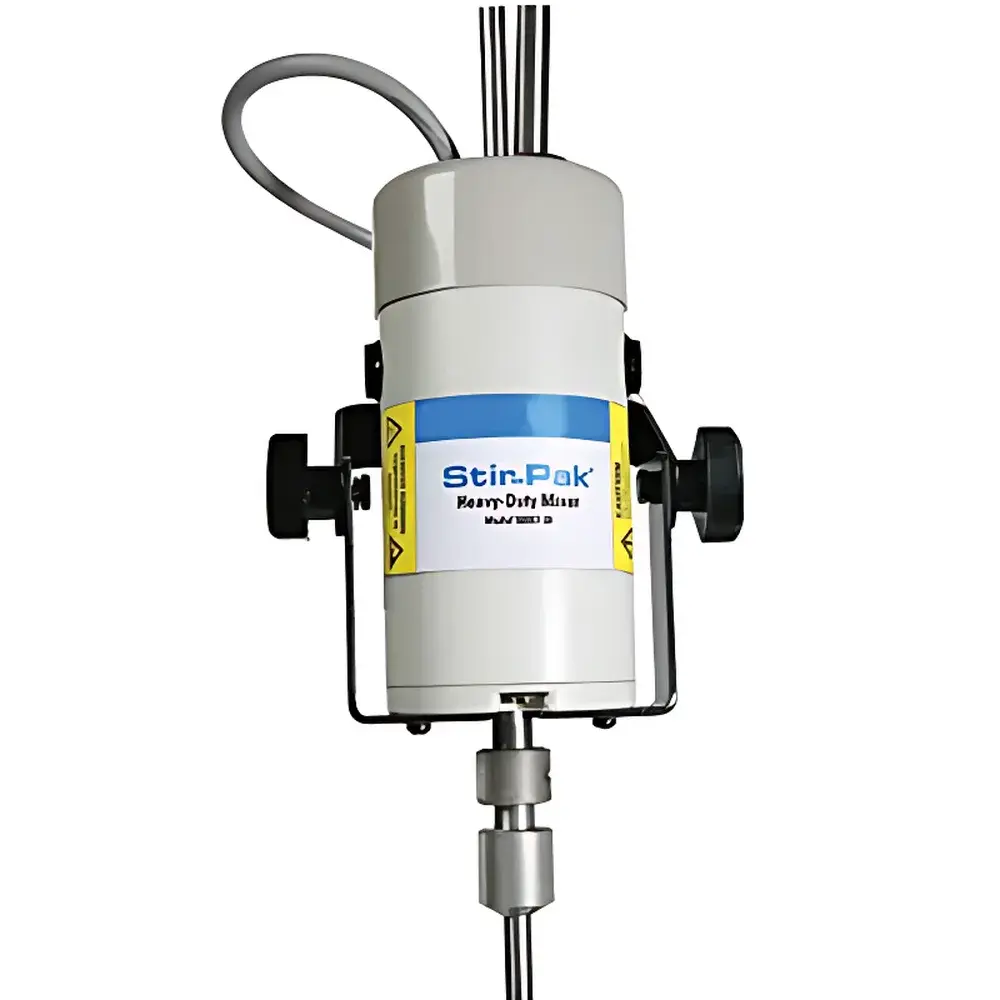
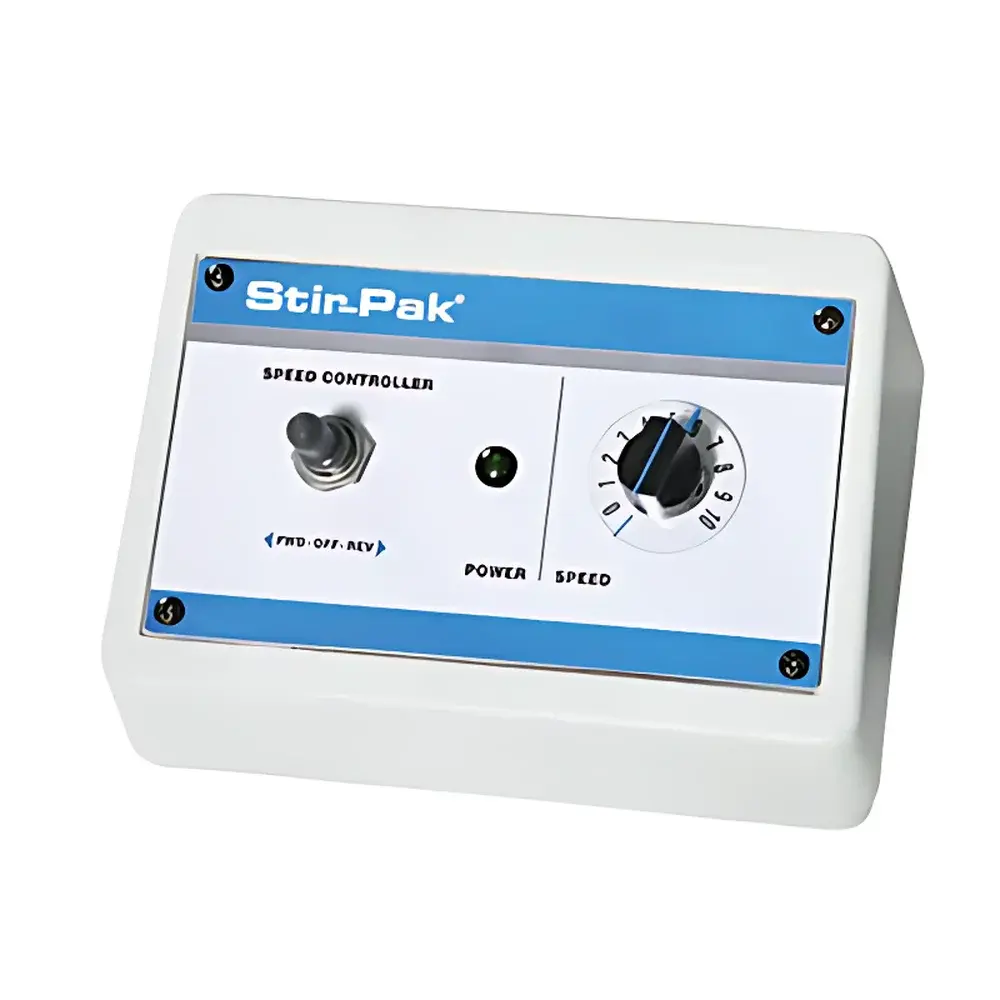
Cole-Parmer Stir-Pak High-Torque Modular Mixing System
| Brand | Stir-Pak |
|---|---|
| Origin | USA |
| Manufacturer Type | Authorized Distributor |
| Product Category | Imported |
| Model | 50007-35 |
| Price | Upon Request |
| Speed Range | 23–2300 rpm |
| Torque | 0.3 N·m |
| Power Rating | 74.6 W |
| Input Voltage | 230 VAC, 50/60 Hz |
Overview
The Cole-Parmer Stir-Pak High-Torque Modular Mixing System is an engineered solution for demanding laboratory-scale mixing, homogenization, and dispersion tasks requiring precise speed control, consistent torque delivery, and long-term operational reliability. Unlike fixed-speed vortex mixers or basic magnetic stirrers, the Stir-Pak system employs a brushless permanent-magnet DC motor with sealed, permanently lubricated ball bearings—ensuring minimal maintenance and stable rotational performance across its full operating range. Its modular architecture separates the controller (50007-05), drive head, base assembly, shafts, impellers, and clamping fixtures into interoperable components, enabling users to configure systems tailored to specific viscosity ranges, vessel geometry, and process duty cycles. The system operates on constant-voltage AC input (230 VAC, 50/60 Hz) and implements electronic speed regulation with ±2% accuracy over a 100:1 turndown ratio—critical for reproducible shear-sensitive protocols in pharmaceutical formulation, polymer solution preparation, and colloidal suspension stabilization.
Key Features
- Modular design supports flexible configuration: purchase complete systems or individual components (controller, drive head, base, shafts, impellers, clamps) for application-specific optimization.
- Dedicated forward/reverse/stop toggle switch operates independently of the analog speed control dial—allowing instantaneous direction reversal without resetting speed setpoints.
- Integrated torque-limiting circuitry protects motor windings and gear train from stall-induced thermal overload, significantly extending service life under high-viscosity or intermittent-load conditions.
- TENV-rated (Totally Enclosed Non-Ventilated) motor housing provides dust resistance and moisture protection suitable for general laboratory environments per IEC 60034-5 standards.
- Four interchangeable drive head variants (50007-15, -25, -35, -45 and corresponding -17, -27, -37, -47 models) cover speed-torque profiles from high-torque/low-RPM (2–180 rpm, 2.4 N·m) to high-RPM/low-torque (60–6000 rpm, 0.1 N·m), accommodating diverse fluid rheologies.
Sample Compatibility & Compliance
The Stir-Pak system accommodates a broad spectrum of sample types—including Newtonian and non-Newtonian liquids, suspensions, emulsions, and semi-solid pastes—when paired with appropriate impeller geometry (e.g., pitched-blade, anchor, or propeller types) and vessel mounting solutions. It is compatible with standard borosilicate glass, stainless steel, and polypropylene labware up to 20 L capacity, depending on selected drive head and shaft length. While not certified for hazardous area use (e.g., ATEX or IECEx), the system meets CE marking requirements for electromagnetic compatibility (EMC Directive 2014/30/EU) and low-voltage safety (LVD Directive 2014/35/EU). Its construction and documentation support adherence to GLP-compliant workflows when integrated into validated laboratory procedures; audit trails for speed/torque settings may be maintained manually or via external data logging interfaces.
Software & Data Management
The Stir-Pak 50007-35 operates as a standalone analog-controlled instrument without embedded firmware or digital connectivity. Speed and direction are set via front-panel mechanical controls, ensuring deterministic response and immunity to software failure modes. For laboratories requiring traceability, optional third-party analog-to-digital signal converters (e.g., USB-based 0–10 V input modules) can interface with LabVIEW, MATLAB, or custom Python scripts to record real-time RPM and runtime data. Though not natively compliant with FDA 21 CFR Part 11, the system supports ALCOA+ principles through documented calibration logs, user access records, and procedural SOPs governing setup, operation, and preventive maintenance.
Applications
- Preparation of uniform polymer solutions and hydrogels where controlled shear rate prevents chain scission.
- Homogenization of cell culture media containing heat-labile proteins or growth factors at sub-100 rpm to minimize foaming and denaturation.
- Dispersion of nanomaterials (e.g., graphene oxide, metal oxides) in aqueous or organic solvents using high-shear impellers at 1500–2300 rpm.
- Batch mixing of viscous pharmaceutical ointments and topical gels using low-speed, high-torque configurations (50007-15/-17).
- Stirring of large-volume buffer solutions (≥10 L) in jacketed reactors during temperature-controlled synthesis protocols.
FAQ
Can the Stir-Pak system be used in explosion-proof environments?
No—the system lacks ATEX, IECEx, or Class I Division 1 certification and is intended for general laboratory use only.
Is speed calibration traceable to NIST standards?
Calibration certificates are available upon request; users may perform periodic verification using a handheld tachometer referenced to NIST-traceable sources.
What impeller types are recommended for high-viscosity mixing?
Anchor, helical ribbon, or double-helical impellers mounted on extended shafts (e.g., 50007-15 drive head with 300 mm shaft) provide optimal bulk flow and wall scraping in viscosities exceeding 50,000 cP.
Does the controller support remote start/stop via dry contact?
No—remote control requires external relay interfacing; the controller features only local push-button and rotary controls.
How often should maintenance be performed?
Under normal use, inspect bearings and drive coupling annually; replace carbon brushes only if specified for legacy brushed motor variants (not applicable to TENV DC motors in current 50007-x5/x7 series).



