
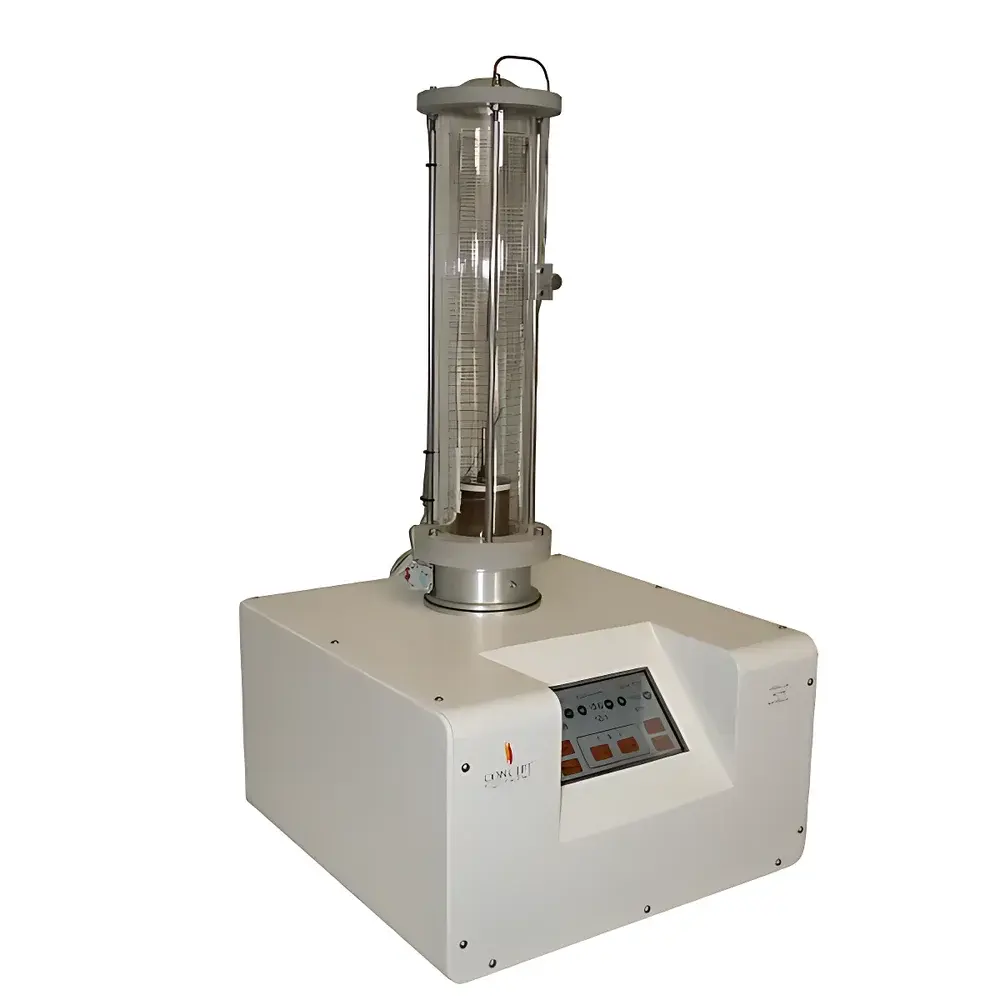
Concept Temperature Index Module (TIM) for High-Temperature Oxygen Index Testing
| Brand | Concept |
|---|---|
| Origin | United Kingdom |
| Model | Temperature Index Module |
| Electrical Supply | 230 V AC, 50 Hz / 115 V AC, 60 Hz |
| Operating Temperature Range | 10–35 °C |
| Test Temperature Range | Ambient to 400 °C |
| Gas Flow Rate | 0–20 nl/min |
| Minimum Gas Supply Pressure | 2.6 bar (38 psi) for O₂ and N₂ |
| Minimum Gas Supply Flow | 25 nl/min |
| Oxygen Analyzer Range | 0–100% O₂ |
| Oxygen Measurement Repeatability | ±0.1% O₂ (typ.) |
| Oxygen Linearity | ±0.1% O₂ (typ.) |
| Dimensions | 450 mm (W) × 800 mm (H) × 450 mm (D) |
Overview
The Concept Temperature Index Module (TIM) is a precision-engineered high-temperature extension to the standard Oxygen Index Module (OIM), designed specifically to determine the limiting oxygen index (LOI) of polymeric and composite materials under elevated thermal conditions—up to 400 °C. Unlike conventional LOI testers operating exclusively at ambient temperature, the TIM implements a dual-heater column architecture that enables controlled, uniform heating of both the test specimen and the surrounding gas stream, in strict compliance with ISO 4589-3 and NES 715. The module operates on the fundamental principle that oxygen concentration required to sustain candle-like combustion decreases as ambient temperature rises; therefore, high-temperature LOI data provides critical insight into real-world fire performance under pre-ignition thermal stress—particularly relevant for aerospace composites, rail interior materials, and electric vehicle battery enclosures.
Key Features
- Integrated dual-zone heating system: independent control of pre-heater and test column heaters ensures stable, uniform thermal profiles across the sample zone without manual recalibration between runs.
- Touchscreen-driven operation: all parameters—including flow rate, target temperature, and calibration mode—are selected via intuitive interface; the embedded controller automatically adjusts valve timing, heater power, and sensor gain.
- High-fidelity paramagnetic oxygen sensing: calibrated range 0–100% O₂ with ±0.1% repeatability and linearity (typ.), eliminating drift-related uncertainty common in electrochemical sensors.
- Low-noise, pulse-free gas pump: delivers consistent air pre-conditioning prior to O₂/N₂ mixture introduction, minimizing cylinder gas consumption and extending heater element service life.
- Real-time thermal monitoring: adjustable thermocouple probe mounted within the heated column provides direct, contact-based measurement of specimen-adjacent temperature—traceable to NIST-traceable references.
- Automated two-point calibration: initiated via “Auto-Cal” command on display; performs zero (0% O₂) and span (100% O₂) calibration sequentially using certified gases—no manual potentiometer trimming required.
- Safety-integrated gas fault detection: continuous monitoring of combustion gas composition triggers immediate heater shutdown and visual/audible alarm if O₂ concentration deviates beyond ±0.5% during test execution.
Sample Compatibility & Compliance
The TIM accommodates standard ISO 4589-2 specimen geometries (e.g., 150 mm × 10 mm × 10 mm bars) and supports rigid, semi-crystalline, and filled thermoplastics—including PEEK, polyimides, halogen-free flame-retardant formulations, and carbon-fiber-reinforced laminates. All hardware and firmware comply with CE marking requirements under the EU Machinery Directive 2006/42/EC and Electromagnetic Compatibility Directive 2014/30/EU. Data acquisition protocols support audit-ready traceability per GLP and GMP environments; optional timestamped event logs (including heater status, flow setpoints, O₂ readings, and thermal ramp profiles) are exportable in CSV format for regulatory submission.
Software & Data Management
No external PC or proprietary software is required for routine operation—the TIM’s embedded Linux-based controller manages all test sequencing, data logging, and alarm handling locally. Internal non-volatile memory stores ≥1,000 test records with full metadata: date/time stamp, operator ID (user-selectable), test temperature, flow rate, measured LOI value, and pass/fail flag relative to user-defined thresholds. Export is performed via USB 2.0 port; files conform to ASTM E1358-22 Annex A1 formatting for interoperability with LIMS platforms. Optional firmware update path supports future enhancements to reporting templates and compliance with emerging revisions of ISO 4589-3.
Applications
- Quality assurance of flame-retardant additives in wire & cable jacketing compounds tested at 200–350 °C to simulate conduit heating scenarios.
- Comparative ranking of intumescent coating efficacy under thermal preconditioning prior to vertical burn testing (ASTM D635).
- Development screening of bio-based polymers where decomposition onset overlaps with LOI measurement window—enabling correlation between TGA onset and sustained combustion threshold.
- Fire safety validation of composite sandwich panels used in marine bulkheads, per IMO FTP Code Part 5 requirements.
- Root-cause analysis of batch-to-batch LOI variability in recycled PET blends, isolating thermal degradation effects from formulation inconsistencies.
FAQ
Does the TIM require external gas regulators or flow controllers?
No—integrated mass flow control eliminates dependency on external needle valves or rotameters. Gas supply must meet minimum pressure (2.6 bar) and flow (25 nl/min) specifications at the inlet manifold.
Can the TIM be operated in inert atmospheres (e.g., pure nitrogen)?
Yes—while primarily configured for O₂/N₂ mixtures, the system supports programmable gas switching sequences, including purge cycles with inert gas prior to ignition.
Is the oxygen sensor field-replaceable?
Yes—the paramagnetic cell is a sealed, factory-calibrated module with plug-and-play electrical and pneumatic interfaces; replacement requires no user recalibration.
What maintenance intervals are recommended?
Filter elements (inlet particulate and hydrocarbon traps) should be inspected every 200 test hours; oxygen sensor verification with certified 0% and 21% O₂ gases is advised quarterly.
Does the TIM support remote monitoring or network connectivity?
Not natively—but RS-232 serial output is available for integration into centralized lab automation systems (e.g., LabVantage, Thermo Fisher SampleManager) via custom middleware.



