
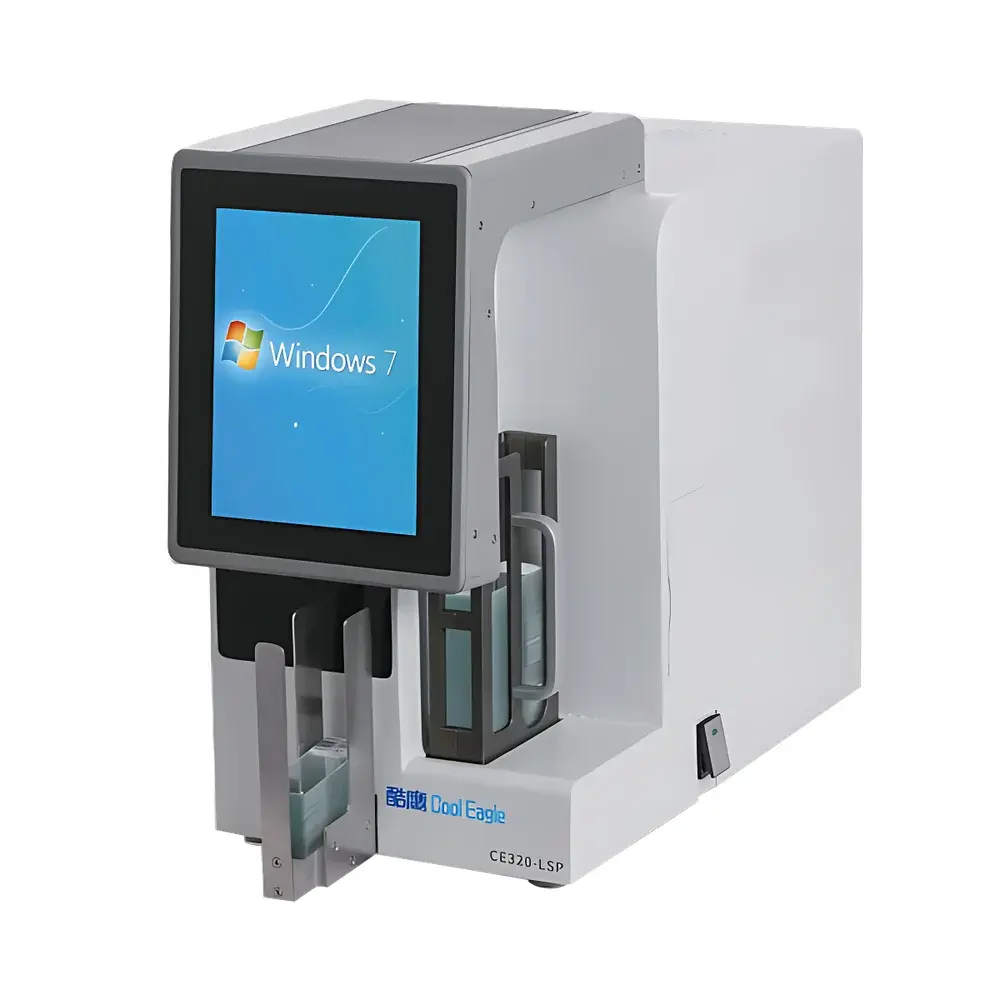
Cool Eagle CE320-LSP UV Laser Slide Labeling System
| Brand | HISTO |
|---|---|
| Origin | Zhejiang, China |
| Manufacturer Type | Authorized Distributor |
| Country of Origin | China |
| Model | CE320-LSP |
| Price | USD 22,500 (FOB Zhejiang) |
| Dimensions (L×W×H) | 440 × 220 × 380 mm |
| Weight | 25 kg |
| Power Supply | AC 100–240 V, 50–60 Hz |
| Operating Temperature | −5 °C to 40 °C |
| Power Consumption | 120 W |
| Max. Loading Capacity | 150 slides |
| Max. Collection Capacity | 100 slides |
| Print Speed | >15 slides/min |
| Resolution | 0.01 mm |
| Minimum Printable Character Size | 1 mm × 1 mm (Chinese character) |
| Display | 8-inch capacitive touchscreen |
| Integrated Barcode Scanner | Yes |
| Air Handling | Vacuum-based dual-stage adsorption (liquid + solid phase), with automatic duct cleaning function |
| Slide Ejection | Front-facing, bi-lateral access |
| Cassette Design | Interchangeable collection trays (compatible with standard slide transport workflows) |
Overview
The Cool Eagle CE320-LSP UV Laser Slide Labeling System is an engineered solution for high-fidelity, consumable-free identification of histological glass slides in clinical pathology, research laboratories, and core facilities. Unlike thermal transfer or inkjet-based systems, the CE320-LSP employs a solid-state ultraviolet (UV) laser source operating at 355 nm wavelength to induce controlled photochemical modification of standard microscope slide surfaces—typically soda-lime or borosilicate glass coated with proprietary silane or polymer layers. This non-contact, ablation-free marking process generates permanent, high-contrast alphanumeric characters and 2D barcodes without introducing volatile organic compounds (VOCs), particulate residue, or substrate warping. The system is designed for integration into automated tissue processing lines or standalone use in GLP-compliant diagnostic environments where traceability, audit readiness, and operator safety are governed by ISO 15189, CAP accreditation requirements, and national medical device regulations.
Key Features
- UV laser marking technology eliminates dependency on ribbons, inks, solvents, or thermal foils—reducing total cost of ownership and eliminating cross-contamination risks.
- Optical resolution of 0.01 mm enables reliable rendering of 1 mm × 1 mm Chinese characters and GS1 DataMatrix codes compliant with ISO/IEC 16022 standards.
- Parallelized mechanical workflow: slide feeding, positioning, laser exposure, and ejection occur concurrently; non-printing motion overhead is limited to ≤2 seconds per cycle.
- Integrated 8-inch industrial-grade touchscreen with intuitive WYSIWYG template editor—no external software or context switching required for label layout revision.
- Vacuum-driven air management system features dual-phase adsorption media (activated carbon + hydrophobic polymer filter) and programmable duct self-cleaning cycles to capture submicron aerosols and condensable organics generated during UV surface interaction.
- Front-access ejection path supports ergonomic retrieval by personnel stationed on either side of the instrument—critical for benchtop deployment in spatially constrained pathology labs.
- Modular slide collection cassettes (100-slide capacity) are mechanically identical to common transport carriers, enabling direct use in downstream staining or scanning workflows without manual rehandling.
Sample Compatibility & Compliance
The CE320-LSP accommodates standard 75 mm × 25 mm × 1 mm microscope slides made from annealed soda-lime or low-fluorescence borosilicate glass. It supports coated slides—including APES-, PTM-, or poly-L-lysine-treated variants—as well as uncoated and frosted-edge preparations. All labeling remains stable through routine histological processing steps: xylene dewaxing, ethanol dehydration, hematoxylin-eosin staining, and immunohistochemical antigen retrieval (pH 6–9, 95–100 °C). The system complies with IEC 61000-6-3 (EMC emission limits), IEC 60950-1 (safety), and meets Class 1 laser product requirements per IEC 60825-1:2014. Air filtration performance adheres to ISO 16000-26 for indoor air quality control in occupied laboratory spaces.
Software & Data Management
Firmware v3.2 includes embedded SQLite database logging with timestamped records of every printed slide (slide ID, template used, operator ID, UTC timestamp, laser power calibration index). Audit trail functionality satisfies FDA 21 CFR Part 11 requirements for electronic records when deployed with network-authenticated user accounts and role-based access controls (admin, technician, viewer). Export options include CSV and PDF batch reports with digital signatures. Optional DICOM-SR integration allows direct embedding of slide labels into pathology imaging metadata via HL7v2 or FHIR interfaces.
Applications
- Primary labeling of surgical specimens prior to grossing and embedding.
- Secondary re-labeling of archived slides during digitization projects.
- Barcode generation for LIMS integration in high-throughput molecular pathology labs (e.g., NGS sample tracking).
- Custom annotation of control slides used in QC/QA programs (e.g., “CAL-2024-Q3”, “NEG-CTRL-07”).
- Labeling of cytology slides, frozen section cassettes, and tissue microarray blocks when mounted on compatible carriers.
FAQ
Does the CE320-LSP require periodic recalibration of the laser focus or galvanometer alignment?
No—optical path stability is maintained via monolithic kinematic mounting and temperature-compensated lens assemblies. Factory calibration remains valid for ≥18 months under normal operation; verification is performed using NIST-traceable glass scale targets during annual service.
Can the system print on pre-stained or coverslipped slides?
It is not recommended. UV absorption characteristics change significantly with dye loading and resin thickness; consistent contrast cannot be guaranteed. Labeling should precede staining and coverslipping.
Is remote firmware update supported over Ethernet or Wi-Fi?
Yes—secure OTA updates are delivered via HTTPS with SHA-256 signature validation. Network configuration is managed through DHCP or static IP assignment in the system settings menu.
What maintenance tasks are required beyond filter replacement?
Annual preventive maintenance includes vacuum pump oil change, laser output power verification, touchscreen calibration, and adsorption media replacement—documented in the included service logbook.
How does the system handle slide jams or misfeeds?
Real-time optical detection at three positions (input, print zone, output) triggers immediate motion halt and GUI alert. Jam recovery is manual but requires <15 seconds; no tools are needed.



