
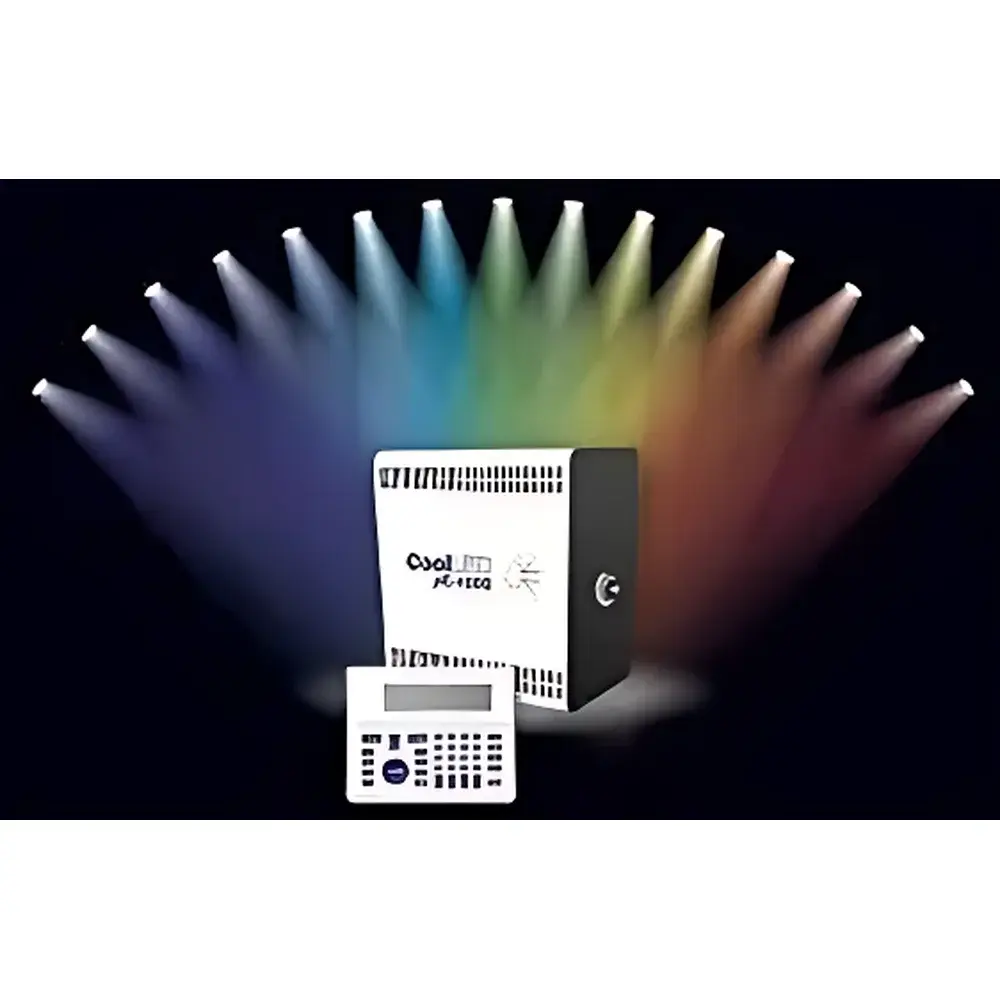
CoolLED pE-4000 16-Channel LED Illumination System
| Brand | CoolLED |
|---|---|
| Origin | United Kingdom |
| Model | pE-4000 |
| Wavelength Range | 365–770 nm |
| Number of Selectable Channels | 16 |
| Max Simultaneous Wavelengths | 4 |
| Control Interface | TTL, USB, RS232, Analog |
| Intensity Resolution | 1% (0–100%) |
| Lifetime | 25,000 hours |
| Illumination Mode | Internal (epi-illumination compatible) |
| Microscope Compatibility | Universal (Olympus, Nikon, Zeiss, Leica, and custom systems) |
| Regulatory Compliance | CE, UKCA, RoHS |
Overview
The CoolLED pE-4000 is a high-performance, multi-channel LED illumination system engineered for precision fluorescence microscopy. Unlike traditional arc-lamp or broadband sources, the pE-4000 employs solid-state LED technology operating across 16 discrete, factory-calibrated wavelengths from 365 nm (UVA) to 770 nm (deep red), enabling targeted excitation of a broad spectrum of fluorophores—including DAPI, FITC, TRITC, Cy5, mCherry, and far-red dyes—without spectral bleed-through or thermal drift. Its architecture follows the principle of digitally addressable, independently controlled LED channels, each with thermally stabilized current drivers ensuring intensity stability <±0.5% over 8 hours. Designed specifically for epi-fluorescence and transmitted-light applications, the system delivers uniform, collimated output optimized for Köhler illumination alignment and integrates seamlessly into both upright and inverted microscope platforms via standard C-mount or fiber-coupled interfaces.
Key Features
- 16 pre-aligned, narrow-band LED channels (FWHM ≤ 20 nm), covering UV through visible to near-infrared (365, 385, 405, 420, 435, 455, 470, 490, 505, 520, 535, 555, 575, 625, 660, 770 nm)
- Simultaneous activation of up to four wavelengths—enabling real-time multi-color acquisition without mechanical filter wheels or shutter latency
- Digital intensity control with 1% resolution (0–100%) per channel; no neutral density filters required
- Instant on/off response (<1 µs rise/fall time); eliminates warm-up, cool-down, and ozone generation associated with mercury/xenon lamps
- Thermal management system maintains LED junction temperature within ±0.3°C, ensuring photometric reproducibility across extended time-lapse experiments
- Modular driver architecture supports integration with third-party hardware triggers (TTL, analog voltage, USB-serial) and synchronization to camera exposure timing
Sample Compatibility & Compliance
The pE-4000 is validated for use with fixed and live biological specimens—including cultured cells, tissue sections, zebrafish embryos, and C. elegans—under standard epifluorescence, confocal, TIRF, and light-sheet modalities. Its low-heat output (<1.2 W total optical power per channel) minimizes phototoxicity and thermal artifact in sensitive assays. The system conforms to IEC 61000-6-3 (EMC emission standards), IEC 62471 (photobiological safety classification: Risk Group 1 for all channels), and carries CE and UKCA markings. It supports GLP/GMP workflows through audit-trail-ready software logging (via pE-4000 Manager v3.x) and is compatible with FDA 21 CFR Part 11-compliant laboratory information management systems (LIMS) when deployed with electronic signature-enabled acquisition software (e.g., NIS-Elements, ZEN, MetaMorph).
Software & Data Management
Control is managed via the cross-platform pE-4000 Manager application (Windows/macOS/Linux), which provides protocol-based illumination sequencing, intensity ramping, time-gated pulsing (down to 100 µs pulse width), and event-triggered channel switching synchronized to camera frame acquisition. All parameter changes are timestamped and logged with user ID and system metadata. The device exposes a full SCPI command set over USB virtual COM port and supports direct integration into Python (PySerial), MATLAB (Instrument Control Toolbox), and LabVIEW via standard VISA drivers. Exported logs include CSV-formatted intensity history, error codes, and thermal sensor readouts—facilitating retrospective QA/QC analysis and instrument qualification documentation.
Applications
- Multi-parameter fluorescence co-localization studies requiring precise spectral separation and temporal registration
- Long-term live-cell imaging where photostability and minimal photodamage are critical (e.g., stem cell differentiation, neuronal activity mapping)
- Automated high-content screening (HCS) platforms requiring repeatable, script-driven illumination protocols
- Quantitative FRET and ratiometric Ca²⁺ imaging using dual-excitation wavelength pairs (e.g., 340/380 nm or 420/490 nm)
- Development and validation of novel fluorescent probes and biosensors requiring defined excitation spectra
- Teaching laboratories requiring robust, maintenance-free illumination with intuitive hardware/software interface
FAQ
Is the pE-4000 compatible with my existing microscope’s filter cube turret?
Yes—the pE-4000 is designed for drop-in replacement of arc-lamp illuminators and interfaces directly with standard fluorescence filter sets; no physical modification to the microscope is required.
Can I use the pE-4000 for transmitted-light brightfield or DIC imaging?
While optimized for fluorescence, selected channels (e.g., 470 nm, 520 nm, 625 nm) provide sufficient irradiance for LED-based brightfield and contrast-enhanced techniques when coupled with appropriate condenser optics.
Does the system require recalibration after installation?
No—each LED channel is factory-aligned and intensity-calibrated; field recalibration is not necessary under normal operating conditions.
What is the recommended maintenance schedule?
None beyond periodic dust removal from the output port; the solid-state design eliminates lamp replacement, alignment, or consumables.
How does the pE-4000 handle heat dissipation during continuous operation?
An active heatsink with silent PWM-controlled fan and internal thermal sensors maintain LED die temperature within specification; ambient air intake is filtered to prevent particulate ingress.




