
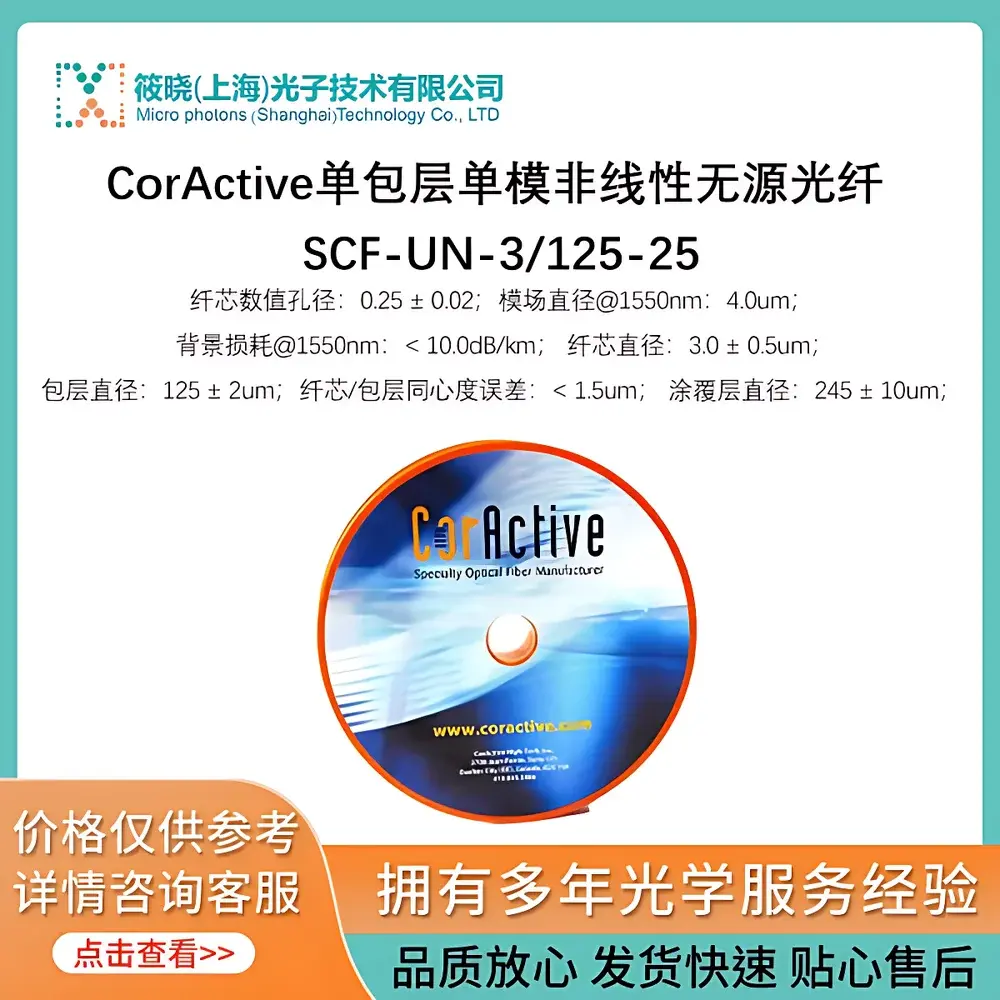
CorActive SCF-UN-3/125-25 Single-Clad, Single-Mode, Nonlinear Passive Optical Fiber
| Brand | CorActive |
|---|---|
| Origin | Canada |
| Model | SCF-UN-3/125-25 |
| Core Diameter | 3 µm |
| Cladding Diameter | 125 µm |
| Coating Diameter | 250 µm |
| Numerical Aperture (NA) | ~0.12 |
| Operating Wavelength Range | 1060–1600 nm |
| Fiber Type | Nonlinear, Passive, Step-Index, Single-Mode |
| Compatibility | Pump & Signal Delivery in High-Power Fiber Lasers and Amplifiers |
Overview
The CorActive SCF-UN-3/125-25 is a high-purity, single-clad, single-mode passive optical fiber engineered for nonlinear photonic applications in high-power continuous-wave (CW) and pulsed fiber laser systems. Designed with a germanosilicate core and pure-silica cladding, this fiber supports robust mode confinement and low propagation loss across the 1060–1600 nm spectral window—enabling efficient stimulated Raman scattering (SRS), four-wave mixing (FWM), and supercontinuum generation when integrated into carefully designed cavity or amplifier configurations. Its precisely controlled 3 µm core diameter and 125 µm cladding diameter meet industry-standard splicing and packaging requirements, while the 250 µm acrylate coating ensures mechanical stability during cabling, coiling, and thermal cycling. Unlike active gain fibers, the SCF-UN-3/125-25 contains no rare-earth dopants, making it ideal as a passive nonlinear medium where signal integrity, polarization maintenance (when used with appropriate winding protocols), and long-term photostability are critical.
Key Features
- Single-mode guidance with MFD ≈ 5.2 µm @ 1064 nm and ≈ 6.8 µm @ 1550 nm—optimized for coupling into standard single-mode components
- Ultra-low background loss (< 15 dB/km @ 1550 nm) due to CorActive’s proprietary MCVD/OVD hybrid preform fabrication process
- High damage threshold (> 1 MW/cm² peak power for nanosecond pulses; > 5 kW average power for CW operation under proper thermal management)
- Controlled numerical aperture (~0.12) ensures compatibility with commercial fusion splicers and alignment stages without mode field mismatch penalties
- Acrylate dual-layer coating provides excellent strip-and-cleave yield, bend resistance up to 30 mm radius, and long-term environmental reliability per Telcordia GR-20-CORE specifications
- Manufactured and tested in accordance with ISO 9001-certified cleanroom facilities in Quebec, Canada
Sample Compatibility & Compliance
The SCF-UN-3/125-25 is fully compatible with industry-standard fiber handling tools—including precision strippers (e.g., Fujikura FSM-100P), cleavers (e.g., Vytran LDC-400), and fusion splicers (e.g., Fitel S178). It meets IEC 60793-2-50 (category B1.1) for standard single-mode telecom fiber geometry and attenuation performance benchmarks. While not ITU-T G.652.D compliant due to its specialized nonlinear design, it adheres to relevant sections of IEC 61300-2-46 (tensile proof testing), IEC 61300-2-19 (bend loss evaluation), and MIL-STD-883H Method 2015.1 (thermal shock endurance). The fiber is suitable for use in Class 1M and Class 4 laser systems when installed per IEC 60825-1:2014 safety guidelines and integrated into optomechanical assemblies certified under UL 61010-1.
Software & Data Management
Although the SCF-UN-3/125-25 is a passive component and does not incorporate embedded firmware or digital interfaces, full characterization data—including spectral attenuation profiles, chromatic dispersion curves, nonlinear coefficient (γ ≈ 10–12 W⁻¹km⁻¹), and splice loss matrices—is provided in NIST-traceable calibration reports delivered with each reel. These reports comply with ISO/IEC 17025 requirements and support GLP-compliant documentation workflows. Customers integrating this fiber into automated test benches may import measured parameters into simulation environments such as Lumerical MODE, RP Fiber Power, or OptiSystem for predictive modeling of nonlinear conversion efficiency, modulational instability thresholds, and spectral broadening dynamics.
Applications
- Nonlinear frequency conversion stages in Yb- and Er-doped fiber laser architectures
- Seed source conditioning and pulse compression in chirped-pulse amplification (CPA) systems
- Supercontinuum generation for OCT, spectroscopy, and metrology light sources
- High-fidelity delivery of ultrashort pulses in multiphoton microscopy beam paths
- Passive saturable absorber emulation via self-phase modulation in all-fiber ring resonators
- Reference fiber for benchmarking splice loss, bend-induced loss, and mode-field diameter consistency in QC labs
FAQ
Is the SCF-UN-3/125-25 polarization-maintaining?
No—it is a standard non-PM single-mode fiber. For polarization-sensitive nonlinear experiments, users should implement external polarization control or consider CorActive’s PM variants (e.g., SCF-UN-PM-3/125-25) with elliptical stress rods.
What is the recommended bending radius for long-term reliability?
Minimum long-term static bend radius is 30 mm; dynamic coiling (e.g., on motorized spools) should maintain ≥ 45 mm radius to avoid microbend-induced loss or fatigue.
Can this fiber be used in hydrogen-loaded environments?
Yes—its pure-silica cladding exhibits low hydrogen diffusion rates. However, prolonged exposure (>1000 h) to >1 atm H₂ at elevated temperatures (>80 °C) may induce transient loss increase; post-annealing at 120 °C restores baseline performance.
Does CorActive provide reel-level certification with every shipment?
Yes—each reel includes a Certificate of Conformance (CoC) listing lot-specific geometry measurements, cut-off wavelength, and attenuation at 1310/1550 nm, traceable to NRC Canada standards.
Is the fiber compatible with UV-written fiber Bragg gratings?
Limited compatibility—standard 244 nm UV exposure yields weak index change due to low Ge concentration; enhanced photosensitivity requires optional hydrogen loading or femtosecond IR inscription techniques.




