
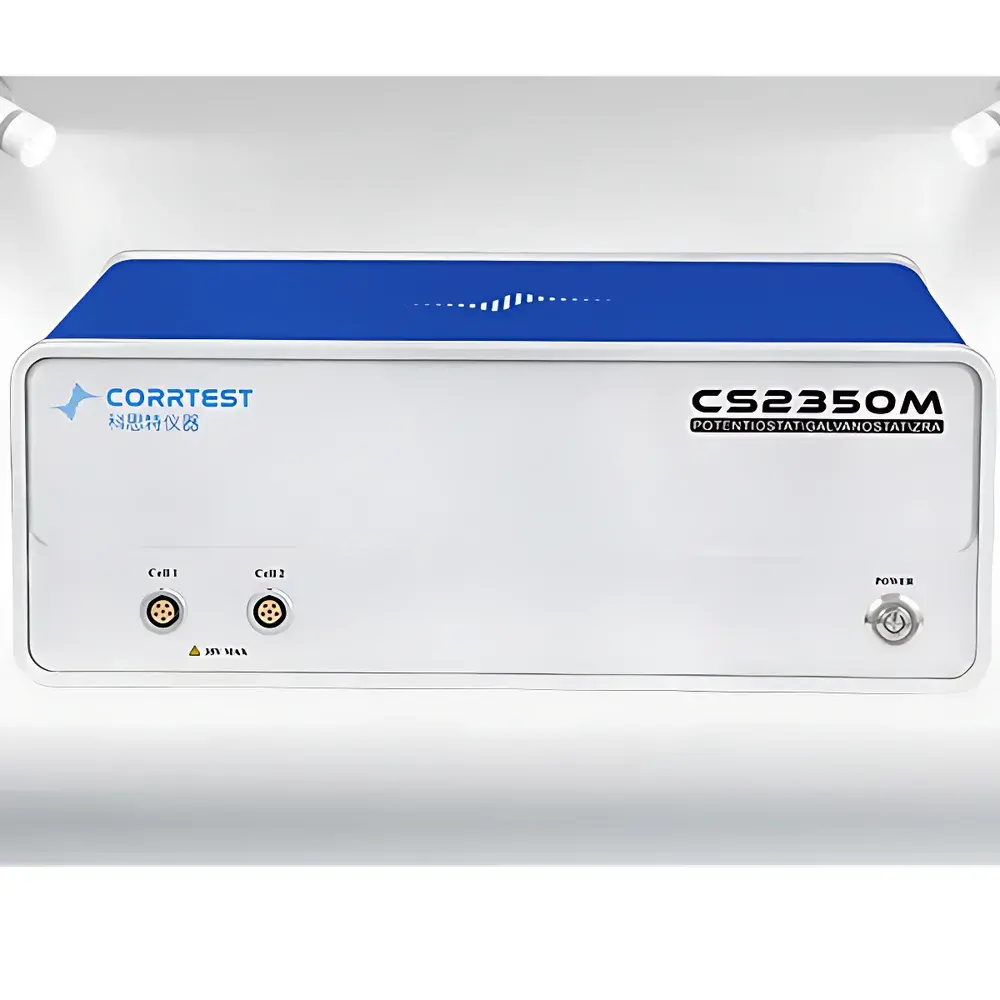
CorrTest CS2350M Dual-Potentiostat/Galvanostat Electrochemical Workstation
| Brand | CorrTest |
|---|---|
| Origin | Hubei, China |
| Model | CS2350M |
| Instrument Type | Dual-Channel Electrochemical Workstation |
| Number of Channels | 2 Independent Potentiostat/Galvanostat Units |
| Current Range | ±1.0 A |
| Current Accuracy | ±0.1% of full-scale reading |
| Potential Accuracy | ±0.1% of full-scale reading ±1 mV |
| Potentiostatic Control Range | ±10 V |
| Electrochemical Impedance Spectroscopy (EIS) Frequency Range | 10 µHz to 1 MHz |
| Input Impedance (Reference Electrode) | 10¹² Ω |
| Current Sensitivity | 1 pA |
| Potential Sensitivity | 3 µV (<10 Hz), 10 µV (>100 Hz) |
| Potentiostat Rise Time | <1 µs (<10 mA), <10 µs (<2 A) |
| Current Ranges | 2 A to 2 nA (10 decades) |
| DA/AD Resolution | 16-bit DAC / 16-bit @ 1 MHz, 20-bit @ 1 kHz ADC |
| Communication Interface | Ethernet |
| Dimensions (W×D×H) | 36.5 × 30.5 × 16 cm |
| Net Weight | 7.5 kg |
Overview
The CorrTest CS2350M Dual-Potentiostat/Galvanostat Electrochemical Workstation is a rigorously engineered two-channel potentiostatic platform designed for advanced electrochemical research and industrial corrosion analysis. Unlike conventional single-channel systems or software-synchronized dual setups, the CS2350M integrates two fully independent, hardware-isolated potentiostat/galvanostat units within a single chassis—each with dedicated working, counter, and reference electrode outputs, independent analog signal paths, and synchronized timing architecture. This true dual-potentiostat design enables simultaneous, phase-coherent control and measurement across two electrochemical interfaces, supporting both independent parallel experiments and tightly coupled multi-electrode configurations—including rotating ring-disk electrode (RRDE), Devanathan-Stachurski hydrogen permeation cells, and four-electrode impedance measurements. The system operates on principles of controlled-potential (potentiostatic) and controlled-current (galvanostatic) electrochemistry, with real-time current and potential acquisition governed by high-fidelity 16-bit DACs and 20-bit ADCs at up to 1 MHz sampling. Its analog front-end is optimized for low-noise, high-bandwidth response—critical for transient techniques such as chronoamperometry, pulse voltammetry, and high-frequency EIS.
Key Features
- Two physically isolated potentiostat/galvanostat channels with independent electrode drive circuitry and signal conditioning paths
- Wide dynamic current range: ±2 A to ±2 nA (10 decades), auto-ranging capability with programmable gain selection
- Precise potential control: ±10 V compliance, ±0.1% full-scale accuracy ±1 mV, sub-microsecond rise time (<1 µs at low currents)
- High-resolution EIS capability: 10 µHz–1 MHz frequency sweep with 0.005% frequency accuracy, 0.1 mV RMS signal resolution, and programmable 8-stage low-pass filtering
- Dedicated RRDE support: Independent voltage programming for disk and ring electrodes with real-time current ratio computation (e.g., for n and %H₂O₂ in ORR studies)
- Hydrogen diffusion analysis mode: Built-in dual-cell synchronization for Devanathan-Stachurski permeation testing with concurrent cathodic charging and anodic oxidation current monitoring
- Ethernet-based communication interface ensuring deterministic latency and compatibility with lab network infrastructure and remote operation protocols
- Robust analog architecture featuring 10¹² Ω reference input impedance, ±21 V槽压 output, and programmable DC bias compensation (±10 V / ±1 A)
Sample Compatibility & Compliance
The CS2350M supports standard three-electrode and four-electrode electrochemical cells, including but not limited to conventional beaker cells, microfluidic electrochemical flow cells, rotating disk/ring-disk electrodes, and custom-designed dual-compartment permeation cells. Its high input impedance and low leakage current design ensure compatibility with high-resistance reference electrodes (e.g., Ag/AgCl, SCE, Hg/HgO) and insulating sample substrates. The instrument meets fundamental requirements for GLP-compliant electrochemical testing environments: all parameter settings, sequence definitions, and raw data streams are timestamped and logged with metadata integrity. While not pre-certified for FDA 21 CFR Part 11, the CS Studio software architecture supports audit-trail-enabling configurations—including user access logs, method versioning, and electronic signature-ready reporting workflows—facilitating internal validation for ISO/IEC 17025 and ASTM G59, G102, G106, and D1141-compliant test protocols.
Software & Data Management
CS Studio is a native Windows-based application developed specifically for CorrTest instrumentation, offering integrated experiment design, real-time visualization, post-acquisition modeling, and report generation. It provides hierarchical method scripting with conditional branching and inter-channel synchronization triggers—enabling complex sequences such as stepped potential RRDE scans or alternating充氢/oxidation cycles in hydrogen permeation tests. All acquired data are stored in open-format binary files (.csd) with embedded metadata (instrument ID, firmware version, calibration timestamps, environmental conditions). Export options include CSV, MATLAB .mat, and ASCII-compatible formats suitable for third-party analysis platforms (e.g., Thales, EC-Lab, Python-based PyEIS). The software includes built-in fitting modules for Butler-Volmer kinetics, Warburg diffusion, and Kramers-Kronig validation of EIS data, with customizable error weighting and convergence criteria. Raw AD/DA registers and hardware status flags are accessible via API for automated integration into LIMS or MES environments.
Applications
- Oxygen reduction reaction (ORR) mechanism studies using rotating ring-disk electrode (RRDE) configuration, enabling quantitative determination of electron transfer number (n) and hydrogen peroxide yield (%H₂O₂) via ring-disk current ratios
- Hydrogen embrittlement and permeation kinetics in structural alloys (e.g., pipeline steels, Ni-based superalloys) using Devanathan-Stachurski dual-electrolyte cells
- High-throughput battery electrode screening with synchronized galvanostatic charge/discharge and potentiostatic hold protocols across two independent cells
- Corrosion rate quantification via linear polarization resistance (LPR), electrochemical noise (EN), and harmonic distortion analysis (HDA)
- Electrocatalyst stability assessment under accelerated stress testing (AST) with simultaneous potential cycling and open-circuit potential (OCP) monitoring
- Double-layer capacitance and charge-transfer resistance mapping in coated metal substrates for coating integrity evaluation per ASTM D1750
FAQ
Can the CS2350M operate both channels simultaneously in different modes (e.g., one in potentiostatic CV and the other in galvanostatic CA)?
Yes—the two channels are hardware-independent and support asynchronous operation with distinct technique selection, parameter sets, and timing schedules.
Is the EIS module capable of multi-sine or broadband impedance measurement?
No—the CS2350M implements single-sine frequency-domain EIS only; it does not support multi-sine or time-domain broadband methods.
Does the system support external triggering from auxiliary equipment (e.g., potentiostat-synchronized spectroelectrochemical modules)?
Yes—TTL-level trigger I/O ports are provided for external start/stop synchronization and event marking during acquisition.
What calibration standards are recommended for routine verification?
CorrTest supplies traceable passive RC networks and precision resistor-capacitor calibration kits aligned with IEC 60601-2-60 and ASTM E2003 guidelines; annual recalibration is recommended for metrological traceability.
Can CS Studio export data directly to MATLAB or Python for custom modeling?
Yes—raw data files include header metadata and are structured for direct loading via provided Python utilities (csd_reader.py) and MATLAB import functions included in the software distribution package.





