
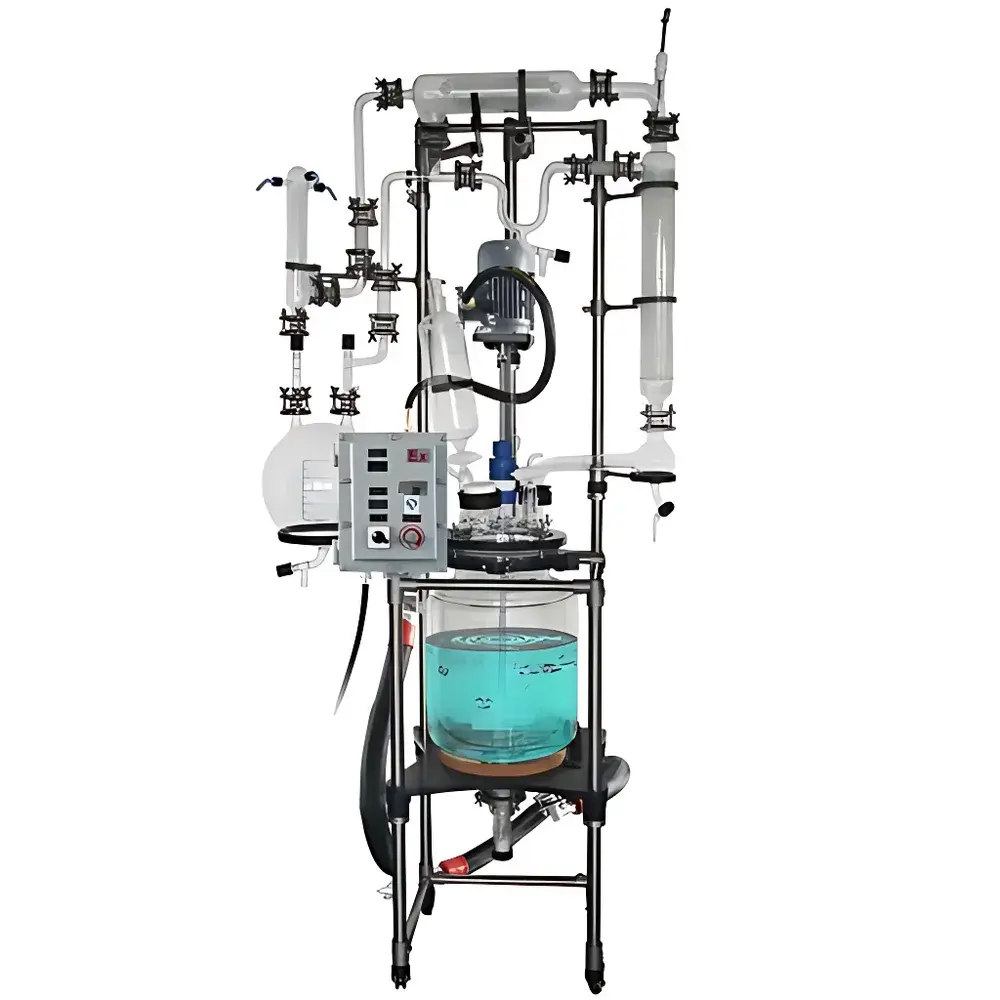
Great Wall GR-30TEx Benchtop Glass Reactor System with Explosion-Proof Control Cabinet
| Brand | The Great Wall |
|---|---|
| Origin | Henan, China |
| Manufacturer Type | Direct Manufacturer |
| Country of Origin | China |
| Model | GR-30TEx |
| Usable Volume | 30 L |
| Vessel Material | Borosilicate Glass 3.3 (DIN ISO 3585) |
| Working Pressure Range | −0.1 to 0.0 MPa (vacuum only) |
| Maximum Vacuum | 0.098 MPa |
| Jacket Volume | ~10 L |
| Condenser Heat Transfer Area | 0.341 m² |
| Temperature Range | −80 °C to +200 °C |
| Stirring Speed Range | 50–500 rpm |
| Motor Power | 180 W |
| Explosion Protection | Exd II BT4 (certified components) |
| Temperature Sensor | Pt100 (±0.1 °C accuracy) |
| Frame Material | SUS304 Stainless Steel |
| Dimensions (W×D×H) | 1200 × 750 × 2750 mm |
Overview
The Great Wall GR-30TEx is a fully integrated, explosion-proof benchtop glass reactor system engineered for safe, precise, and reproducible chemical synthesis, distillation, and reaction monitoring under vacuum and controlled temperature conditions. Designed around the principles of jacketed thermal management and sealed mechanical agitation, it employs a robust borosilicate glass 3.3 (DIN ISO 3585) vessel assembly—capable of withstanding thermal shocks up to 80 °C differential between inner and outer walls—and operates within a certified hazardous-area-rated environment (Exd II BT4). Its modular architecture supports reflux, fractional distillation, and continuous addition protocols via standardized ground-glass joints (e.g., 50# flange, 40# standard taper), enabling seamless integration into multi-step synthetic workflows common in pharmaceutical process development, fine chemical R&D, and academic organic laboratories.
Key Features
- High-integrity glass train: All transparent components fabricated from ASTM E438 Type I, Class A borosilicate glass 3.3—resistant to thermal stress, alkali corrosion, and hydrolytic degradation.
- Wide operational temperature envelope: Compatible with cryogenic cooling (−80 °C using external circulators) and high-temperature heating (up to +200 °C) while maintaining structural integrity and seal reliability.
- Explosion-proof configuration: Equipped with Exd II BT4-certified three-phase asynchronous stirring motor, explosion-proof control cabinet, and intrinsically safe wiring pathways—fully compliant with IEC 60079-1 and GB 3836.1 standards.
- Optimized condensation efficiency: Horizontal condenser (Ø85 mm × 700 mm) packed with Raschig rings and offering 0.341 m² effective heat exchange area; ensures high recovery yields during solvent reflux or distillative workups.
- Stress-minimized thermal jacket interface: Stainless steel insulated flexible hoses connect jacket inlet/outlet ports—eliminating mechanical strain on glass-to-metal junctions during thermal cycling.
- Corrosion-resistant agitation system: PTFE-sheathed SUS304 stirring shaft, paddle-type impeller with PTFE blades, and precision-machined ceramic-sealed bearings prevent particle shedding and ensure long-term vacuum integrity.
- Enhanced process safety: No-liquid-retention side discharge valve with PTFE-lined body; dual-layer Pt100 sensor sheathed in PTFE tubing for accurate, chemically inert temperature feedback.
- Mobility and stability: SUS304 frame with locking casters allows repositioning without compromising level alignment or vibration isolation during operation.
Sample Compatibility & Compliance
The GR-30TEx accommodates a broad spectrum of reactive media—including strong acids (e.g., H₂SO₄, HCl), bases (NaOH, KOH), halogenated solvents (CH₂Cl₂, CHCl₃), and organometallic reagents—without degradation of glass or sealing surfaces. Its design conforms to key international laboratory safety and quality frameworks: ISO 9001-certified manufacturing processes; compatibility with GLP-compliant documentation practices; and adherence to mechanical integrity requirements outlined in ASTM E2500 (Good Engineering Practice for Equipment Qualification). All explosion-proof components carry valid third-party certification marks traceable to national explosion protection testing institutes in China and recognized by ATEX-notified bodies.
Software & Data Management
While the GR-30TEx operates as a standalone analog-digital hybrid system (featuring digital RPM display and Pt100-based temperature readout), its electrical architecture supports optional RS485/Modbus RTU integration for connection to centralized lab automation platforms. When interfaced with validated SCADA or LIMS systems, it enables time-stamped logging of critical parameters—including setpoints, actual temperatures, stirring speed, and vacuum levels—meeting audit trail requirements per FDA 21 CFR Part 11 when paired with appropriate electronic signature and access control modules. Data export formats include CSV and XML for post-run kinetic analysis or regulatory submission packages.
Applications
This reactor system is routinely deployed in: controlled exothermic Grignard reactions requiring sub-zero initiation temperatures; catalytic hydrogenation under reduced pressure; vacuum-assisted solvent removal in API intermediate purification; fractional distillation of low-boiling azeotropes; and scale-up feasibility studies bridging flask-based screening and pilot-plant trials. Its modular joint configuration also permits retrofitting with inline FTIR probes, pH electrodes, or automated dosing units—making it suitable for Design of Experiments (DoE)-driven process optimization aligned with Quality by Design (QbD) principles.
FAQ
Is the GR-30TEx suitable for use in Class 1 Division 1 hazardous locations?
Yes—its Exd II BT4 rating certifies suitability for Group IIB explosive atmospheres containing ethylene-class vapors, provided installation follows NEC Article 500 and local authority AHJ requirements.
Can the reactor be operated under positive pressure?
No—the vessel is rated exclusively for vacuum service (−0.1 to 0.0 MPa); positive pressure operation is prohibited per design specification and safety certification.
What maintenance intervals are recommended for the stirring seal and bearings?
Under normal usage (≤8 hrs/day, non-abrasive media), inspect PTFE seals annually; replace ceramic bearings every 24 months or after 10,000 operational hours—whichever occurs first.
Does the system include validation documentation for GMP environments?
Factory-supplied IQ/OQ protocols are available upon request; full PQ support requires site-specific execution by qualified personnel in accordance with Annex 15 and EU GMP guidelines.
Are replacement glass components supplied with dimensional traceability reports?
Yes—all glassware carries batch-specific calibration certificates referencing DIN 12331 and ISO 8573-1 purity classifications for ground-joint tolerances.



