
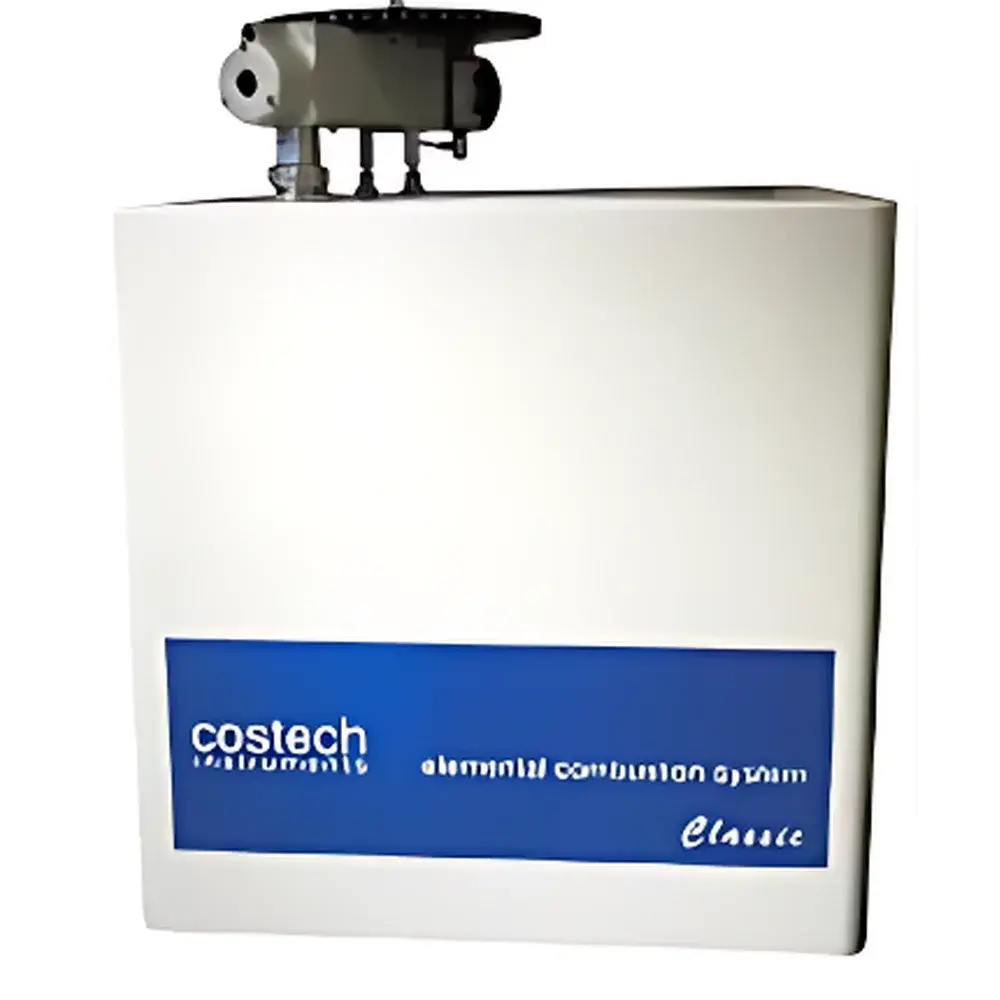
Costech ECS 4024 CHNSO Elemental Analyzer
| Origin | Italy |
|---|---|
| Manufacturer Type | Authorized Distributor |
| Origin Category | Imported |
| Model | Costech ECS 4024 |
| Price Range | USD 13,500 – 27,000 |
Overview
The Costech ECS 4024 CHNSO Elemental Analyzer is a high-precision, fully automated combustion-based instrument engineered for quantitative determination of carbon (C), hydrogen (H), nitrogen (N), sulfur (S), and oxygen (O) in organic and organometallic samples. It operates on the Dumas combustion principle—where sample material is flash-combusted in a high-temperature oxygen-rich environment (800–1100 °C) within a controlled quartz reactor—followed by catalytic reduction and gas-phase separation. Combustion products—including CO₂, H₂O, SO₂, N₂, and CO (for oxygen quantification)—are carried by ultra-high-purity helium carrier gas through a thermostatically regulated gas chromatographic (GC) column (30–110 °C programmable). Separation enables sequential detection using a proprietary, self-calibrating thermal conductivity detector (TCD), eliminating reliance on reference gases or external calibration standards. Designed for laboratory environments requiring regulatory compliance and long-term measurement stability, the ECS 4024 meets foundational requirements for GLP, ISO/IEC 17025, and USP / elemental impurities testing workflows.
Key Features
- Fully automated analysis workflow with integrated combustion, separation, and detection modules
- Self-calibrating TCD detector—no external reference gases required; drift-compensated signal processing ensures long-term baseline stability
- Triple sample introduction options: manual loader, pneumatic autosampler (stackable carousel supporting up to 147 positions), and electronic autosampler (32/50/100-position rotating trays)
- Modular architecture enabling direct interfacing with external isotope-ratio mass spectrometers (e.g., Thermo Scientific Delta V, Picarro G2131-i) for δ¹³C, δ¹⁵N, δ³⁴S, and δ¹⁸O stable isotope analysis
- Real-time combustion chamber monitoring via integrated top-view optical inspection port
- Flexible GC column temperature control (30–110 °C) for optimized resolution of CO₂, H₂O, SO₂, N₂, and CO peaks
- Low operational cost design: no liquid nitrogen or cryogenic traps; minimal consumables (quartz tubes, catalysts, GC columns)
Sample Compatibility & Compliance
The ECS 4024 accommodates solid, liquid, and viscous samples across diverse matrices—including pharmaceutical APIs, marine biomass, petrochemical feedstocks, foodstuffs, polymers, and environmental sediments—with sample mass ranging from 0.01 mg to 200 mg (dependent on C/H/N/S/O content and homogeneity). Its performance complies with ASTM D5291 (standard test method for instrumental determination of elements in petroleum products), ISO 14852 (determination of ultimate aerobic biodegradability), and EN 15936 (determination of total organic carbon in soils). The system supports audit-ready data integrity through optional EAS CLARITY software with 21 CFR Part 11-compliant user access controls, electronic signatures, and immutable audit trails.
Software & Data Management
EAS CLARITY software provides comprehensive instrument control, peak integration, calibration management (linear, quadratic, cubic curve fitting), and customizable reporting. It enables real-time chromatogram visualization, automatic baseline correction, and retention time alignment across multi-day sequences. Raw data files are stored in vendor-neutral formats (.csv, .txt) and support batch reprocessing. Calibration curves can be validated per ICH Q2(R2) guidelines, with residual error mapping and outlier detection. Integration with LIMS platforms is supported via standard OPC UA and ASCII file export protocols.
Applications
- Pharmaceutical quality control: verification of elemental composition in active pharmaceutical ingredients (APIs) and excipients per ICH Q5D and USP
- Environmental research: quantification of C/N ratios in soil organic matter, sedimentary carbon sequestration studies, and microplastic characterization
- Food and agriculture: protein content estimation (via nitrogen), adulteration screening, and nutritional labeling compliance
- Petrochemical R&D: sulfur speciation in fuels, hydrocarbon compositional profiling, and catalyst poisoning assessment
- Academic and isotopic geochemistry labs: preparation of CO₂, N₂, and SO₂ gases for offline IRMS analysis
FAQ
What combustion temperature range does the ECS 4024 support?
The oxidation/reduction furnace operates between 800 °C and 1100 °C, with precise PID-controlled temperature stability ±0.5 °C.
Is helium the only acceptable carrier gas?
Yes—ultra-high-purity helium (99.999%, 3–5 bar) is mandatory for optimal GC separation and TCD sensitivity; argon or nitrogen are incompatible due to thermal conductivity mismatch.
Can the system quantify oxygen without pyrolysis?
Yes—oxygen is determined via high-temperature pyrolysis in graphite-packed reactors, generating CO, which is separated and detected alongside N₂ and CO₂.
Does the analyzer require daily recalibration?
No—self-calibrating TCD design and robust baseline compensation algorithms enable stable operation over multi-day sequences without manual recalibration.
How is data security ensured during regulatory audits?
With EAS CLARITY’s 21 CFR Part 11 module enabled, all user actions, method changes, and result modifications are timestamped, digitally signed, and archived in an unalterable audit trail.





