
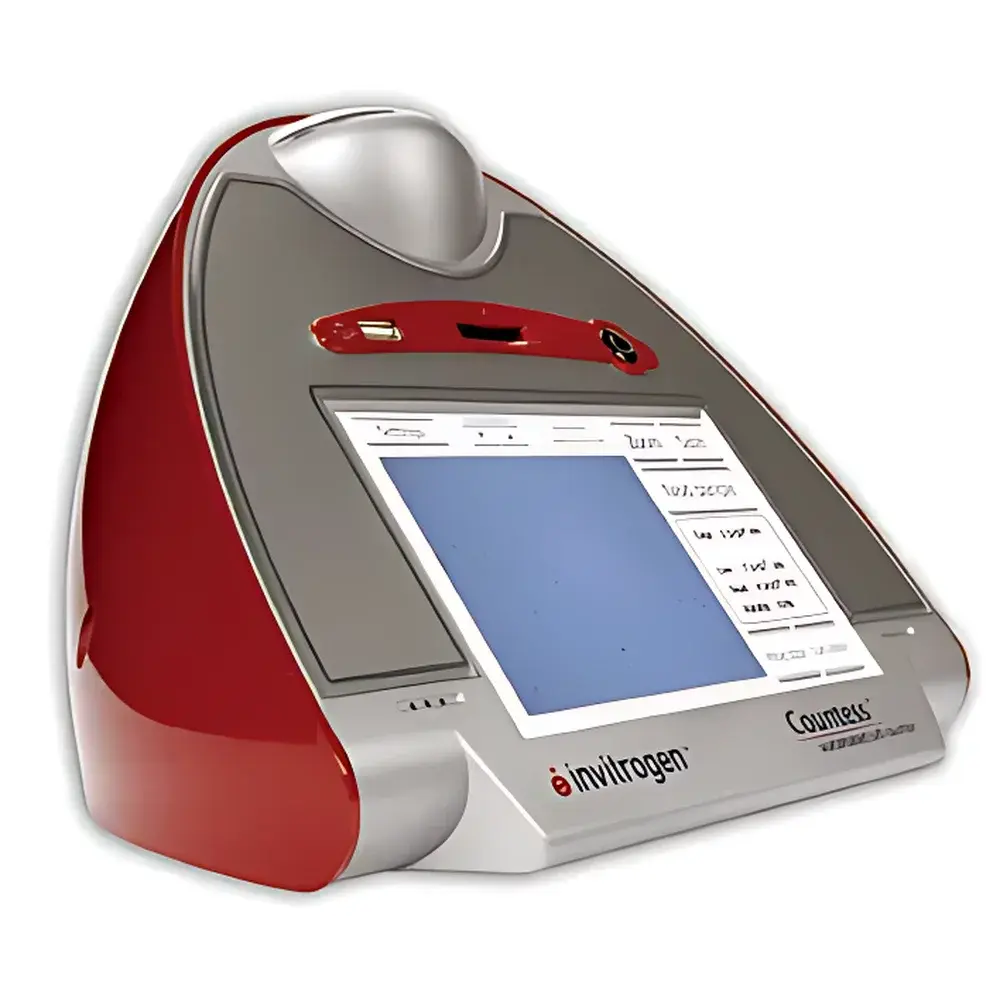
Countess® Automated Cell Counter by Thermo Fisher Scientific (formerly Life Technologies)
| Brand | Thermo Fisher Scientific |
|---|---|
| Origin | USA |
| Model | Countess® |
| Detection Range | 1 × 10⁴ – 1 × 10⁷ cells/mL (optimal: 1 × 10⁵ – 4 × 10⁶ cells/mL) |
| Cell Size Range | 5 – 60 µm |
| Sample Volume | 10 µL |
| Counting Time | ≤30 seconds |
| Staining Method | Trypan Blue exclusion |
| Data Storage | Internal memory with USB export capability |
| Dimensions | 27 × 20 × 19 cm |
| Consumable | Single-use disposable counting chambers |
Overview
The Countess® Automated Cell Counter, developed by Thermo Fisher Scientific (originally introduced under the Life Technologies brand), is a benchtop digital imaging cytometer engineered for rapid, objective, and reproducible cell enumeration and viability assessment in routine and high-throughput life science workflows. It operates on the principle of brightfield microscopy combined with automated image acquisition and proprietary pixel-based segmentation algorithms optimized for trypan blue-stained samples. Unlike manual hemocytometer-based counting—which introduces inter-operator variability, subjective thresholding, and sampling error—the Countess® system standardizes analysis by quantifying total, viable, and non-viable cells based on morphological contrast and dye exclusion kinetics. Its optical architecture supports consistent focus across variable cell densities and sizes (5–60 µm), enabling reliable quantification of adherent, suspension, and primary cell types without user calibration or optical alignment.
Key Features
- Rapid analysis: Delivers total cell count, viability percentage, and mean cell diameter within ≤30 seconds per sample using only 10 µL of suspension.
- Objective viability determination: Relies on standardized trypan blue staining (0.4% w/v) and algorithmic discrimination of membrane-intact (unstained) versus compromised (blue-stained) cells—eliminating subjective gating or manual threshold adjustment.
- Broad dynamic range: Accurately quantifies concentrations from 1 × 10⁴ to 1 × 10⁷ cells/mL, with highest precision between 1 × 10⁵ and 4 × 10⁶ cells/mL—exceeding the linear range of traditional hemocytometers.
- Minimal maintenance design: No fluidics, lasers, or moving optical components; no daily cleaning protocols or alignment procedures required.
- Integrated data management: Stores up to 100 sample records internally; supports export via USB to CSV or PDF for traceability and integration into LIMS or electronic lab notebooks (ELN).
- Biosafety compliance: Uses sterile, single-use, dual-chamber disposable slides—reducing cross-contamination risk and eliminating decontamination steps between hazardous samples (e.g., HIV, BSL-2 pathogens).
Sample Compatibility & Compliance
The Countess® platform accommodates mammalian suspension cells (e.g., CHO, HEK293, Jurkat), primary isolates (PBMCs, neurons), yeast, and algae within the specified size and concentration windows. It is routinely employed in GLP- and GMP-aligned environments where documentation integrity is critical; while the instrument itself does not natively support FDA 21 CFR Part 11-compliant audit trails, exported data files retain timestamped metadata (date/time, user ID, dilution factor, chamber lot number) suitable for regulatory submission when paired with appropriate SOPs. The system complies with IEC 61010-1 safety standards for laboratory electrical equipment and meets CE marking requirements for in vitro diagnostic use in the EU.
Software & Data Management
The embedded firmware provides a streamlined, icon-driven interface accessible via integrated LCD touchscreen—no external PC or software installation required. All processing occurs onboard; images are not retained post-analysis unless explicitly saved. Exported CSV files contain raw counts, viability %, average diameter (µm), coefficient of variation (%CV), and statistical confidence metrics derived from multiple field-of-view sampling. For laboratories requiring centralized data governance, third-party middleware (e.g., LabVantage, Benchling) can ingest exported datasets via automated folder monitoring or API integration. Firmware updates are delivered via USB stick and validated per Thermo Fisher’s quality-controlled release process.
Applications
- Cell culture QC: Daily monitoring of passage-ready confluency, pre-transfection seeding density, and post-thaw recovery assessment.
- Flow cytometry core labs: Standardized input cell counts prior to antibody staining or sorting—ensuring assay reproducibility across operators and instruments.
- High-throughput screening (HTS): Integration into automated liquid handling workflows where rapid, low-volume cell quantification precedes plate-based assays (e.g., cytotoxicity, proliferation).
- Infectious disease research: Safe enumeration of pathogen-infected cells (e.g., HIV-infected T-cells, SARS-CoV-2–infected Vero E6) using disposable slides and closed-system operation.
- Stem cell and organoid characterization: Assessment of dissociated single-cell suspensions prior to reaggregation or differentiation protocols.
FAQ
Does the Countess® require regular calibration?
No. The system uses fixed-focus optics and factory-calibrated image analysis algorithms; no user-performed calibration is necessary.
Can it count unlabeled (unstained) cells?
No. The Countess® relies on trypan blue contrast for viability discrimination and requires staining for accurate classification; unstained samples yield unreliable viability estimates.
Is the instrument compatible with other dyes (e.g., acridine orange/propidium iodide)?
No. The optical filter set and analysis firmware are optimized exclusively for trypan blue; alternative dyes are not supported.
How many users can be configured on the device?
Up to 10 unique user profiles can be stored, each with individual login credentials and access logs for audit purposes.
What is the shelf life of the disposable counting chambers?
Unopened chambers maintain performance specifications for 12 months when stored at room temperature (15–30°C) in original packaging.
Related Products




