
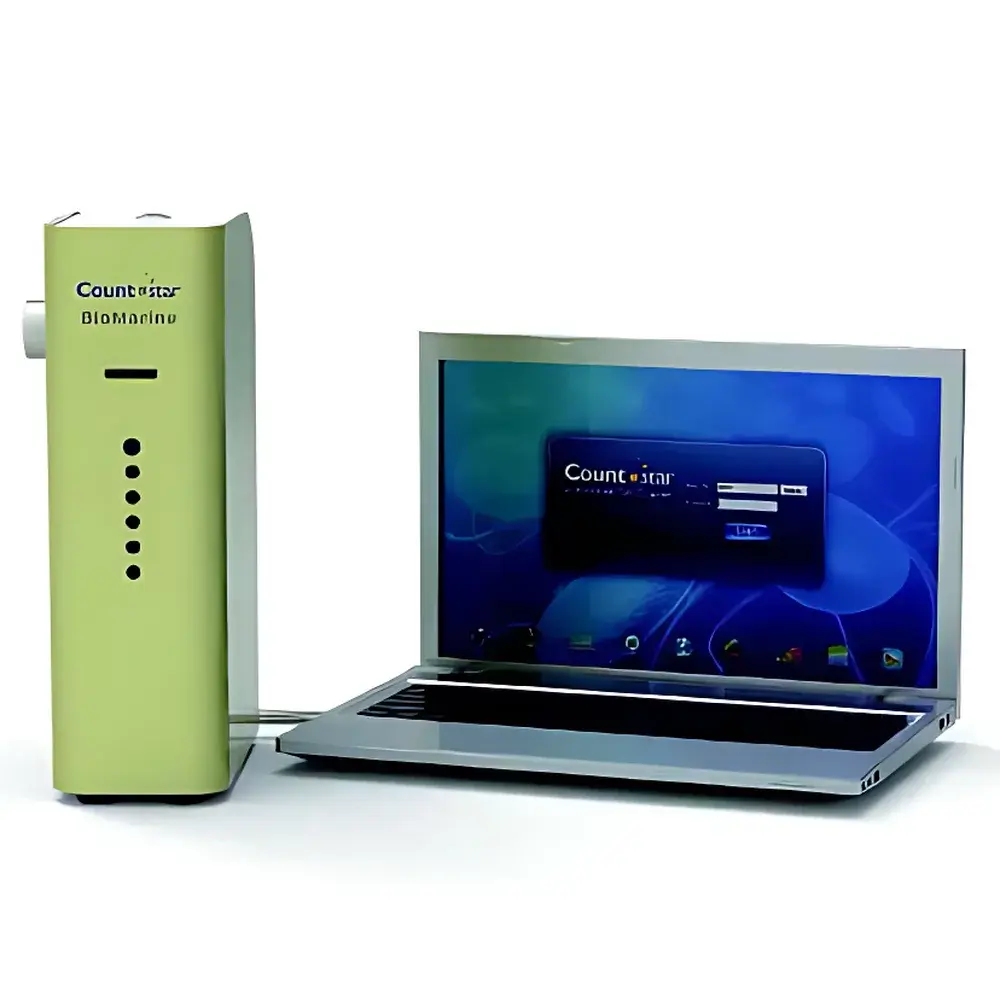
Countstar BioMarine IA1000 Automated Algal Cell Counter
| Brand | Countstar |
|---|---|
| Origin | Shanghai, China |
| Model | IA1000 |
| Analysis Time | <20 s |
| Detection Concentration Range | 5×10⁴–5×10⁷ cells/mL |
| Sample Volume | 20 µL |
| Throughput | 5 samples per run |
| Detectable Cell Size Range | 2–180 µm |
Overview
The Countstar BioMarine IA1000 Automated Algal Cell Counter is a dedicated digital imaging cytometer engineered for high-precision quantification of microalgal populations in research, aquaculture, biotechnology, and environmental monitoring laboratories. Unlike generic cell counters optimized for mammalian or yeast cells, the IA1000 employs a purpose-built optical path and morphology-aware image segmentation algorithms calibrated specifically for phytoplankton diversity — including unicellular species (e.g., Chlamydomonas, Dunaliella), colonial forms (e.g., Volvux), filaments (e.g., Spirulina, Oscillatoria), and chain-forming diatoms (e.g., Thalassiosira). It operates on the principle of brightfield microscopy coupled with adaptive thresholding and multi-feature classification (size, aspect ratio, convexity, texture), enabling reliable discrimination between viable algal cells, detritus, air bubbles, and non-target particulates. The system delivers absolute concentration (cells/mL), morphometric parameters (major/minor axis, area, circularity), and time-series growth kinetics — all without manual gating or user-dependent threshold adjustments.
Key Features
- High-speed analysis: Full quantification and morphological profiling completed in under 20 seconds per sample
- Broad morphotype coverage: Validated detection of spherical, ellipsoidal, cylindrical, filamentous, and colonial algae within a 2–180 µm axial dimension range
- 5-megapixel scientific-grade CMOS sensor with adjustable illumination intensity and focus stability across repeated acquisitions
- Proprietary AI-assisted recognition engine trained on >120 algal taxa, minimizing false positives from organic debris and sediment particles
- Automated size-based subpopulation segmentation: Enables parallel enumeration of co-cultured species (e.g., Nannochloropsis + Tetraselmis) based on calibrated dimensional thresholds
- Integrated growth curve generator: Computes doubling time, lag phase duration, and exponential rate from serial time-point data exported in CSV or Excel format
Sample Compatibility & Compliance
The IA1000 accepts standard 20 µL volumes loaded via sterile disposable counting slides (compatible with ISO 13318-1 particle sizing standards for optical microscopy). It supports raw culture broth, centrifuged pellets resuspended in saline or culture medium, and preserved field-collected water samples (with optional filtration pre-treatment). No staining or fixation is required for routine enumeration, preserving physiological integrity for downstream assays. While not certified for clinical diagnostics, the instrument’s performance aligns with ASTM D6708–22 (Standard Practice for Statistical Assessment of Automated Particle Counters) and meets GLP-relevant documentation requirements, including audit-trail-enabled user logins, timestamped result exports, and configurable report templates compliant with internal QA protocols.
Software & Data Management
The IA1000 runs on Countstar’s proprietary AlgaeAnalysis Suite v4.x, a Windows-based application supporting multi-user role permissions (Administrator, Technician, Viewer). All image datasets are stored locally with optional network drive backup; metadata (operator ID, date/time, slide ID, instrument calibration status) is embedded in each .cst file. Software features include batch processing of up to 5 samples, customizable export fields (concentration, mean diameter, CV%, viability proxy index), and direct integration with LIMS via ODBC-compliant database connectors. Audit trail functionality records all parameter changes, result edits, and software updates — satisfying traceability expectations under FDA 21 CFR Part 11 for non-GMP research environments.
Applications
- Microalgal strain selection and biomass optimization in biofuel and nutraceutical production
- Monitoring bloom dynamics and species succession in mesocosm and wastewater treatment studies
- Quality control of live feed cultures (e.g., Tetraselmis, Isochrysis) in marine hatcheries
- Ecotoxicology assessments where algal growth inhibition serves as an endpoint (OECD 201, ISO 8692)
- Phytoplankton community analysis in limnological and oceanographic field campaigns
- Teaching laboratory modules on quantitative phycology and digital image-based cytometry
FAQ
Does the IA1000 require calibration with reference beads or standard cultures?
No — the system uses factory-calibrated optics and a fixed pixel-to-micron mapping. Routine verification is performed using NIST-traceable polystyrene microspheres (10 µm and 50 µm) supplied with each instrument.
Can it distinguish live from dead algal cells?
Not inherently via brightfield alone; however, optional integration with fluorescent dyes (e.g., FDA/PI) is supported through custom protocol configuration and third-party filter cubes.
Is the software compatible with macOS or Linux operating systems?
No — AlgaeAnalysis Suite requires Windows 10/11 (64-bit) with .NET Framework 4.8 and DirectX 12 support.
What maintenance is required beyond daily cleaning of the slide holder and lens?
Annual recalibration by authorized service engineers is recommended; no consumables other than disposable counting slides are needed during normal operation.
How does the IA1000 handle highly motile species such as Euglena or dinoflagellates?
The automated focus-lock algorithm captures motion-stabilized frames at 30 fps; combined with temporal averaging across 5–8 consecutive images, motility-induced counting artifacts are reduced to <3% CV in validated test runs.



