
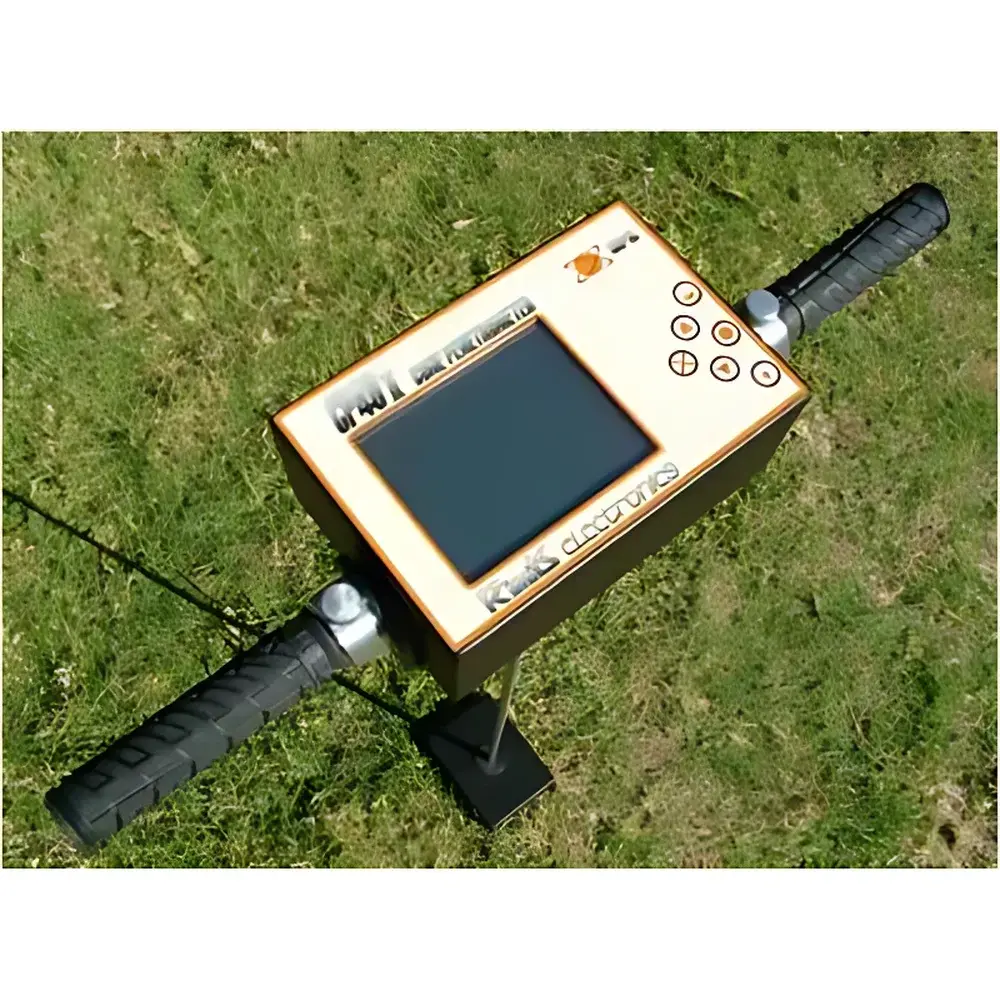
CP40II Soil Compaction Meter by RMF
| Brand | RMF |
|---|---|
| Origin | Australia |
| Model | CP40II |
| Max Cone Index | 5600 kPa (at 75 kg load) |
| Max Measurable Depth | 750 mm |
| Resolution | 0.03 kg |
| Display | 20×16-character LED |
| Data Storage | 512 KB non-volatile flash memory (up to 2047 data points across 75 profiles) |
| Ultrasonic Depth Sensor Accuracy | ±2 mm |
| Operating Temperature | −10 °C to +60 °C |
| Communication | RS-232 serial interface, 9600 bps |
| Battery | Rechargeable 3000 mAh Li-ion |
| Instrument Weight | 3.9 kg |
| Total System Weight (incl. case & accessories) | 9 kg |
| Dimensions (instrument only, no GPS module) | 560 × 1073 × 130 mm |
| Carrying Case Dimensions | 470 × 358 × 175 mm |
Overview
The CP40II Soil Compaction Meter, engineered by RMF and manufactured in Australia, is a field-deployable, handheld penetrometer designed for quantitative assessment of soil mechanical resistance—commonly expressed as cone index (CI) or cone penetration resistance (qc). It operates on the fundamental principle of quasi-static cone penetration testing (CPT), where a standardized conical probe is driven vertically into undisturbed soil at controlled rates, and the force required per unit cross-sectional area is recorded as a function of depth. This measurement directly correlates with soil strength, density, root zone restriction, and structural integrity—critical parameters in agricultural land management, civil infrastructure evaluation, environmental site assessment, and ecological restoration planning. Unlike empirical hardness testers, the CP40II integrates real-time ultrasonic depth sensing and high-resolution load transduction to deliver traceable, depth-synchronized CI profiles with metrological consistency suitable for longitudinal monitoring and regulatory reporting.
Key Features
- High-fidelity dual-range load measurement: Capable of resolving cone indices up to 5600 kPa under maximum 75 kg applied load, with extended low-range sensitivity down to 2200 kPa—enabling precise characterization across diverse soil types from loose sands to compacted clay subgrades.
- Integrated ultrasonic depth sensor: Provides continuous, contactless depth tracking with ±2 mm accuracy up to 750 mm, eliminating manual tape-based depth errors and enabling seamless generation of depth-resolved CI curves.
- Dedicated 20×16-character LED display: Optimized for outdoor legibility under variable ambient lighting; supports simultaneous readout of current cone index, depth, battery status, and profile ID.
- Robust onboard data storage: 512 KB non-volatile flash memory retains up to 2047 individual measurements distributed across 75 independent sampling profiles—sufficient for multi-site surveys without real-time PC connection.
- Field-serviceable architecture: Modular probe assembly, IP65-rated enclosure, and industrial-grade Li-ion battery (3000 mAh) ensure operational reliability across temperature extremes (−10 °C to +60 °C) and rugged terrain conditions.
Sample Compatibility & Compliance
The CP40II is validated for use in mineral soils, structured loams, gravelly substrates, and engineered fill materials. It complies with ASTM D3441 (Standard Test Method for Mechanical Cone Penetration Tests of Soils) for field CPT execution protocols and aligns with ISO 23470:2021 (Soil quality — Determination of soil compaction using cone penetrometers). Its measurement traceability supports GLP-compliant data acquisition when paired with RMF’s certified calibration kit (NIST-traceable reference loads). While not a laboratory-grade instrument, its repeatability (< ±3% CI variation across repeated insertions at same location) meets requirements for Tier-2 site characterization under EPA Region 4 guidance for brownfield redevelopment assessments.
Software & Data Management
Data export is performed via RS-232 serial interface (9600 bps) to Windows-compatible desktop software (RMF SoilProfiler v4.x). The application enables visualization of CI vs. depth plots, statistical aggregation per profile (mean, standard deviation, layer-wise thresholds), GIS coordinate tagging (when used with optional external GPS module), and automated report generation in PDF/CSV formats. All exported datasets include embedded metadata: timestamp, operator ID, temperature, battery voltage, and instrument serial number—supporting audit readiness under ISO/IEC 17025 and FDA 21 CFR Part 11 compliant environments when configured with user authentication and electronic signature modules.
Applications
- Agricultural soil health monitoring: Identifying compaction layers affecting root penetration, water infiltration, and nutrient transport—supporting precision tillage decisions and cover crop strategy validation.
- Roadway and airfield subgrade evaluation: Quantifying bearing capacity pre- and post-construction to verify compliance with FAA AC 150/5320-6D or AASHTO T 256 specifications.
- Landfill cap integrity verification: Detecting desiccation cracks or settlement-induced density loss in clay-based final covers.
- Ecological restoration baseline studies: Documenting pre- and post-revegetation soil mechanical recovery in mined or degraded landscapes.
- Forestry site preparation assessment: Evaluating skid trail compaction impact on seedling establishment success rates.
FAQ
What is the recommended calibration frequency for the CP40II?
Annual calibration against NIST-traceable reference loads is recommended; field verification using the included 10 kg and 50 kg test weights should be performed before each survey day.
Can the CP40II be used in saturated or frozen soils?
Operation in saturated soils is permissible but requires probe cleaning after each insertion to prevent clogging; use in frozen soils (>0 °C bulk temperature) is not advised due to risk of sensor damage and non-representative brittle failure response.
Does the instrument support Bluetooth or Wi-Fi connectivity?
No—data transfer is exclusively via RS-232 serial interface; wireless capability is not integrated to maintain electromagnetic immunity in high-noise field environments.
Is the ultrasonic depth sensor affected by soil texture or moisture content?
Ultrasonic performance remains stable across clay, silt, sand, and gravel matrices; however, surface standing water or heavy surface mulch may attenuate signal return and require manual depth offset correction.
How is measurement reproducibility ensured across operators?
The CP40II includes a guided insertion rate indicator (LED feedback loop) and fixed probe geometry to minimize operator-dependent variables; inter-operator CV remains <4.2% when following ASTM D3441 insertion speed guidelines (1–2 cm/s).







