
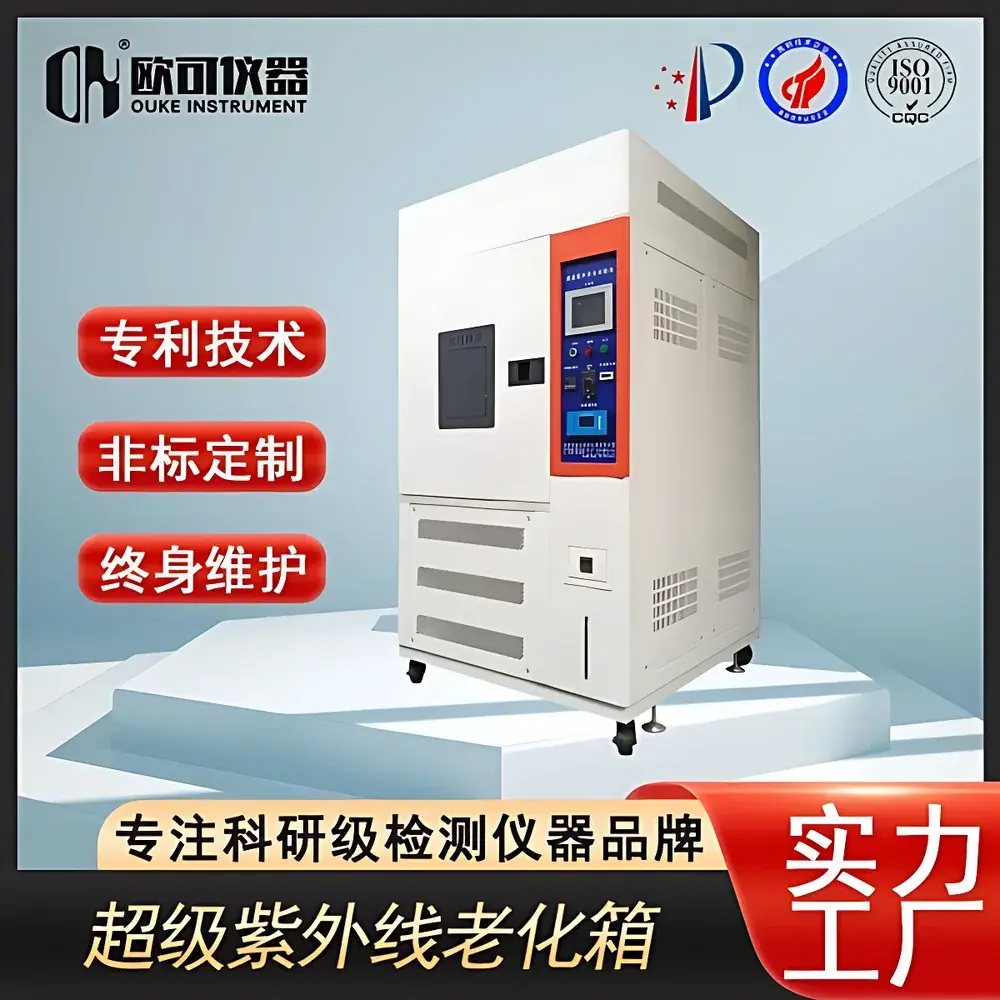
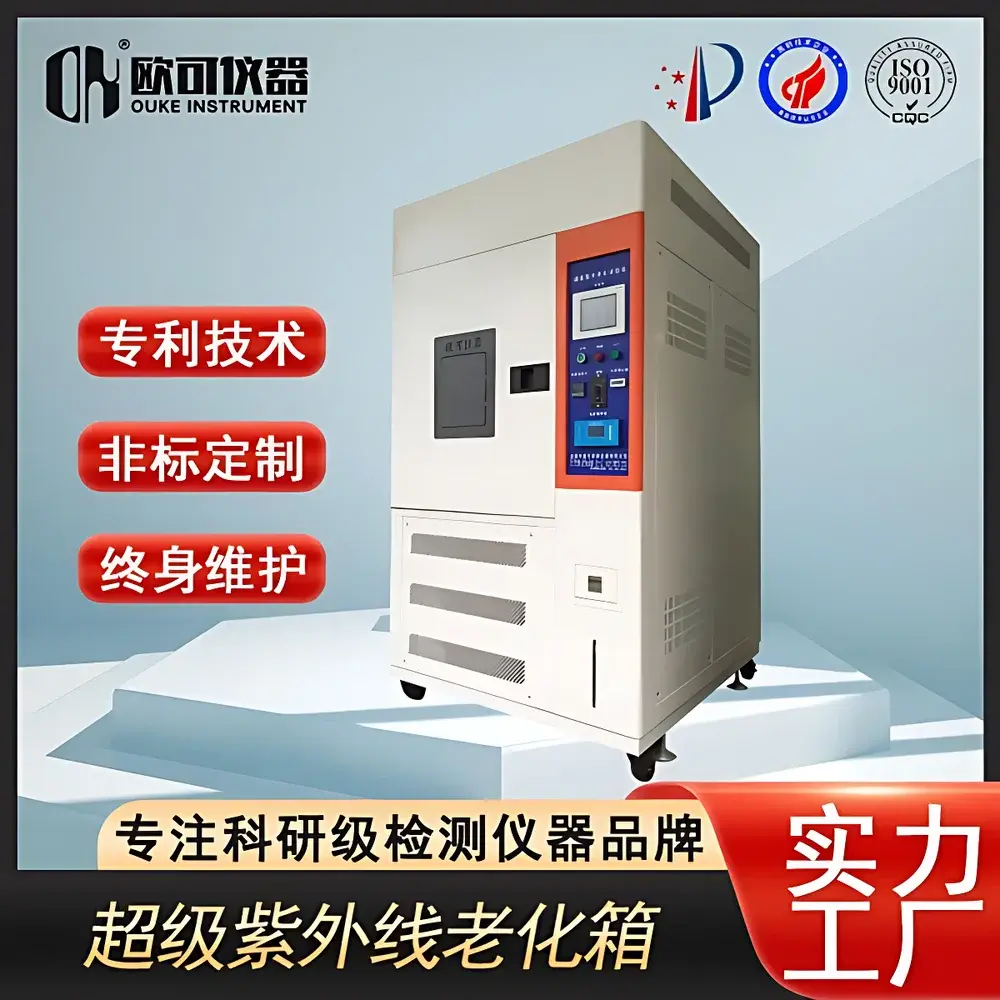
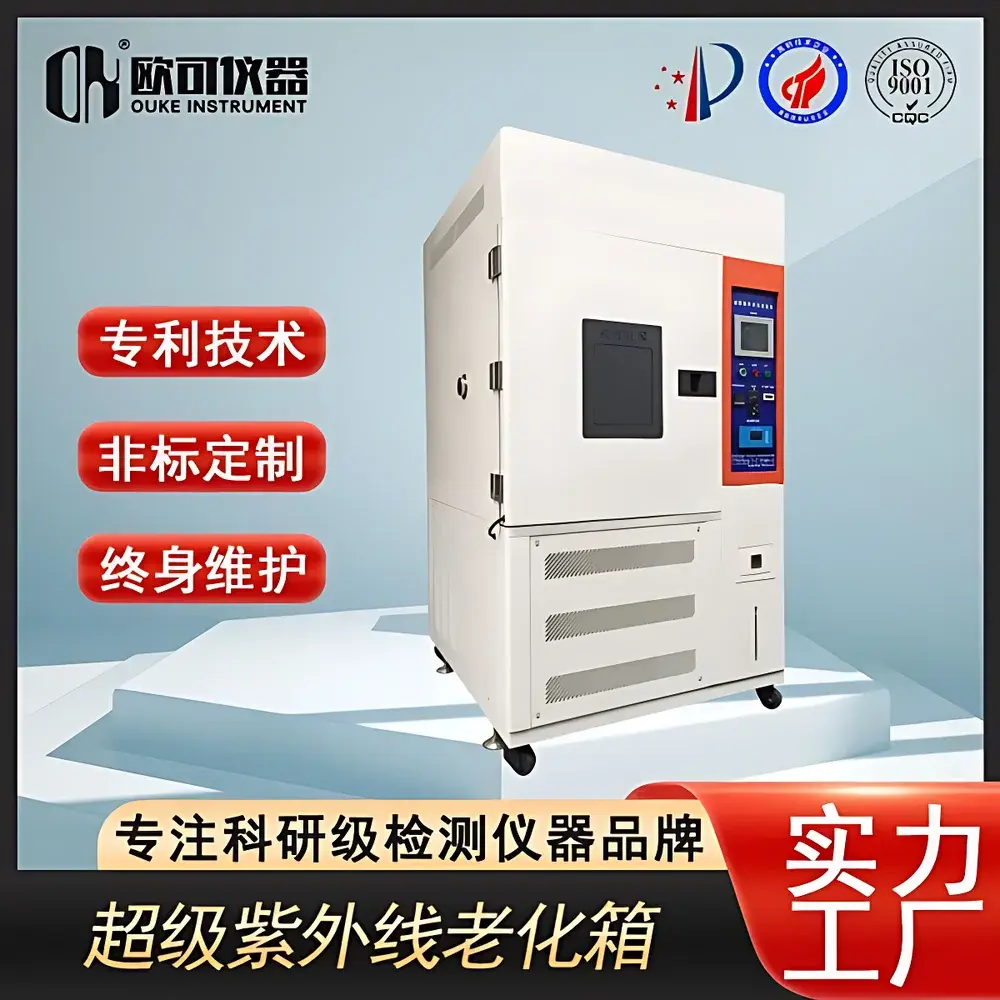
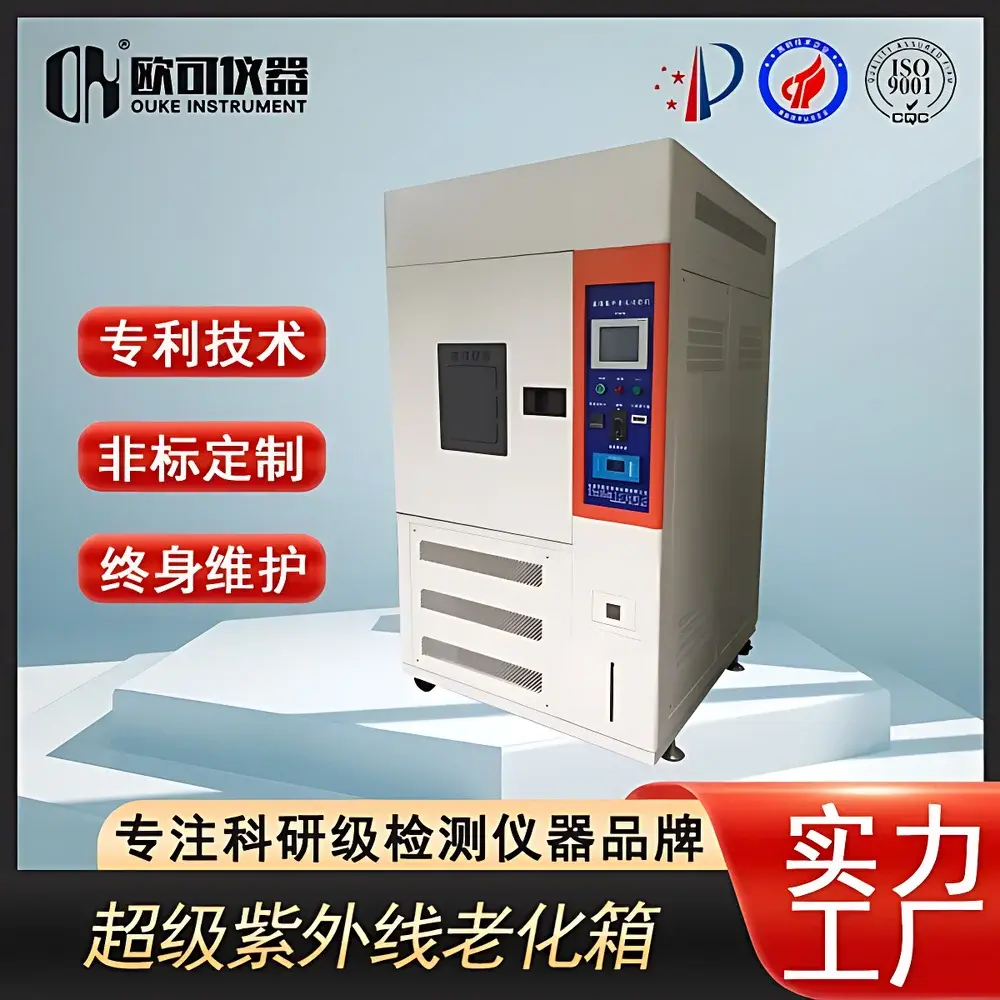
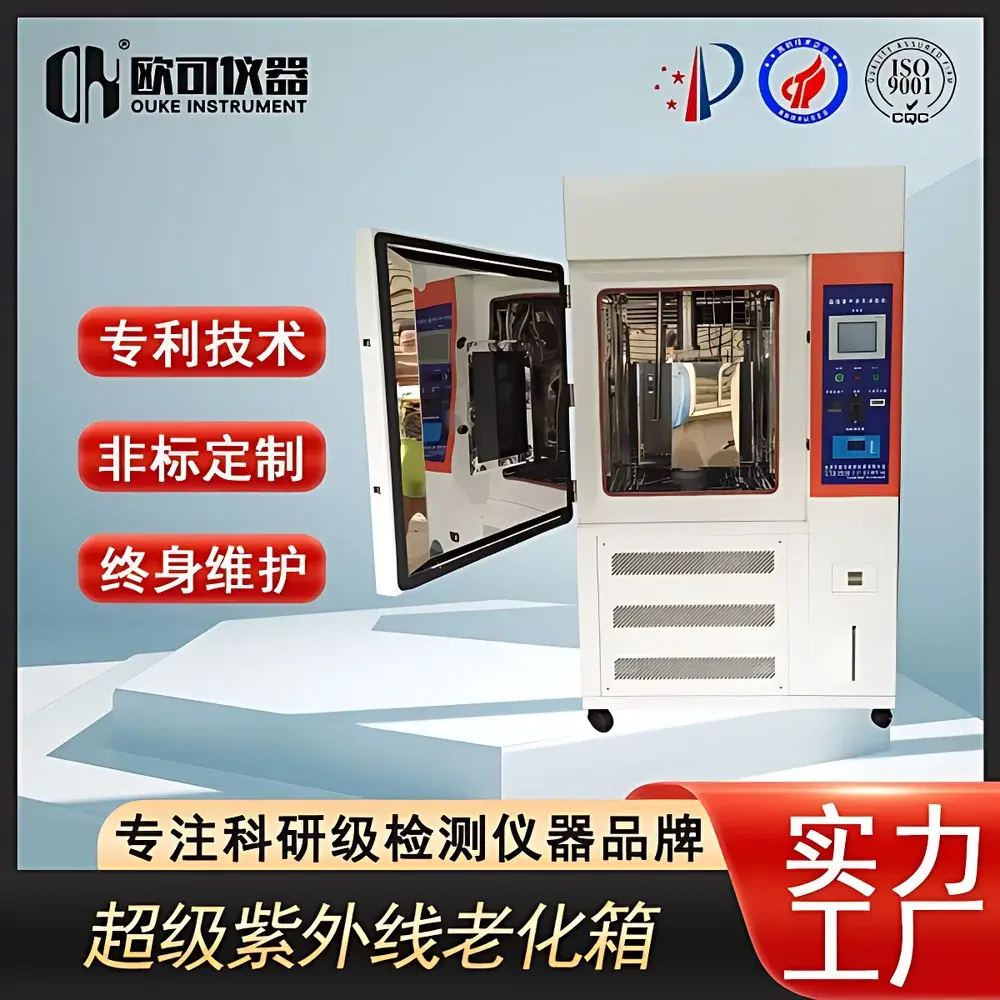
OK-CQUV Super QUV Ultraviolet Accelerated Weathering Tester
| Brand | OK Instruments |
|---|---|
| Origin | Guangdong, China |
| Manufacturer Type | Direct Manufacturer |
| Product Category | Domestic |
| Model | OK-CQUV |
| Humidity Range | ≥95% RH (in-chamber actual value) |
| Lamp Power | 40 W per tube |
| Irradiance Range | 0.72 W/m² |
| Test Duration | 1–9999 h (adjustable) |
| Illumination Temperature Range | 70 °C |
| UV Wavelength Range | 300–400 nm |
| Chamber Dimensions (L×W×H) | 800 × 600 × 500 mm |
Overview
The OK-CQUV Super QUV Ultraviolet Accelerated Weathering Tester is an engineered laboratory instrument designed to replicate and accelerate the photochemical degradation mechanisms induced by solar ultraviolet radiation, moisture condensation, and thermal cycling—key environmental stressors responsible for material aging in outdoor service conditions. Based on the well-established QUV platform architecture, this system employs fluorescent UV lamps (UVA-340 or UVB-313) to deliver controlled spectral irradiance within the 300–400 nm range, closely matching the most damaging portion of terrestrial sunlight. Unlike full-spectrum sources such as xenon arc lamps, the OK-CQUV focuses specifically on UV-driven degradation pathways—including polymer chain scission, chromophore bleaching, and crosslinking—making it especially suited for comparative durability assessment of coatings, plastics, textiles, automotive interiors, and wood finishes. Its operational principle integrates three synchronized exposure phases: UV irradiation under elevated black-panel temperature control, condensation via saturated water vapor deposition on cooled specimens, and optional deionized water spray to simulate rain-induced thermal shock and surface leaching. This tripartite cycle enables reproducible simulation of real-world weathering phenomena—including chalking, gloss loss, color shift, cracking, delamination, and embrittlement—within weeks rather than years.
Key Features
- Fluorescent UV lamp array with selectable UVA-340 (365–295 nm, high solar correlation) or UVB-313 (enhanced short-wavelength output for rapid screening) configurations
- Precise black-panel temperature control up to 70 °C during irradiation cycles, ensuring consistent surface thermal loading across test specimens
- Patented condensation mechanism: heated deionized water reservoir generates saturated vapor that condenses on cooler specimen surfaces, maintaining ≥95% RH in dark cycles
- Programmable spray system with calibrated nozzles for uniform deionized water application during irradiation or dark periods, enabling thermal shock and surface cleaning simulation
- Digital touchscreen controller supporting multi-step program storage, real-time parameter monitoring, and timestamped event logging
- Uniform irradiance distribution across 800 × 600 × 500 mm test chamber volume, validated per ASTM G154 Annex A1 for spatial consistency
- Integrated irradiance monitoring capability (0.72 W/m² nominal at 340 nm), compatible with optional radiometric calibration kits for traceable intensity maintenance
Sample Compatibility & Compliance
The OK-CQUV accommodates flat or moderately contoured specimens up to 10 mm thickness, including coated panels, plastic plaques, textile swatches, and elastomeric seals. Sample mounting fixtures comply with standard rack dimensions defined in ISO 4892-3 and ASTM G154. The system supports full alignment with internationally recognized accelerated weathering protocols, including but not limited to: ASTM D4329 (plastics), ASTM D4587 (coatings), ASTM G154 (general UV exposure), ISO 4892-3 (methods for plastics), SAE J2020 (automotive exterior materials), and numerous OEM-specific standards from Tier 1 suppliers and global paint manufacturers. All operational parameters—including irradiance setpoint, temperature ramp profiles, condensation duration, and spray frequency—are configurable to meet method-specific requirements. The instrument’s design facilitates GLP-compliant usage through audit-ready data logs, user-access level controls, and optional electronic signature integration for 21 CFR Part 11 readiness.
Software & Data Management
The embedded controller firmware provides non-volatile storage for up to 100 customizable test programs, each with independent UV/condensation/spray phase sequencing, dwell times, and temperature targets. Real-time display shows current irradiance (if equipped with sensor), black-panel temperature, chamber humidity, elapsed time, and remaining cycle count. All operational events—including start/stop commands, parameter changes, alarm triggers, and lamp replacement records—are timestamped and retained for ≥12 months. Exportable CSV log files include columnar data for irradiance history, thermal profile, and phase transitions, suitable for post-test statistical analysis using external software (e.g., JMP, Minitab). Optional PC-based software extends functionality with automated report generation, trend charting, and deviation alerts based on user-defined thresholds.
Applications
- Coatings & Inks: Evaluation of exterior architectural paints, automotive OEM and refinish coatings, powder coatings, and UV-curable inks for gloss retention, color stability, and adhesion integrity
- Polymers & Elastomers: Accelerated assessment of polyolefins, PVC, ABS, TPO, and EPDM compounds used in building façades, outdoor furniture, and under-hood automotive components
- Automotive Interiors: Testing of instrument panel substrates, door trims, headliners, and seat fabrics for UV-induced fading and mechanical property degradation
- Textiles & Geotextiles: Determination of lightfastness and tensile strength retention in awning fabrics, military-grade tarps, and agricultural mulch films
- Wood Finishes & Composites: Validation of UV-resistant clear coats, pigmented stains, and fiber-cement board surface treatments against checking and photolytic discoloration
FAQ
What UV lamp types are supported, and how do they differ in application?
The OK-CQUV accepts both UVA-340 and UVB-313 lamps. UVA-340 best replicates solar UV below 365 nm and is recommended for correlation studies with outdoor exposure. UVB-313 delivers shorter-wavelength energy for aggressive, rapid-screening applications where absolute outdoor correlation is secondary to comparative ranking.
Is irradiance calibration traceable to national standards?
Yes—when paired with an NIST-traceable UV radiometer and calibrated sensor head, the system supports periodic irradiance verification per ASTM E2437. Factory-installed irradiance sensors require annual recalibration by an accredited metrology lab.
Can the OK-CQUV operate unattended for extended durations?
Yes—the controller includes hardware watchdog timers, overtemperature cutoffs, low-water-level detection, and automatic shutdown on critical fault. Continuous operation up to 9999 hours is supported with scheduled lamp replacement intervals.
Does the system meet requirements for regulatory submission data?
When operated under documented SOPs, with calibrated instrumentation and complete audit trails, data generated on the OK-CQUV is accepted by regulatory bodies for pre-submission stability assessments—particularly in coatings, polymers, and medical device packaging validation per ISO 10993-12.
How is temperature uniformity verified across the test plane?
Per ASTM G154 Section 7.2, temperature mapping is performed using nine calibrated thermocouples placed on a dummy specimen array. Uniformity must remain within ±3 °C across the working area at setpoint temperatures; OK-CQUV achieves ±2.1 °C at 70 °C.



