
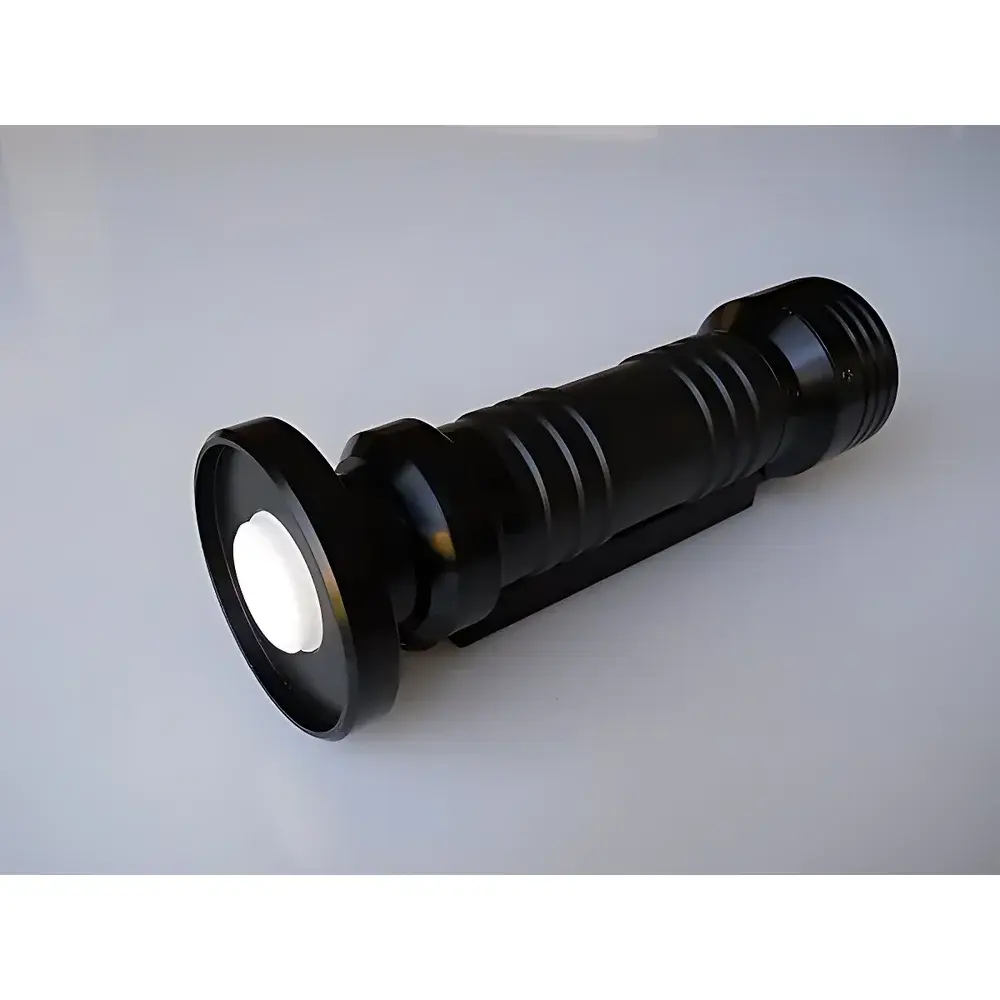
CR110-TA Transient Luminance Analyzer
| Brand | Colorimetry Research (CRI) |
|---|---|
| Origin | USA |
| Model | CR110-TA |
| Wavelength Range | 380–780 nm |
| Luminance Range | 0.002–1000 cd/m² (with ND2 filter) |
| Polarization Error | ≤0.1% |
| ADC Resolution | 16 bits |
| Electro-optical Bandwidth | 2 MHz |
| Max Sampling Rate | 200 kS/s |
| Min Sampling Period | 5 µs |
| Synchronization Frequency | 10–500 Hz (custom up to 10 kHz) |
| Exposure Time | 20 ms |
| Interface | USB 2.0, Ethernet, RS-232 |
| Power | 5 V, 120 mA via USB 2.0 |
| Mass | 0.34 kg |
| Spot Size Equation | 23.0 mm + 0.08732 × distance (mm) |
| Noise Filtering | Proprietary smart noise filter |
Overview
The CR110-TA Transient Luminance Analyzer is a high-speed, spectrally calibrated photometric instrument engineered for precise electro-optical time-domain characterization of light-emitting devices. Based on a silicon photodiode sensor with integrated V(λ)-matched optical filtering and thermally stabilized analog front-end electronics, the CR110-TA captures luminance transients with sub-microsecond temporal resolution—enabling rigorous analysis of rise/fall times, settling behavior, and temporal instability in LED modules, LCD/OLED backlights, micro-LED arrays, and pulsed laser diodes. Its 2 MHz electro-optical bandwidth and 200 kS/s maximum sampling rate support direct digitization of fast luminance waveforms without aliasing, while the 16-bit ADC ensures high dynamic range and low quantization noise across four manually selectable or auto-ranging luminance decades (0.002–1000 cd/m², extendable via ND2 filter). Designed for traceable photometry, the system complies with CIE S 026/E:2015 spectral responsivity requirements and maintains polarization insensitivity (<0.1% error), critical for evaluating anisotropic emitters such as edge-lit panels or polarized OLED stacks.
Key Features
- Real-time transient capture at up to 200,000 samples per second with 5 µs minimum inter-sample interval
- V(λ)-corrected photopic response (380–780 nm) certified to CIE 1931 standard observer functions
- Configurable synchronization input (10 Hz–10 kHz) for lock-in acquisition with external drivers or PWM controllers
- Proprietary adaptive noise filtering algorithm suppressing both broadband electronic noise and periodic interference (e.g., 50/60 Hz mains coupling)
- Modular optical hood with calibrated spot size geometry: 23.0 mm diameter at hood exit, scaling linearly with working distance (23.0 + 0.08732 × D mm)
- Dual-mode operation: non-contact luminance (cd/m²) and illuminance (lux) via optional cosine-corrected diffuser head
- Multi-interface connectivity: USB 2.0 (for power + data), Gigabit Ethernet (for remote lab integration), and RS-232 (for legacy OEM control)
Sample Compatibility & Compliance
The CR110-TA supports standardized evaluation of flicker and temporal light artefacts (TLAs) in accordance with IEC TR 61547-1:2019, IEEE 1789-2015, and the IDMS v2.0 and ICDM v2.1 display measurement standards. Its built-in FFT engine computes primary flicker frequency, percent flicker, flicker index, and weighted flicker metrics aligned with human visual sensitivity models—including the CIE TN 006:2020 perceptual weighting function. All photometric calibrations are NIST-traceable, and the instrument’s firmware implements audit-ready logging per FDA 21 CFR Part 11 requirements when operated in GLP/GMP environments. The device meets CE, FCC Class B, and RoHS compliance for laboratory deployment in North America, EU, and APAC markets.
Software & Data Management
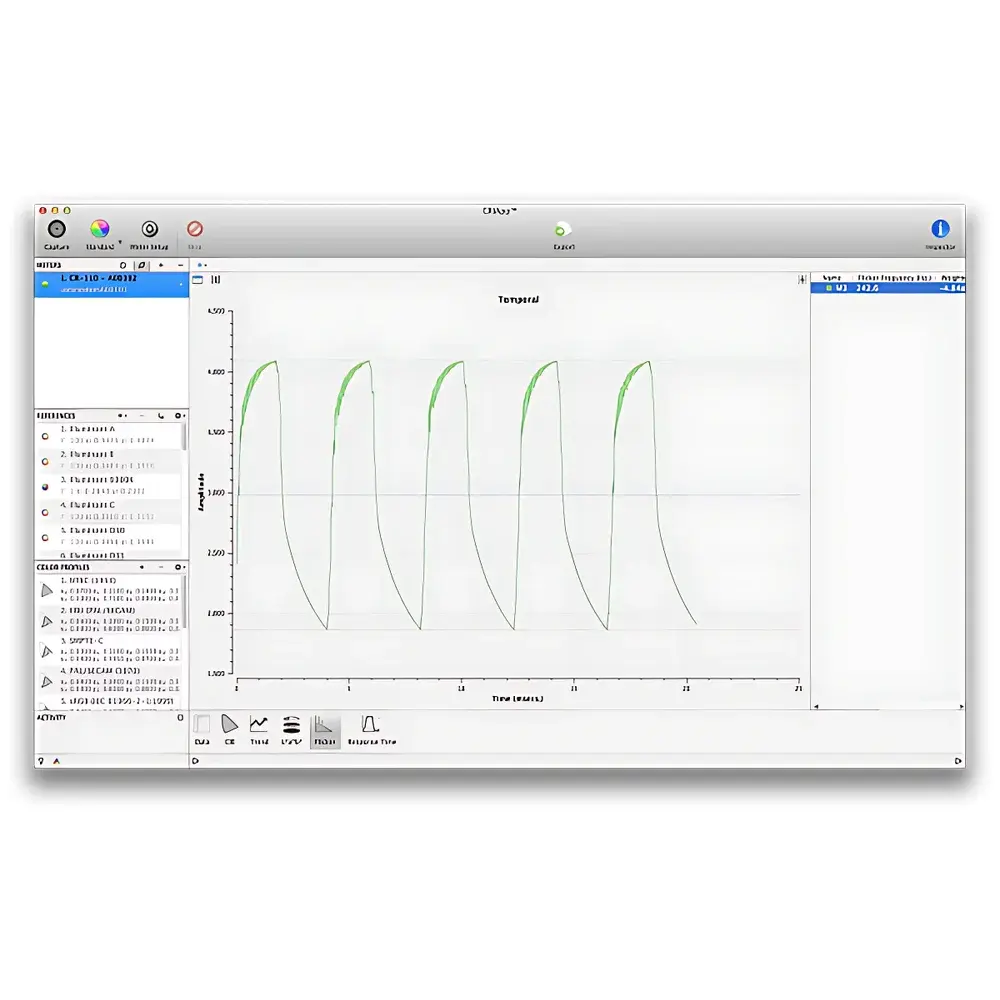
The CR110-TA operates with CRI’s Luminance Analysis Suite (LAS) v4.x, a Windows-based application supporting real-time waveform visualization, batch processing of transient datasets, and automated report generation compliant with ISO/IEC 17025 documentation frameworks. LAS provides scripting interfaces (Python COM API) for integration into automated test benches and CI/CD pipelines. Raw time-series data are stored in HDF5 format with embedded metadata (timestamp, calibration ID, sync trigger source, filter state), ensuring full reproducibility. Audit trails record all user actions, parameter changes, and calibration events—including digital signatures for operator authentication—meeting ALCOA+ principles for regulated quality systems.
Applications
- Quantification of LED driver-induced temporal artifacts in automotive headlamps and adaptive driving beam (ADB) systems
- Validation of flicker mitigation algorithms in HDR display backlight dimming controllers
- Characterization of microsecond-scale turn-on delay in UV-C pulsed LEDs for disinfection efficacy modeling
- Electro-optical validation of AR/VR microdisplay temporal response under variable frame-rate rendering
- Root-cause analysis of temporal non-uniformity in mini-LED local dimming zones
- Compliance testing for ENERGY STAR Lamps V2.1, DLC Premium, and TÜV Rheinland Flicker Certification protocols
FAQ
Does the CR110-TA require external power beyond USB?
No—full operation (sensor, ADC, FPGA, and communication interfaces) is powered exclusively via USB 2.0 (5 V, 120 mA). No external power supply or battery pack is needed.
Can the CR110-TA measure illuminance directly?
Yes—when equipped with the optional cosine-corrected illuminance adapter, the instrument reports lux values traceable to NIST SP250-95 calibration protocols.
Is firmware upgrade supported in-field?
Yes—secure over-the-air updates are delivered via Ethernet or USB; each update includes cryptographic signature verification and rollback capability.
What is the uncertainty budget for luminance measurements at 1 cd/m²?
At 1 cd/m², expanded uncertainty (k=2) is ±2.3% (coverage includes calibration drift, linearity deviation, temperature coefficient, and polarization error).
How is synchronization latency characterized and minimized?
Hardware-triggered acquisition introduces <120 ns jitter; total system latency from external sync edge to first sample timestamp is factory-measured and logged in the calibration certificate.






