Creaform C-Track Optical 3D Tracking System
| Brand | Creaform |
|---|---|
| Origin | Canada |
| Model | C-Track |
| Measurement Rate | 30 Hz |
| Tracking Principle | Dual-camera stereoscopic optical tracking with dynamic reference frame locking |
| TRUaccuracy™ Technology | Yes |
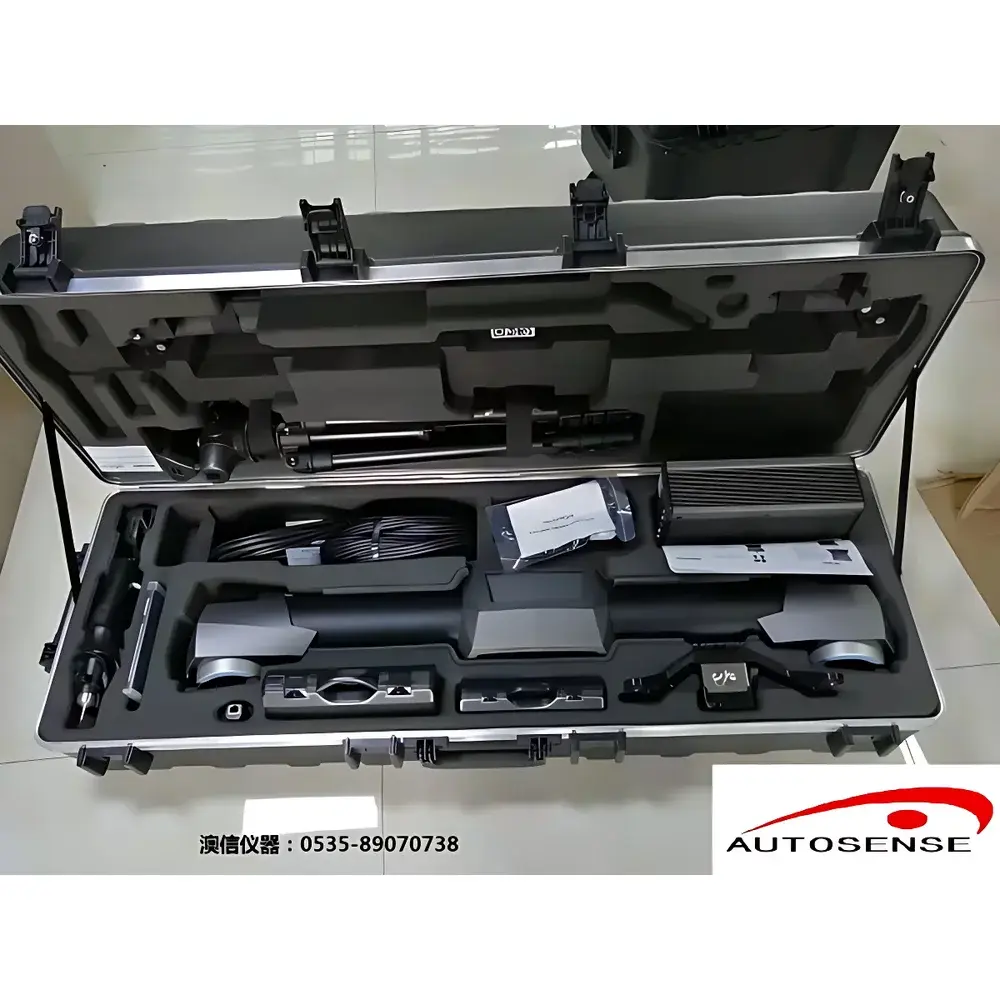
| Portability | Fully portable, tripod- or magnet-mounted |
| Software Compatibility | Native integration with VXelements, Geomagic Control X, PolyWorks, and other metrology-grade CAD/inspection platforms |
| Application Scope | Coordinate-measured geometry validation, hybrid (contact + non-contact) inspection, reverse engineering, large-part alignment, fixture verification |
| Compliance | Designed for ISO 17025-compliant metrology workflows |
| Typical Use Environments | Production floor, assembly line, tool room, R&D lab, field service |
Overview
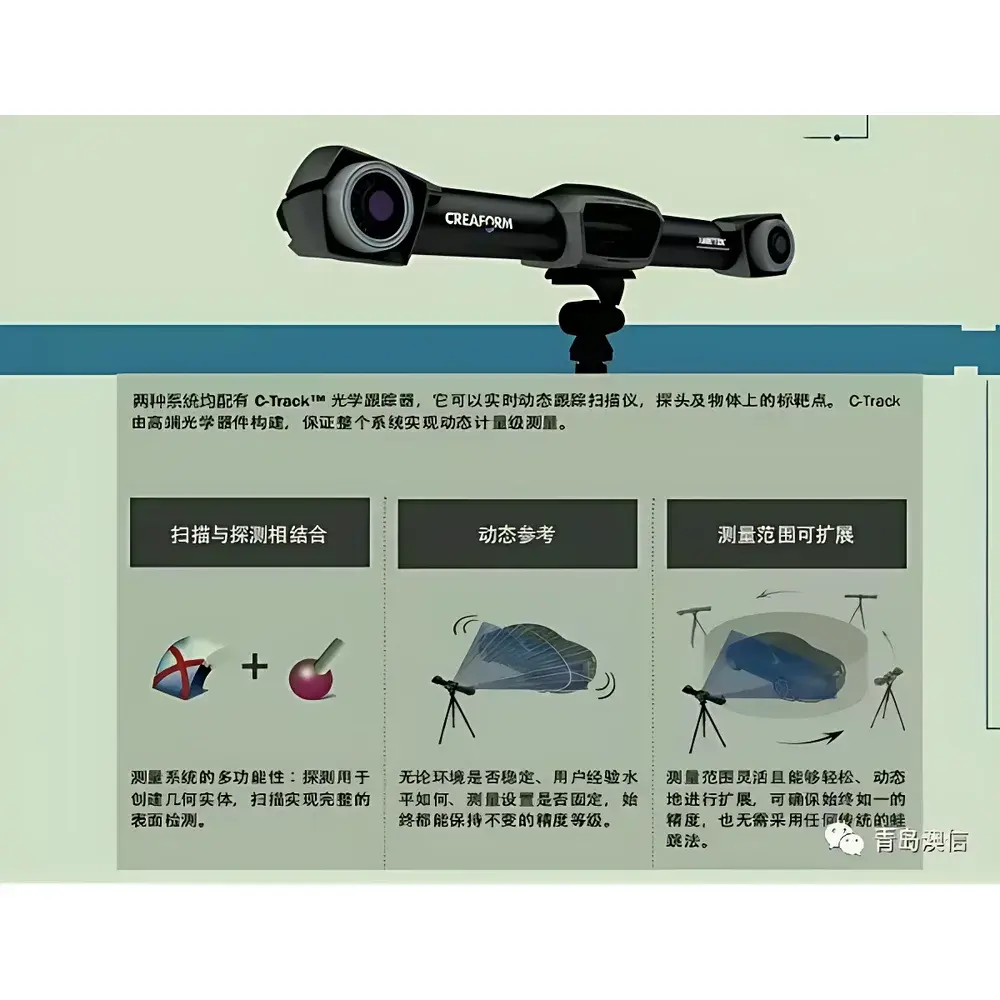
The Creaform C-Track is a high-performance, dual-camera optical 3D tracking system engineered for precision coordinate metrology in dynamic industrial environments. Unlike conventional laser trackers or articulated arms, the C-Track operates on stereoscopic vision principles—using synchronized, calibrated CCD sensors to triangulate the 3D position of reflective targets (e.g., passive spheres or coded markers) in real time. Its core innovation lies in the Dynamic Reference Frame (DRF) functionality: by continuously monitoring a set of reference targets affixed to the part or fixture, the system maintains a stable, part-centric coordinate system—even as the operator repositions the C-Track unit or physically manipulates the component. This eliminates iterative re-alignment, mitigates cumulative error from manual setup, and enables true “walk-around” measurement without positional drift. The system delivers sub-millimeter volumetric accuracy across its operational envelope and sustains measurement integrity under ambient challenges including floor vibration, thermal gradients, and operator variability—enabled by Creaform’s proprietary TRUaccuracy™ calibration architecture.
Key Features
- 30 Hz Real-Time Tracking: Captures up to 30 synchronized stereo image pairs per second, enabling high-fidelity motion capture and rapid scanning of moving or rotating parts.
- Dynamic Reference Frame (DRF): Automatically locks the measurement coordinate system to the workpiece via embedded reference targets—ensuring consistent datum definition throughout multi-step inspections or hybrid probing cycles.
- Frog-Leap-Free Scalability: Supports seamless expansion of the measurable volume through strategic placement of additional C-Track units or reference bars—without recalibration or loss of traceable accuracy.
- TRUaccuracy™ Technology: A hardware-software co-optimized calibration framework that compensates for thermal lensing, mechanical flexure, and sensor drift in real time—validated per ISO 10360-8 for volumetric performance stability.
- Zero-Arm, Handheld Flexibility: Operates without articulated arms or fixed mounts; compatible with magnetic bases, tripods, or overhead suspension—ideal for large assemblies, aerospace structures, or confined tooling spaces.
- Plug-and-Play Integration: Installs in under five minutes; requires no specialized infrastructure—only standard power and USB 3.0 or GigE connectivity.
Sample Compatibility & Compliance
The C-Track is optimized for geometric measurement of rigid metallic and composite components ranging from small machined fixtures (10 m). It accommodates parts with high reflectivity, complex freeform surfaces, and occluded geometries—especially when paired with Creaform’s HandySCAN 3D or MetraSCAN 3D scanners. All target-based measurements adhere to ISO 15530-3 (coordinate measuring machine calibration using reference artifacts) and support uncertainty budgets compliant with ISO/IEC 17025. When deployed with validated software such as PolyWorks Inspector or Geomagic Control X, the system meets FDA 21 CFR Part 11 requirements for electronic records and signatures—including full audit trail logging, user access control, and data immutability.
Software & Data Management
The C-Track interfaces natively with Creaform’s VXelements platform—a modular, scriptable metrology environment supporting automated reporting, GD&T evaluation (per ASME Y14.5 and ISO 1101), and statistical process control (SPC) charting. Raw tracking data is exported in standard formats (ASCII, CSV, XML) and can be imported into third-party CAD/CAM systems (e.g., Siemens NX, CATIA, SolidWorks) for deviation analysis. Data management workflows include version-controlled project archiving, encrypted cloud synchronization (via optional Creaform Cloud Services), and role-based permission hierarchies—ensuring traceability across multi-shift operations and supplier audits.
Applications
- Tooling and fixture validation: Verification of weld jigs, stamping dies, and composite layup molds against master CAD models.
- Large-part dimensional inspection: In-situ measurement of aircraft fuselage sections, wind turbine blades, and railcar underframes.
- Hybrid metrology: Synchronized use with tactile probes (e.g., Romer Absolute Arm) and structured-light scanners for comprehensive surface + feature-level assessment.
- Reverse engineering of legacy components: High-density point cloud registration for CAD reconstruction of worn or undocumented parts.
- Assembly guidance and alignment: Real-time feedback for robotic positioning, panel gap/flushness verification, and structural rigging in shipbuilding or heavy machinery.
FAQ
What is the maximum unambiguous tracking volume for a single C-Track unit?
A single C-Track achieves an effective working volume of approximately 4 m × 4 m × 3 m (L×W×H) with optimal target visibility; larger volumes are realized via multi-unit networked operation.
Does the C-Track require periodic factory recalibration?
Yes—annual recalibration is recommended per ISO 9001 and internal quality procedures; however, on-site verification using certified reference artifacts (e.g., ball bars, gauge blocks) is supported via VXelements.
Can the C-Track track active (powered) targets?
No—it is designed exclusively for passive retroreflective targets; active LED or RF-based targets are not supported.
Is the system compatible with robotic automation interfaces?
Yes—through Ethernet/IP, OPC UA, or custom API integration, enabling synchronization with CNC machines, collaborative robots, and automated guided vehicles (AGVs).
How does TRUaccuracy™ handle temperature-induced measurement drift?
TRUaccuracy™ employs real-time thermal modeling of optical path length changes, combined with continuous in-situ reference target monitoring, to maintain volumetric accuracy within ±0.025 mm over a 15–35 °C ambient range.