
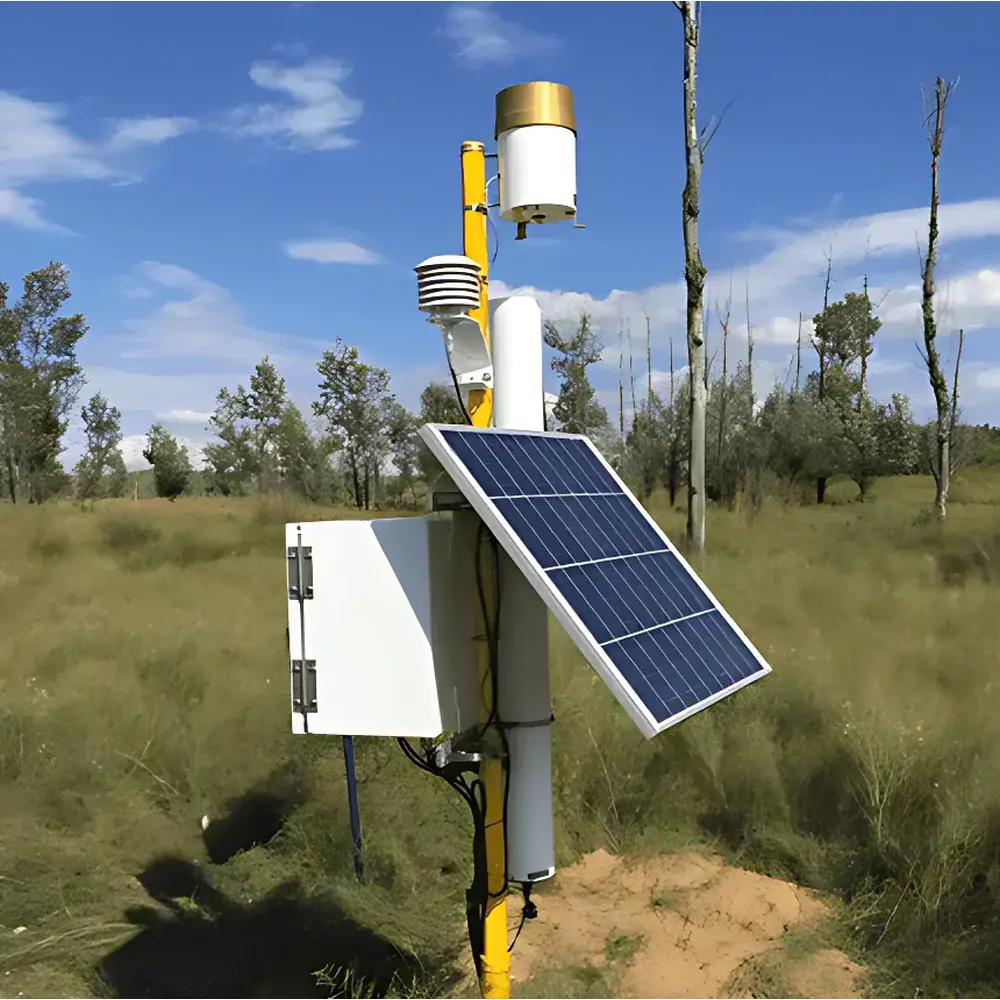
CRS 2000B Cosmic-Ray Neutron Probe (CRNP) Soil Moisture Measurement System
| Origin | USA |
|---|---|
| Manufacturer Type | Authorized Distributor |
| Origin Category | Imported |
| Model | CRS 2000B |
| Pricing | Available Upon Request |
Overview
The CRS 2000B Cosmic-Ray Neutron Probe (CRNP) Soil Moisture Measurement System is a field-deployable, passive geophysical instrument engineered for continuous, area-integrated estimation of near-surface soil water content. It operates on the well-established principle of cosmic-ray neutron sensing (CRNS), leveraging naturally occurring secondary neutrons generated by galactic cosmic rays interacting with Earth’s atmosphere and surface materials. As high-energy neutrons descend through the atmosphere and penetrate the soil column, they undergo elastic scattering—primarily with hydrogen nuclei—resulting in energy loss and directional change. A fraction of the resulting epithermal (fast) neutrons escapes back to the air–soil interface and reaches equilibrium within a characteristic footprint. The intensity of this epithermal neutron flux exhibits an inverse exponential relationship with volumetric hydrogen concentration—dominated by soil water—and is minimally affected by soil texture, bulk density, salinity, or surface roughness. This physical basis enables the CRS 2000B to deliver representative, non-invasive, and calibration-free soil moisture estimates over a circular footprint of up to 700 m diameter (350 m radius) and effective sensing depth of ~70 cm—bridging the critical observational gap between point-scale in situ sensors (e.g., TDR, capacitance probes) and coarse-resolution satellite remote sensing.
Key Features
- Passive, non-contact measurement—no soil disturbance, no insertion, no electromagnetic interference
- Large-area integration: effective spatial scale of up to 700 m diameter, eliminating representativeness bias inherent in point measurements
- Minimal sensitivity to soil chemical and physical heterogeneity—including clay content, electrical conductivity, organic matter variation, and surface topography
- Low-power architecture: nominal current draw of ~150 mA at 12 VDC; fully compatible with solar-rechargeable battery systems for unattended operation
- Modular system design: integrates neutron detection, environmental sensing (air temperature, relative humidity, barometric pressure), data acquisition, and optional telemetry
- Flexible temporal resolution: configurable data logging intervals from 1 minute to 1 year, supporting both high-frequency process studies and long-term monitoring
- Robust environmental housing with IP67-rated enclosure and field-serviceable components
Sample Compatibility & Compliance
The CRS 2000B is designed for deployment across diverse terrestrial ecosystems—including agricultural fields, grasslands, forests, tundra, and snow-covered terrain—without requiring site-specific calibration. Its measurement principle is inherently insensitive to soil ion chemistry, making it suitable for saline soils, volcanic ash, or highly weathered tropical profiles where conventional dielectric sensors exhibit drift or bias. The system complies with international standards for environmental instrumentation including IEC 60529 (IP67 ingress protection), ISO 17025 traceability frameworks for environmental metrology, and supports audit-ready data logging aligned with GLP and GMP principles when configured with time-stamped, tamper-evident storage. Optional GSM or Iridium satellite telemetry modules enable secure, encrypted data transmission compliant with ITU-R M.2012 spectrum usage guidelines and regional telecommunications regulations.
Software & Data Management
Data acquisition is managed via an embedded ARM-based controller running real-time Linux firmware. Raw neutron counts, environmental metadata (temperature ±1 °C, RH ±3%, pressure ±0.1 mbar), and diagnostic flags are stored on dual SD card slots (internal + hot-swappable external) with cyclic overwrite protection and CRC-32 error checking. USB and RS-232 interfaces support local configuration, firmware updates, and bulk data retrieval. The system supports NMEA 0183-compatible GPS synchronization and optional integration with external sensors—including tipping-bucket rain gauges and calibrated TDR probes—via TTL digital I/O and 0–5 V analog channels. Data output conforms to CF Metadata conventions and is exportable in NetCDF-4 and CSV formats. Post-processing software (CRSN Processor v3.x) implements standardized correction algorithms per Desilets et al. (2010) and Köhli et al. (2015), including atmospheric pressure normalization, incoming neutron flux correction using neutron monitor network data (e.g., NMDB), and vegetation water content attenuation modeling.
Applications
- Ground-truthing and validation of satellite-derived soil moisture products (e.g., SMAP, Sentinel-1, ASCAT)
- Calibration and bias correction of eddy covariance towers for evapotranspiration partitioning
- Large-scale irrigation scheduling and water use efficiency assessment in precision agriculture
- Drought onset detection and severity indexing for early warning systems
- Snow water equivalent (SWE) estimation during accumulation and melt phases
- Hillslope-scale hydrological modeling input for landslide and flash flood forecasting
- Long-term climate observatory networks measuring land–atmosphere feedbacks under changing precipitation regimes
FAQ
How does the CRS 2000B differ from traditional point sensors like TDR or FDR probes?
It provides spatially integrated soil moisture over hundreds of meters, avoiding extrapolation uncertainty and installation artifacts associated with discrete in-ground probes.
Does soil salinity affect measurement accuracy?
No—unlike dielectric methods, CRNS relies on neutron–hydrogen interactions and is effectively insensitive to dissolved ions or electrical conductivity.
Can the system operate autonomously for extended periods?
Yes—designed for multi-year deployments with solar charging, low-power electronics, and redundant data storage.
Is atmospheric pressure correction mandatory?
Yes—barometric pressure strongly modulates cosmic-ray neutron intensity; the integrated 0.1 mbar sensor enables real-time correction without external inputs.
What is the minimum detectable change in volumetric water content?
Detection limit depends on integration time and background neutron flux but typically achieves ±0.005 m³/m³ precision at 1-hour averaging under mid-latitude conditions.







