
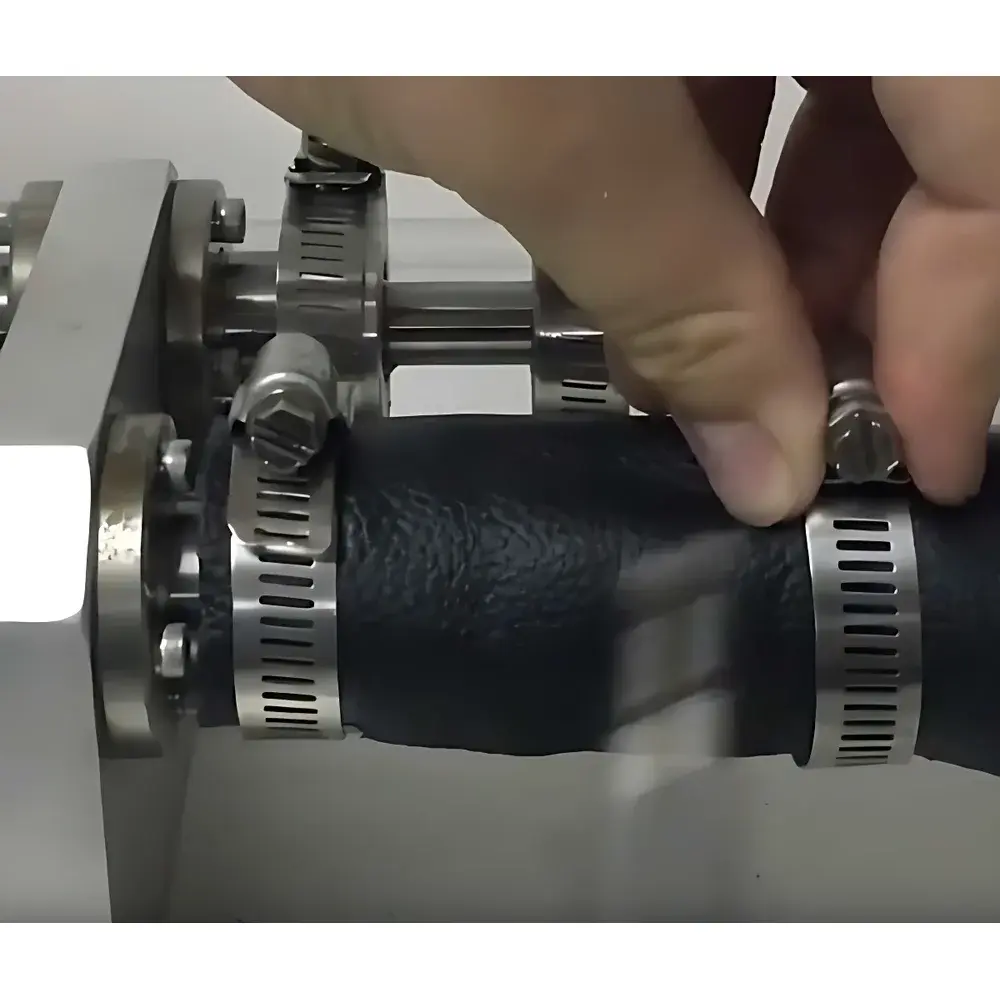
Crumpleflex Tester HY-789-1 by HENGYU
| Brand | HENGYU |
|---|---|
| Origin | Tianjin, China |
| Model | HY-789-1 |
| Power Supply | AC 220 V, 50 Hz, 500 W |
| Operating Environment | 20 ± 2 °C, 65 ± 4 % RH |
| Dimensions (L×W×H) | 60 × 40 × 40 cm |
| Weight | 80 kg |
| Compliant Standards | ASTM D2097, GM 9226P / 9216P, Ford FLTM BN 102-02, MF-MH BN2-2, TSL5101G Section 3.14.1 B |
Overview
The Crumpleflex Tester HY-789-1 is a precision-engineered mechanical fatigue testing instrument designed to evaluate the flex resistance, crease recovery, and interlayer adhesion integrity of coated textiles, automotive leather trim, synthetic upholstery materials, and laminated flexible composites. It operates on the principle of controlled, repetitive bending deformation—applying defined angular displacement and cyclic loading to simulate real-world mechanical stress encountered during vehicle interior use, garment wear, or industrial handling. Unlike generic bending testers, the HY-789-1 implements standardized mandrel geometry and fixed stroke amplitude per test protocol, ensuring high reproducibility across laboratories and compliance with internationally recognized automotive and material specification frameworks.
Key Features
- Motor-driven dual-arm mechanism delivering consistent, programmable crimping frequency (typically 60–120 cycles/min) with mechanical dwell control at peak deflection points.
- Interchangeable mandrel sets calibrated to match ASTM D2097 (12.7 mm diameter), GM 9226P (10 mm), and Ford FLTM BN 102-02 (6.4 mm) requirements—enabling direct cross-standard evaluation without hardware modification.
- Integrated digital cycle counter with manual reset and automatic stop function upon reaching preset cycle count (1–99,999 cycles).
- Rigid steel frame construction with vibration-dampening base plate ensures minimal energy loss and stable force transmission during high-cycle testing.
- Front-access sample clamping system with micrometer-adjustable pressure plates accommodates specimens up to 100 mm wide and 5 mm thick, minimizing edge slippage and enabling repeatable positioning.
- No external PC or software dependency for basic operation—fully self-contained electromechanical control architecture compliant with IEC 61000-6-2/6-4 EMC standards.
Sample Compatibility & Compliance
The HY-789-1 accepts flat, non-stretchable or low-elongation flexible sheet materials including aniline-dyed leathers, PVC- and PU-coated fabrics, thermoplastic elastomer laminates, and solvent-bonded textile composites. Specimen conditioning follows ISO 291 and ASTM D618 protocols: equilibration at 20 ± 2 °C and 65 ± 4 % RH for ≥4 hours prior to testing. All test methods implemented—including visual assessment of cracking, delamination, coating flaking, and surface whitening—are traceable to OEM-specified acceptance criteria. The instrument meets mechanical verification requirements outlined in ISO/IEC 17025 Clause 6.4.3 for test equipment used in accredited quality control laboratories supporting automotive Tier-1 suppliers.
Software & Data Management
While the HY-789-1 operates as a stand-alone mechanical tester, optional RS-232 serial interface enables connection to external data acquisition systems for time-stamped cycle logging and pass/fail flagging. When integrated into GLP- or IATF 16949-compliant environments, users may configure external software (e.g., LabVIEW or custom Python-based DAQ tools) to record operator ID, environmental sensor readings (via optional external hygrothermograph), and test termination reason—supporting audit-ready electronic records per FDA 21 CFR Part 11 Annex 11 principles. Calibration certificates include traceability to NIM (National Institute of Metrology, China) via accredited third-party labs.
Applications
- Automotive interior component validation: door panel inserts, seat bolsters, console covers, and dashboard overlays subjected to repeated flexing during service life.
- Quality gate screening for leather tanneries supplying OEMs—ensuring batch-to-batch consistency in grain layer cohesion and finish durability.
- R&D evaluation of novel coating formulations (e.g., waterborne polyurethanes, silicone-modified acrylics) where crack initiation threshold and propagation rate under cyclic strain are critical performance indicators.
- Comparative benchmarking against competitor materials using harmonized test parameters defined in GMW15634 or VDA 230-206.
- Failure mode analysis support: correlating crumpleflex results with SEM imaging of fracture surfaces or FTIR mapping of coating degradation zones.
FAQ
What is the recommended calibration interval for the HY-789-1?
Calibration verification—including mandrel diameter measurement, cycle timing accuracy, and clamping force uniformity—should be performed annually or after 10,000 test cycles, whichever occurs first, using certified gauge blocks and stopwatch traceable to national standards.
Can the tester accommodate curved or pre-formed samples?
No—the HY-789-1 is designed exclusively for flat, rectangular specimens mounted between parallel clamps. Three-dimensional parts require alternative test methods such as dynamic bending jigs or servo-hydraulic flexural testers.
Is operator training required before use?
Yes. Users must complete documented training covering specimen preparation per ASTM D2097 Section 7, environmental chamber synchronization, mandrel selection logic, and interpretation of failure modes per TSL5101G Section 3.14.1 B acceptance tables.
Does the unit meet CE or UKCA marking requirements?
The HY-789-1 complies with the essential health and safety requirements of the EU Machinery Directive 2006/42/EC when supplied with full technical file and EC Declaration of Conformity; UKCA marking is available upon request with GB-specific notified body review.
How is maintenance performed on the drive mechanism?
The gearmotor assembly requires biannual inspection of carbon brushes and lubrication of timing belts per HENGYU Maintenance Manual HY-789-1 Rev. 3. No user-serviceable components exist within the control electronics module.



