
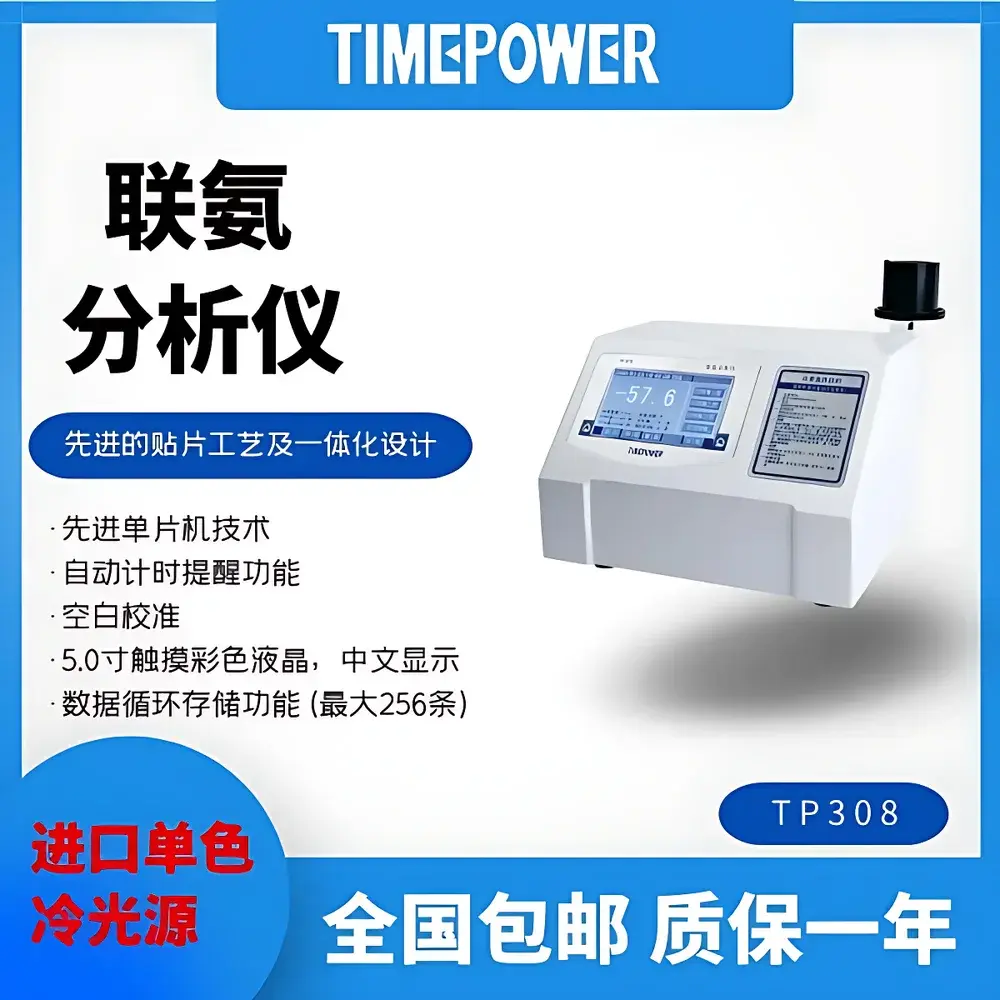
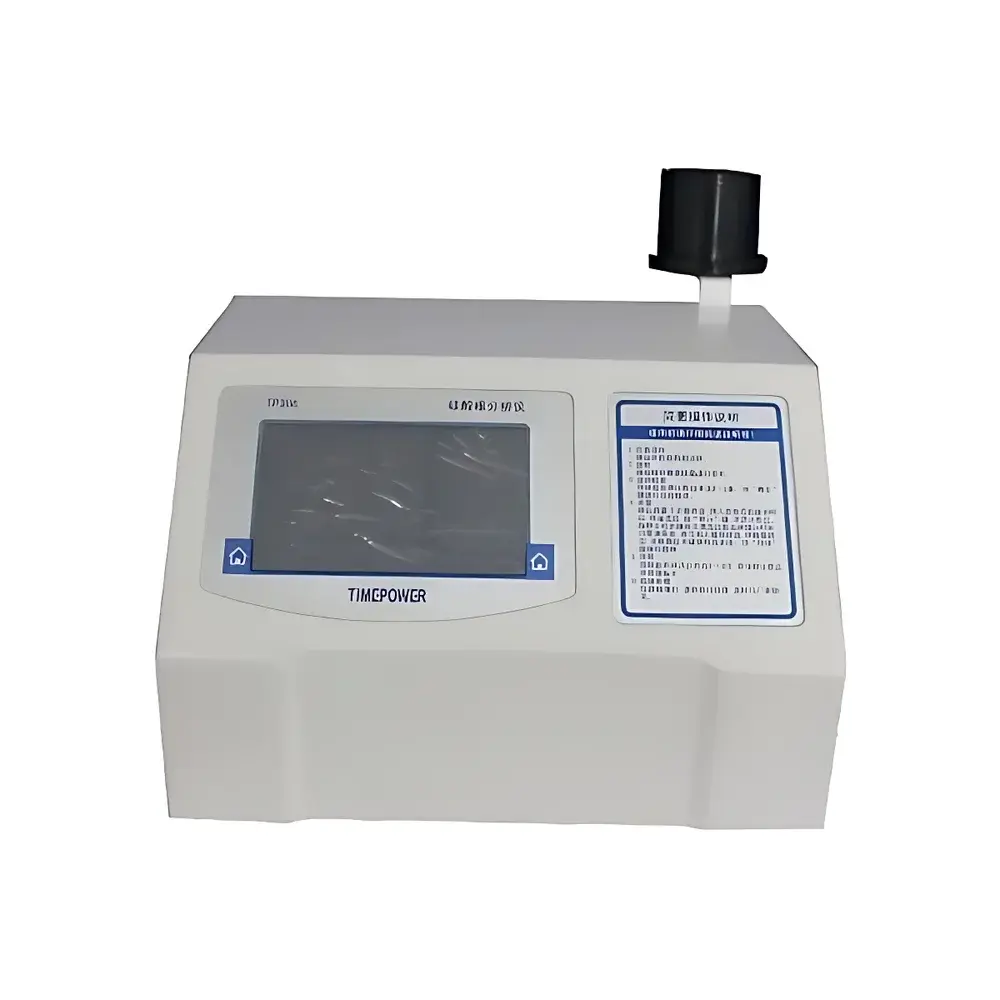
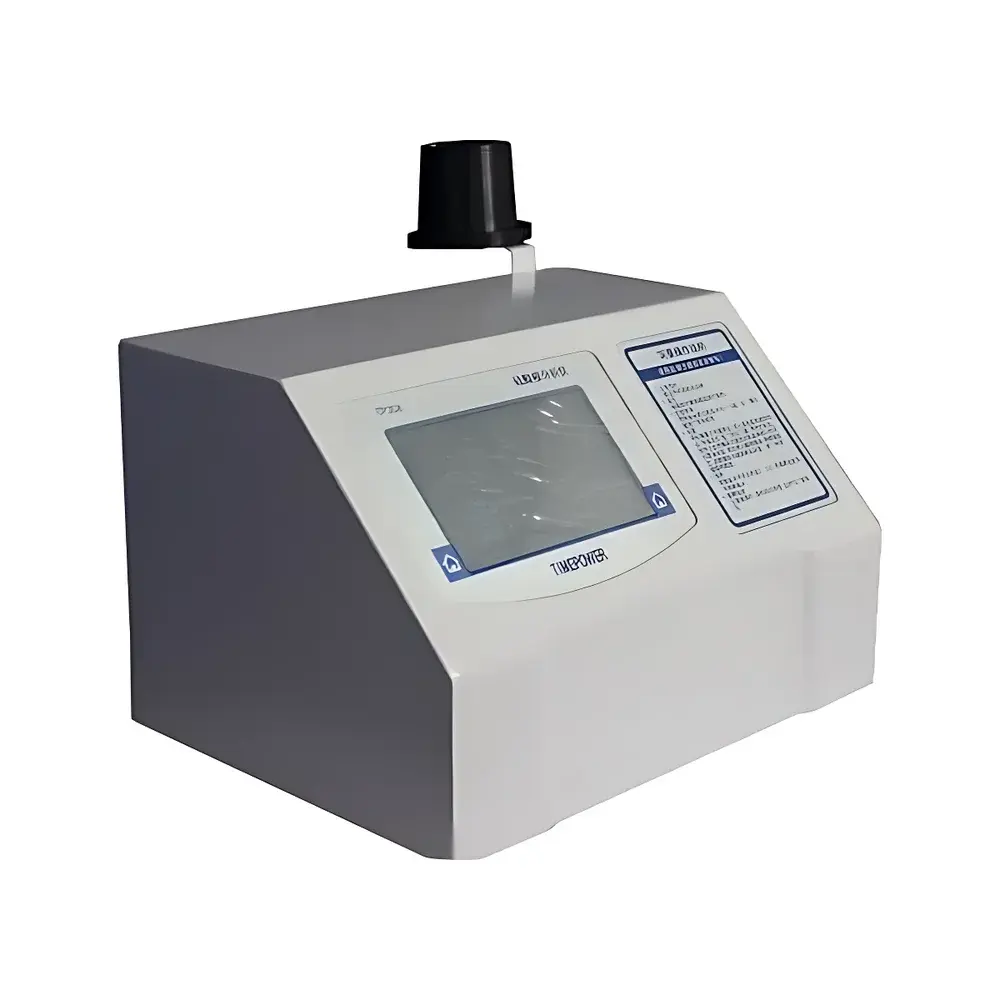
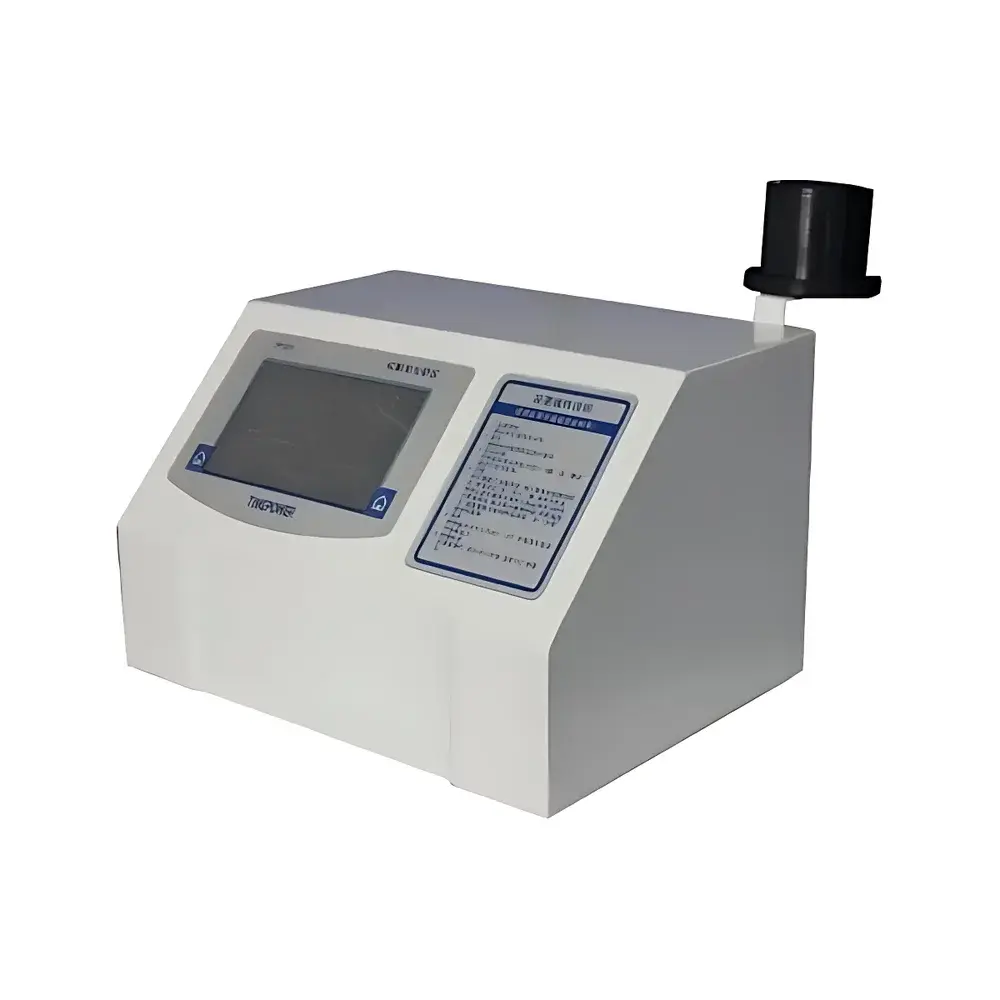
Timepower TP308 Hydrazine Analyzer for Laboratory Water Quality Analysis
| Brand | Timepower |
|---|---|
| Model | TP308 |
| Origin | Beijing, China |
| Manufacturer Type | Direct Manufacturer |
| Product Origin | Domestic (China) |
| Price | Upon Request |
| Display | 5.0-inch color touch LCD (Chinese interface) |
| Measurement Principle | Photometric colorimetry via p-dimethylaminobenzaldehyde (p-DMAB) reaction under acidic conditions |
| Measuring Range | 0–100 µg/L |
| Accuracy | ±2% FS |
| Resolution | 0.1 µg/L |
| Repeatability | ≤1% |
| Stability | ±1% FS / 4 h |
| Operating Temperature | 5–45 °C |
| Relative Humidity | ≤90% RH (non-condensing) |
| Power Supply | AC 85–265 V, 45–65 Hz |
| Power Consumption | ≤30 W |
| Dimensions | 260 × 200 × 180 mm |
| Weight | 3.2 kg |
| Data Storage | 256 cyclic records |
| Calibration | Blank calibration and curve calibration supported |
| Compliance | Based on Chinese national standard method for hydrazine determination using p-DMAB |
Overview
The Timepower TP308 Hydrazine Analyzer is a dedicated benchtop photometric instrument engineered for precise, routine quantification of dissolved hydrazine (N₂H₄) in ultrapure water matrices. It operates on the internationally recognized colorimetric principle defined in GB/T 6904–2008 (and aligned with ASTM D3752–19 and ISO 10530:1992 methodologies), wherein hydrazine reacts quantitatively with p-dimethylaminobenzaldehyde (p-DMAB) under controlled acidic conditions to form a stable yellow azo chromophore. Absorbance is measured at the characteristic peak wavelength (~455 nm) using a high-stability imported monochromatic cold light source. The system integrates optical path optimization, thermal drift compensation, and real-time signal processing to deliver reproducible results in low-concentration regimes critical to power plant chemistry control and high-purity process water monitoring.
Key Features
- 5.0-inch capacitive touch color LCD with intuitive Chinese-language UI—designed for rapid operator training and minimal procedural error.
- Compact, integrated mechanical architecture employing advanced SMT (surface-mount technology) PCBs and ruggedized enclosure—engineered for long-term stability in laboratory and auxiliary control room environments.
- Dedicated microcontroller unit (MCU) platform optimized for low-power operation (<30 W) and deterministic timing control—ensures consistent reaction incubation and photometric acquisition cycles.
- Imported cold-light LED source with narrow spectral bandwidth and low thermal output—minimizes baseline drift and extends optical lifetime beyond 10,000 hours.
- Automated timing prompts for reagent addition, reaction wait, and measurement—standardizing analyst workflow and reducing inter-operator variability.
- Onboard blank calibration function—compensates for zero-point offset arising from cuvette imperfections, electronic offset, and ambient light leakage.
- Cyclic data storage for up to 256 measurement records with auto-rollover—supports traceability without external logging; all entries timestamped and non-editable post-acquisition.
Sample Compatibility & Compliance
The TP308 is validated for use with deionized water, condensate, boiler feedwater, and steam-cycle samples meeting ASTM D1193 Type I or ISO 3696 Grade 1 purity specifications. Its 0–100 µg/L linear dynamic range meets the detection requirements of IAPWS RP-19 (International Association for the Properties of Water and Steam) for hydrazine residual control in supercritical boiler systems. While not FDA 21 CFR Part 11–compliant out-of-the-box, audit-ready operation is achievable when paired with documented SOPs, manual logbooks, and periodic verification per ISO/IEC 17025:2017 clause 7.7. All reagents—including p-DMAB stock solution and acid buffer—must conform to analytical grade (≥99.5%) purity and be stored in certified polyethylene containers to prevent adsorption or hydrolysis. Daily blank calibration and biweekly calibration curve verification are mandatory per manufacturer’s maintenance protocol to sustain ±2% FS accuracy.
Software & Data Management
The embedded firmware supports local data review, export via USB interface (CSV format), and configurable alarm thresholds. No proprietary software installation is required for basic operation; however, optional PC-based reporting tools (available upon request) enable GLP-compliant report generation—including operator ID, sample ID, calibration history, and environmental condition stamps. Data integrity safeguards include write-once record logic, absence of editable fields, and automatic time/date stamping synchronized to internal RTC (real-time clock). Firmware updates are delivered via encrypted USB firmware image—validated against SHA-256 checksum prior to installation.
Applications
- Monitoring hydrazine residuals in turbine condensate and feedwater circuits of fossil and nuclear power plants—ensuring oxygen scavenging efficacy while avoiding excessive dosing that may accelerate copper alloy corrosion.
- Verification of hydrazine removal efficiency in mixed-bed polishing units serving semiconductor fab ultrapure water (UPW) distribution loops (per SEMI F63).
- QC release testing of pharmaceutical water-for-injection (WFI) and purified water (PW) systems where hydrazine is used as a sterilant intermediate—aligned with USP and EP 2.2.48 guidelines.
- Process validation support in synthetic fiber production (e.g., nylon-6,6 polymerization lines) where hydrazine serves as a reducing agent in catalyst activation.
- Environmental compliance screening of wastewater effluents from chemical synthesis facilities handling hydrazine derivatives—per EPA Method 377.1 adaptation.
FAQ
What is the recommended water purity for preparing reagents and blanks?
Use Type I ultrapure water generated by a high-performance mixed-bed ion exchange system (resistivity ≥18.2 MΩ·cm at 25 °C, TOC <1 ppb)—as specified in ASTM D1193 and ISO 3696.
How frequently must calibration be performed?
Blank calibration is required daily; full multi-point calibration curve verification must be conducted every 14 days—or immediately after reagent lot change, lamp replacement, or instrument relocation.
Can the TP308 be used for field deployment?
No—it is designed exclusively for controlled laboratory or fixed-location utility monitoring environments; it lacks battery power, shock resistance, or IP-rated enclosure.
Is the p-DMAB reagent stable over time?
When stored refrigerated (2–8 °C) in amber polyethylene bottles, the working p-DMAB solution retains quantitative reactivity for ≤72 hours; stock solutions remain stable for ≤6 months under inert gas blanket.
Does the analyzer comply with ISO/IEC 17025 requirements?
The TP308 itself is not accredited, but its metrological performance—when operated within defined environmental limits and with documented calibration traceability to NIST-traceable hydrazine standards—supports laboratory accreditation under ISO/IEC 17025:2017 clause 7.7.







