
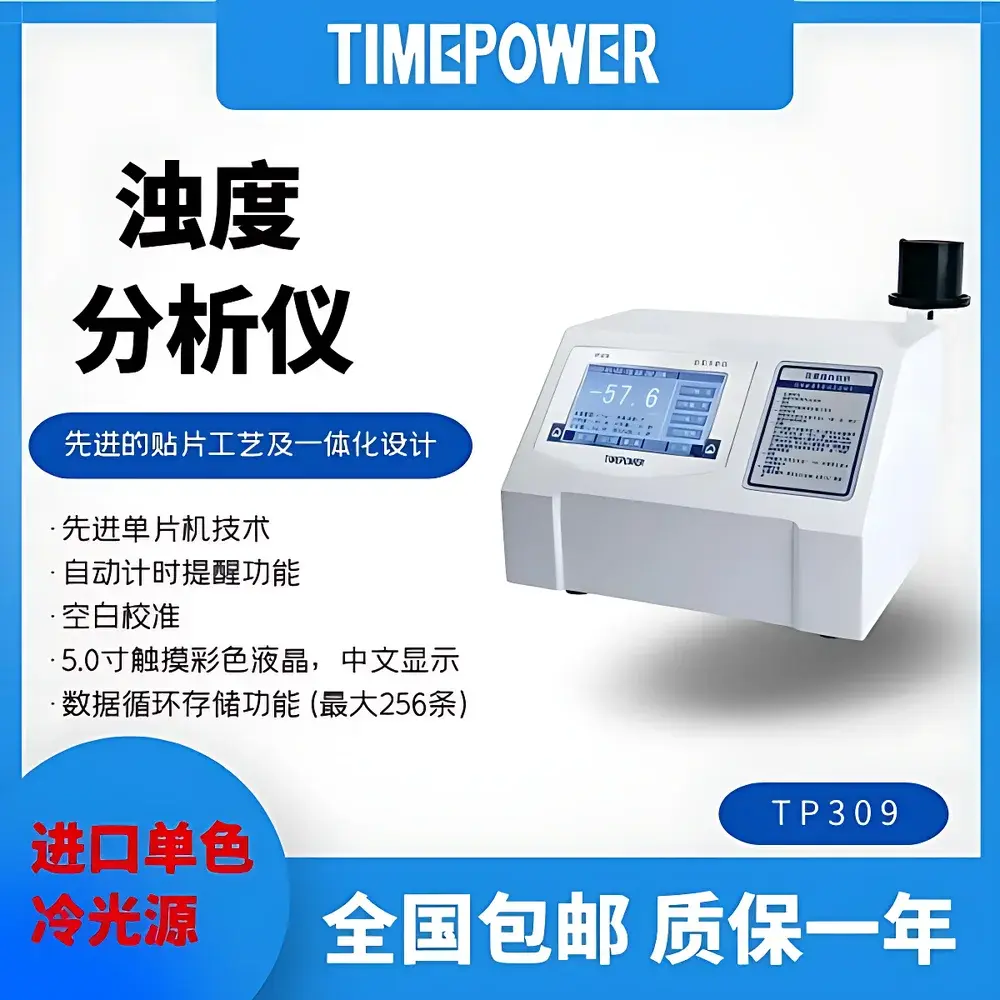
TimePower TP-308 Benchtop Turbidimeter
| Brand | TimePower |
|---|---|
| Origin | Beijing, China |
| Manufacturer Type | Direct Manufacturer |
| Regional Category | Domestic (China) |
| Model | TP-308 |
| Form Factor | Benchtop / Laboratory |
| Measurement Range | 20–200 NTU |
| Resolution | 0.1 NTU |
| Operating Ambient Temperature | 0–25 °C |
| Accuracy | ±2 % |
| Light Source | Imported Cold LED Source (100,000 h Lifetime) |
| Display | Large LCD Screen with Keypad Interface |
| Data Storage | Up to 30,000 measurements |
| Connectivity | Ethernet & USB |
| Calibration Standards | Compliant with ISO 7027 and ISO 7887–1985 for turbidity and color measurement |
| Curve Library | Preloaded Standard Curves + 96 User-Defined Curves |
| Power Management | Battery Backup for Data Integrity During Power Interruption |
| Consumables | Low-Cost, Low-Volume Reagents |
Overview
The TimePower TP-308 Benchtop Turbidimeter is a precision optical instrument engineered for reliable, repeatable turbidity quantification in laboratory and quality control environments. It operates on the principle of nephelometry—measuring the intensity of light scattered at 90° by suspended particles in aqueous samples—conforming to ISO 7027 (optical method using formazin standard) and supporting dual-compliance with ISO 7887–1985 for simultaneous color and turbidity assessment where applicable. Designed for routine analysis of surface water, groundwater, wastewater, and industrial effluents, the TP-308 delivers traceable, stable readings across its specified range of 20–200 NTU, with resolution down to 0.1 NTU and certified accuracy of ±2 % of full scale. Its robust architecture integrates a thermally stabilized, imported cold LED light source—rated for 100,000 hours—to ensure long-term photometric consistency without lamp drift or warm-up delay.
Key Features
- Optically optimized nephelometric detection system compliant with ISO 7027 for turbidity and ISO 7887–1985 for color-turbidity correlation studies
- Benchtop form factor with ergonomic keypad interface and high-contrast LCD display for intuitive operation under ambient lab lighting
- Integrated thermal printer enabling immediate hard-copy output of current measurements and historical datasets
- Onboard memory capacity for up to 30,000 measurement records, including timestamp, sample ID, operator code, and calibration metadata
- Dual-interface connectivity via Ethernet (TCP/IP) and USB 2.0 for seamless integration into LIMS, ELN, or centralized data management platforms
- Intelligent guided workflow software embedded in firmware—step-by-step prompts for calibration, blanking, sample loading, and QC verification
- Power-fail protection circuitry with non-volatile memory retention, preserving all stored data and user-defined calibration curves during unexpected shutdowns
Sample Compatibility & Compliance
The TP-308 accepts standard 25 mm round glass cuvettes (10 mm pathlength) and supports both batch-mode and sequential multi-sample analysis. It accommodates clarified, filtered, and lightly colored aqueous matrices typical of municipal water treatment, pharmaceutical process water, beverage production, and environmental monitoring laboratories. Instrument validation aligns with GLP and GMP documentation requirements: audit trails for calibration events, user access logs, and electronic signature support are enabled through optional firmware modules compatible with FDA 21 CFR Part 11–compliant configurations. All factory calibrations are traceable to NIST-certified formazin standards; users may perform two-point (low/high) or multi-point calibration using certified reference materials.
Software & Data Management
Firmware includes embedded data management logic supporting structured export of CSV-formatted reports via USB or network transfer. The internal curve library holds ISO-referenced standard curves plus up to 96 user-configurable polynomial or linear calibration functions—each assignable to specific sample types or operational protocols. Data fields include measurement date/time, operator ID, cuvette ID, calibration status flag, and deviation from reference value. When connected to a local network, the device supports SNMP-based health monitoring and remote firmware updates via secure HTTPS protocol. Optional PC software provides advanced statistical tools—including trend analysis, control charting (X-bar/R), and compliance reporting against EPA Method 180.1 or APHA Standard Methods 2130 B.
Applications
- Regulatory compliance testing for drinking water per WHO Guidelines and China’s GB 5749–2022
- Process water monitoring in biopharmaceutical manufacturing (WFI/PW systems)
- Effluent discharge verification in chemical, textile, and food processing facilities
- Educational laboratories conducting ASTM D6507–20 (Standard Test Method for Turbidity of Water) exercises
- Environmental field labs performing rapid screening of river, lake, and reservoir samples prior to gravimetric or microscopic particle analysis
- Method development and validation studies requiring documented repeatability (RSD < 1.5 % at 100 NTU) and inter-laboratory comparability
FAQ
What turbidity standards is the TP-308 calibrated against?
The instrument is factory-calibrated using NIST-traceable formazin suspensions and supports user recalibration with formazin, styrene divinylbenzene (SDB), or polymer microsphere standards per ISO 7027 Annex A.
Does the TP-308 meet regulatory requirements for pharmaceutical water testing?
Yes—when operated with validated procedures and maintained under documented calibration schedules, it satisfies USP , EP 2.2.1, and ChP 0902 turbidity test criteria for Purified Water and Water for Injection.
Can historical data be exported in a format compatible with LIMS?
Yes—CSV exports include ISO 8601 timestamps, measurement units (NTU), uncertainty flags, and operator identifiers, enabling direct ingestion into most LIMS platforms without manual reformatting.
Is the built-in printer compatible with standard thermal paper rolls?
Yes—the printer uses industry-standard 57 mm wide thermal paper with auto-cutter; no proprietary consumables are required.
How does the TP-308 handle colored or highly absorbing samples?
While optimized for low-to-moderate color interference, the 90° scatter geometry minimizes absorption bias; for strongly colored matrices, users may apply correction algorithms available in the optional advanced software module.




