
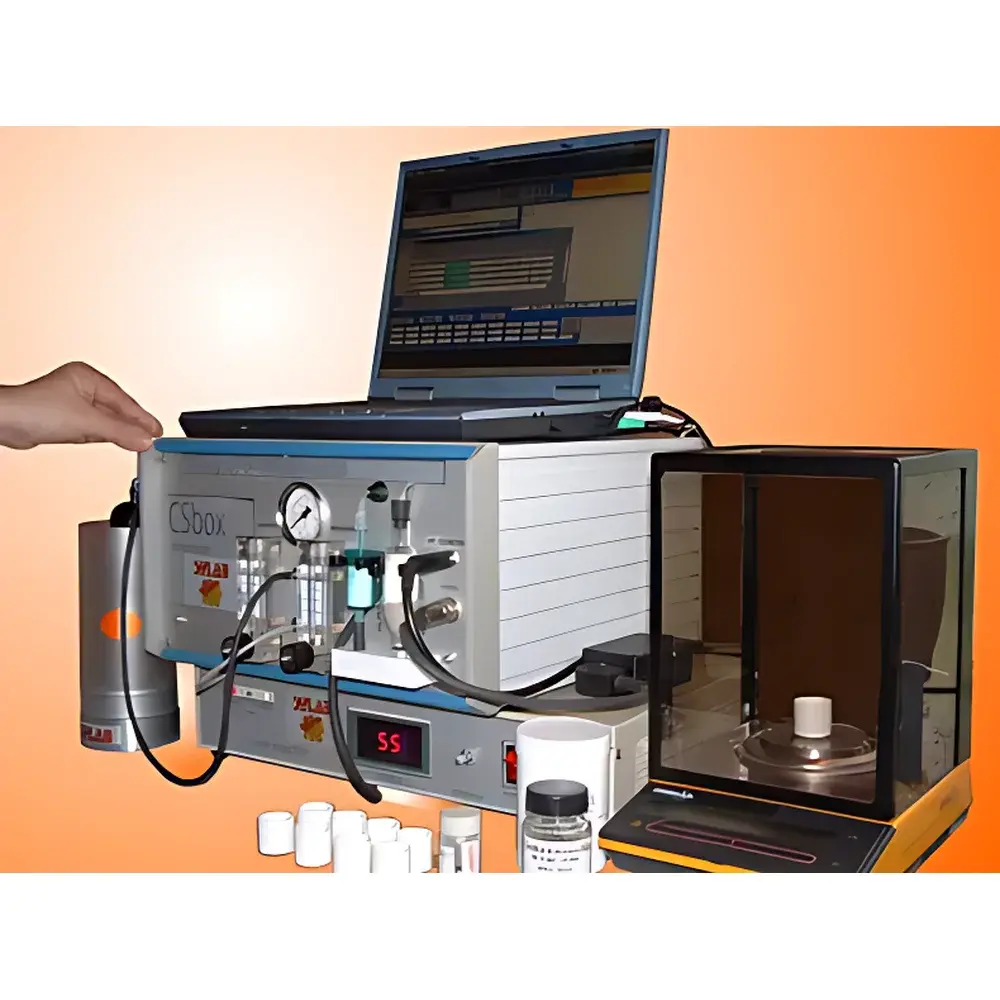
CSBox-HF High-Frequency Infrared Carbon-Sulfur Analyzer
| Origin | France |
|---|---|
| Manufacturer Type | Authorized Distributor |
| Origin Category | Imported |
| Model | CSBox-HF |
| Detection Method | Non-Dispersive Infrared (NDIR) |
| Measurement Range | C: 0.001–4 wt% |
| S | 0.002–1 wt% (extendable to 100% via sample weight reduction) |
| Precision | ±1% relative (for majority of solid inorganic samples) |
| Analysis Time | 20–60 s (typical) |
| Sample Mass | 100–2000 mg |
| Combustion Temperature | 1300–1500 °C (HF induction furnace) |
| Power Supply | 180–240 V AC, 50/60 Hz |
| HF Furnace Rating | 3.5 kW |
| Dimensions (Furnace) | 200 × 90 × 360 mm (L×W×H) |
| Weight | 24 kg (total system) |
| Carrier Gas | Ultra-high-purity O₂ (≥99.5%), 1 bar, ~2 L per analysis |
| Pump | External diaphragm pump with Viton seals (Germany-sourced) |
Overview
The CSBox-HF High-Frequency Infrared Carbon-Sulfur Analyzer is a compact, field-deployable elemental combustion analyzer engineered for precise quantification of total carbon (C) and sulfur (S) in solid inorganic matrices. It operates on the principle of high-frequency induction combustion followed by non-dispersive infrared (NDIR) spectroscopic detection — a method standardized under ASTM E1019, ISO 15350, and GB/T 20123 for metallurgical and mineralogical applications. Samples (100–2000 mg) are combusted in an inert or oxygen-rich atmosphere within a sealed HF induction furnace operating at 1300–1500 °C, converting carbon and sulfur into CO₂ and SO₂ gases. These combustion products are sequentially dried, filtered, and directed under controlled flow and pressure into dual-wavelength NDIR cells equipped with interference filters optimized for CO₂ (4.26 µm) and SO₂ (7.35 µm) absorption bands. Signal intensities are linearly correlated to concentration via calibrated reference curves, enabling direct mass-percent reporting of C and S with trace-level sensitivity and high reproducibility across heterogeneous materials including ferrous alloys, cement clinker, coal ash, iron ores, and refractory ceramics.
Key Features
- Modular high-frequency induction furnace (3.5 kW) with rapid thermal ramping and stable temperature control between 800–1500 °C, ensuring complete oxidation of refractory carbides and sulfides.
- Integrated NDIR optical module featuring dual gas cells, thermoelectrically stabilized detectors, and drift-compensated signal processing for long-term baseline stability.
- External diaphragm vacuum pump with Viton-sealed components (Germany-manufactured), mounted externally for service accessibility and reduced thermal coupling to the optical path.
- Compact footprint (24 kg total mass) and low-voltage operation (180–240 V AC) enable deployment in mobile laboratories, plant-floor QC stations, or remote field sites without dedicated power conditioning.
- Eight pre-configured analysis modes — including low-carbon steel, carbonate-rich limestone, HCl-decarburized samples, and high-sulfur slag — selectable via intuitive software interface to optimize combustion parameters and signal integration windows.
- Automated sample weighing interface supporting native protocols from Sartorius, Mettler Toledo, Precia Molen, and Ohaus balances; manual entry also supported. Up to 90 sample IDs and masses retained in volatile memory for audit trail continuity.
Sample Compatibility & Compliance
The CSBox-HF is validated for use with solid, non-volatile, non-hygroscopic inorganic samples requiring no prior acid digestion or solvent extraction. Certified applicability includes carbon steel, stainless steel, cast iron, manganese ferroalloys, Portland cement, limestone, bauxite, phosphate rock, and coal combustion residues. All hardware and firmware comply with IEC 61000-6-3 (EMC emissions) and IEC 61010-1 (safety for laboratory equipment). Data acquisition and reporting modules support GLP/GMP-aligned workflows: full electronic audit trail, user-access logs, calibration history retention, and optional 21 CFR Part 11 compliance mode (with digital signature and role-based access control enabled via software license). Method validation documentation aligns with ISO/IEC 17025 requirements for testing laboratories.
Software & Data Management
The embedded control system runs on a dedicated ARM-based microcontroller paired with a Windows-compatible USB-host interface. The CSBox Control Suite (v4.x) provides real-time combustion monitoring, automatic peak integration, multi-point calibration management, and customizable report templates (PDF/CSV/XLSX export). Raw spectral data, detector voltage traces, flow rate logs, and furnace temperature profiles are stored with timestamped metadata. Software supports batch processing of up to 99 samples per sequence, with auto-rejection of out-of-tolerance runs based on signal-to-noise ratio, baseline drift, or incomplete combustion flags. Calibration curves are maintained using certified reference materials (CRMs) traceable to NIST SRM 1261a (steel), SRM 278a (limestone), and IRMM-039 (sulfide ore).
Applications
- Quality control of incoming raw materials in steelmaking: verification of C/S specifications in scrap, pig iron, and fluxes.
- Routine analysis of cement raw meals and finished clinker to ensure compliance with ASTM C114 and EN 196-2 limits.
- Environmental monitoring of coal-fired power plant fly ash and bottom ash for sulfur content tracking under EPA Method 7E and ISO 10170.
- Geochemical screening of exploration drill cores and mine tailings for carbonatization and sulfidation indices.
- Research-grade quantification of residual carbon in ceramic matrix composites and refractory linings.
FAQ
What carrier gas is required, and what purity is necessary?
Ultra-high-purity oxygen (≥99.5% O₂, ≤5 ppm hydrocarbons, ≤1 ppm moisture) delivered at 1 bar regulated pressure. Approximately 2 L of O₂ is consumed per analysis cycle.
Can the instrument analyze liquid or organic samples?
No. The CSBox-HF is designed exclusively for solid, thermally stable inorganic matrices. Volatile, halogenated, or highly hydrated samples may damage the combustion chamber or contaminate the IR cell.
Is external cooling water required for the HF furnace?
No. The furnace employs air-cooling only; no recirculating chiller or tap-water connection is needed.
How often must the IR cell be cleaned or recalibrated?
Under normal operation with clean samples and proper filtration, the NDIR cell requires no routine cleaning. Calibration verification is recommended daily using CRM; full multi-point calibration every 72 hours or after 50 analyses.
Does the system meet regulatory requirements for pharmaceutical or food-grade testing?
While not intended for direct food/pharma release testing, its architecture supports 21 CFR Part 11 compliance when configured with licensed software modules and operated under documented SOPs meeting FDA and EMA expectations for elemental impurity screening in excipients.




