
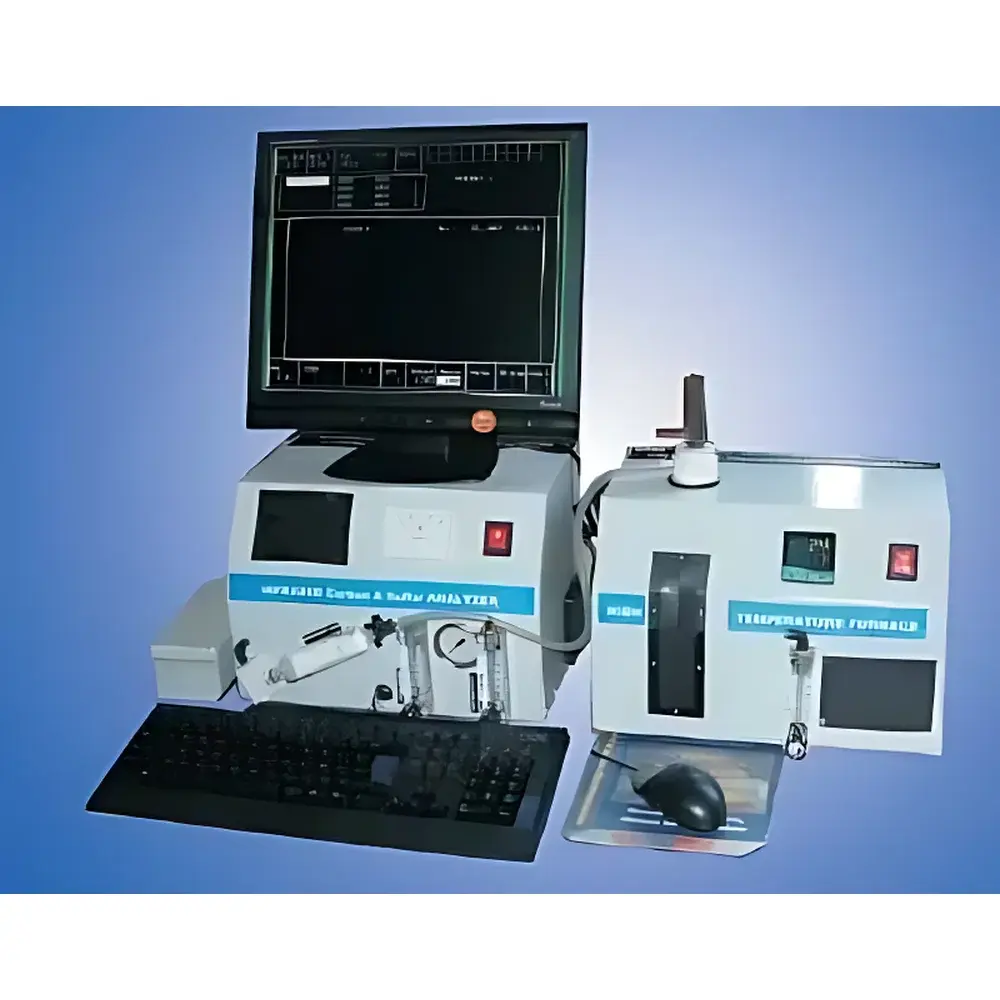
CSBox-Tube-S Non-Dispersive Infrared Coal Sulfur Determinator
| Origin | Imported |
|---|---|
| Manufacturer Type | Authorized Distributor |
| Detection Principle | Non-Dispersive Infrared (NDIR) |
| Model | CSBox-Tube-S |
| Measurement Range | 0.005–100 wt% S |
| Accuracy | ±1% relative (typical samples) |
| Sample Mass | 10–200 mg |
| Analysis Time | 40–300 s |
| Combustion Temperature | 800–1500 °C (configurable by mode) |
| Interface Protocol Support | Sartorius, Mettler, Precia, Ohaus (RS-232/USB), manual entry |
| Data Output | LPT, COM, USB, LAN (RJ45) |
| Operating System | FreeDOS on Advantech industrial motherboard |
Overview
The CSBox-Tube-S Non-Dispersive Infrared Coal Sulfur Determinator is a dedicated elemental sulfur analyzer engineered for high-reproducibility quantitative determination in solid and liquid fuels, minerals, and industrial raw materials. It operates on the principle of high-temperature catalytic combustion followed by non-dispersive infrared (NDIR) spectroscopic detection of sulfur dioxide (SO₂). During analysis, a precisely weighed sample (10–200 mg) is combusted in a tubular furnace under controlled oxygen flow at temperatures ranging from 800 °C to 1500 °C—adjustable based on sample matrix complexity. Combustion gases are conditioned through integrated dust and moisture traps before entering a thermally stabilized NDIR measurement cell equipped with interference filters optimized for the 7.3 µm SO₂ absorption band. The instrument delivers direct mass-based sulfur concentration results expressed as weight percent (wt%), traceable to certified reference materials and compliant with ASTM D4294, ISO 4297, and GB/T 214–2007 methodologies.
Key Features
- Modular combustion architecture supporting both vertical and inclined tube configurations: vertical mode enables high-temperature (up to 1500 °C) combustion using tin foil or tin capsules for refractory sulfur species (e.g., in ores and metallurgical slags); inclined mode utilizes quartz boats and nickel combustion aids for volatile or low-melting-point matrices (e.g., coal, coke, biomass).
- Integrated gravimetric interface compatible with major analytical balance protocols (Sartorius, Mettler Toledo, Precia Molen, Ohaus) via RS-232 or USB; automatic sample weight capture with onboard buffer storing up to 90 sample IDs and mass entries.
- Industrial-grade embedded computing platform based on Advantech motherboard running FreeDOS; supports password-protected hard drive access and full audit trail configuration for GLP/GMP environments.
- Real-time gas flow regulation and pressure stabilization ensure consistent residence time in the IR cell, minimizing signal drift and enhancing long-term calibration stability.
- Multi-interface connectivity including parallel (LPT), serial (COM), USB 2.0, and Ethernet (RJ45) for seamless integration into laboratory information management systems (LIMS) or centralized data acquisition networks.
Sample Compatibility & Compliance
The CSBox-Tube-S accommodates heterogeneous solid and liquid matrices without derivatization, including bituminous and anthracite coals, petroleum coke, cement clinker, iron ore, soil, agricultural feedstocks, and distillate fuels. Its combustion protocol meets the thermal decomposition requirements specified in ASTM D4294 (Standard Test Method for Sulfur in Petroleum and Petroleum Products by Energy-Dispersive X-ray Fluorescence Spectroscopy) for comparative validation, while its NDIR detection methodology aligns with ISO 4297 (Coal and Coke — Determination of Total Sulfur — Instrumental Methods) and Chinese national standard GB/T 214–2007. The system supports 21 CFR Part 11-compliant electronic record generation when paired with validated third-party software, and all calibration, maintenance, and result logs are timestamped and user-attributed for regulatory audit readiness.
Software & Data Management
Data acquisition, processing, and reporting are managed via a native DOS-based application with ASCII-text output capability. Raw IR absorbance signals, combustion temperature profiles, gas flow rates, and sample metadata are logged sequentially per analysis. Export formats include CSV and TXT for post-processing in Excel, MATLAB, or statistical process control (SPC) platforms. Optional firmware upgrades enable automated calibration verification using certified sulfur standards (e.g., SRM 1632c, NIST coal reference materials), with pass/fail criteria configurable per QA/QC protocol. Audit trails record operator ID, method version, calibration date, and instrument status flags—fully retrievable and exportable for internal review or external inspection.
Applications
- Quality control of coal blends in power generation facilities to ensure compliance with SOₓ emission limits under EPA MATS or EU IED directives.
- Specification testing of metallurgical coke for blast furnace operations, where sulfur content directly impacts slag basicity and hot metal quality.
- Raw material screening in cement manufacturing to prevent kiln corrosion and optimize clinker mineralogy.
- Environmental monitoring of contaminated soils and sediments for regulatory remediation assessment (e.g., EPA Method 9071B adaptation).
- R&D laboratories quantifying sulfur speciation effects in alternative fuels (e.g., torrefied biomass, waste-derived pellets) prior to combustion trials.
FAQ
What combustion atmosphere options are supported?
Oxygen-enriched flow (99.5% purity) is standard; ambient air may be used for select low-sulfur matrices upon method validation.
Is the instrument suitable for regulatory reporting under ISO 17025-accredited labs?
Yes—when operated with documented SOPs, traceable calibrations, and maintained logbooks, it fulfills technical requirements for accredited sulfur testing per ISO/IEC 17025:2017 clause 7.2.
Can the system analyze liquid fuels such as diesel or heavy fuel oil?
Yes, using quartz microboats and optimized ramp profiles; viscosity and volatility must be accounted for during sample introduction to avoid splashing or incomplete volatilization.
How frequently does the IR detector require recalibration?
Under routine use (≤20 samples/day), zero/span verification is recommended daily; full multi-point calibration every 30 days or after maintenance events.
Does the system support remote diagnostics or firmware updates?
Firmware updates are performed locally via USB stick; remote desktop access is not natively enabled but can be implemented via customer-configured secure VPN tunnels adhering to IT security policies.






