
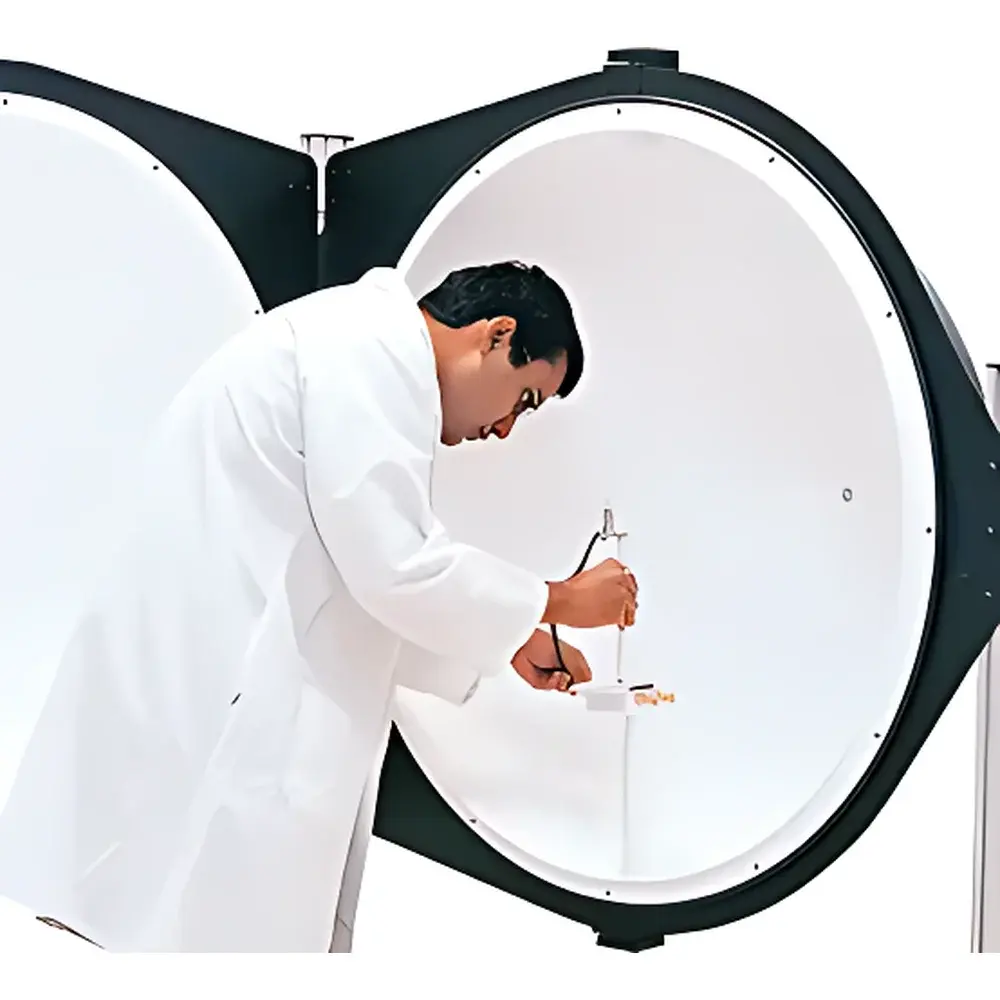
CSLMS-4021 LED, Fluorescent, Incandescent, HID and Projection Lamp Spectral Color Measurement System
| Brand | Labsphere |
|---|---|
| Origin | USA |
| Manufacturer Type | Authorized Distributor |
| Origin Category | Imported |
| Model | CSLMS-4021 |
| Pricing | Available Upon Request |
Overview
The CSLMS-4021 Spectral Color Measurement System is a fully integrated, NIST-traceable optical metrology platform engineered for comprehensive photometric and colorimetric characterization of general lighting sources—including LED, fluorescent, incandescent, high-intensity discharge (HID), and projection lamps. At its core, the system implements a double-pass Czerny-Turner monochromator architecture coupled with a thermoelectrically cooled, back-illuminated CCD detector—delivering high signal-to-noise ratio, low stray-light performance, and exceptional spectral stability across 380–780 nm. Unlike conventional integrating sphere-based setups relying on single-point detectors or uncooled sensors, the CSLMS-4021 leverages array-based spectral acquisition to simultaneously resolve radiant flux, spectral power distribution (SPD), chromaticity coordinates (CIE 1931 x,y and u′,v′), correlated color temperature (CCT), color rendering index (CRI), TM-30 metrics (Rf, Rg), and luminous flux (lm) in a single measurement cycle. The system operates under controlled thermal conditions (±0.1 °C detector stabilization), ensuring repeatability ≤0.3% for luminous flux and ≤0.0015 Δu′v′ for chromaticity—critical for compliance verification against IES LM-79, IES LM-80, ENERGY STAR, and DLC requirements.
Key Features
- Thermoelectrically cooled, thin-back-illuminated CCD spectrometer (CDS-1100 or CDS-2100) with 10⁶ dynamic range
- Integrated shutter mechanism enabling real-time dark current correction and automated background subtraction
- NIST-traceable spectral irradiance and luminous flux calibration, documented per ISO/IEC 17025-accredited procedures
- 4π solid-angle measurement geometry using a high-reflectance (≥98% BaSO₄) integrating sphere (1.5 m diameter standard configuration)
- Optional auxiliary absorption-corrected reference lamp for in-situ validation and long-term drift monitoring
- Motorized sample positioning stage with center-aligned mounting fixture for repeatable source orientation
Sample Compatibility & Compliance
The CSLMS-4021 accommodates lamps and modules ranging from miniature T1¼ halogen bulbs to high-power 1 kW HID projectors, with electrical interface support for AC/DC drivers, constant-current sources, and pulsed operation (up to 10 kHz). All measurements conform to IESNA LM-79-19 (Electrical and Photometric Measurements of Solid-State Lighting Products), CIE S 025/E:2015 (Test Method for LED Lamps, LED Luminaires and LED Modules), and ISO/CIE 13370:2022 (Colorimetry of Light Sources). Optional firmware modules enable audit-ready data export compliant with FDA 21 CFR Part 11 (electronic records/signatures) and GLP/GMP traceability requirements—including timestamped operator ID, instrument configuration logs, and full raw spectral dataset archiving.
Software & Data Management
MtrX-SPEC software provides a deterministic, scriptable measurement environment built on LabVIEW Real-Time architecture. It supports synchronized acquisition of spectral, photometric, and electrical parameters (V, I, P, PF) via IEEE-488 (GPIB) or USB-TMC interfaces. The GUI includes interactive spectral overlay, batch processing workflows, comparative analysis tools (ΔE₀₀, spectral similarity index), and automated report generation in PDF, CSV, and XML formats. Calibration files are digitally signed and version-controlled; all user actions—including calibration updates, measurement edits, and export events—are logged with cryptographic hash integrity checks. Raw .SPE and .JDX files retain full metadata (integration time, slit width, detector gain, ambient temperature/humidity) for third-party reprocessing.
Applications
- LED package and module qualification per JEDEC JESD22-A108 (temperature cycling) and IES TM-21 (lumen maintenance projection)
- Lamp energy labeling compliance testing for EU EPREL, US FTC Lighting Facts, and China GB/T 24823
- Projection system SPD optimization for cinema (DCI-P3), broadcast (Rec. 2020), and medical imaging applications
- R&D validation of phosphor-converted white LEDs, quantum dot hybrids, and narrow-band RGB laser light engines
- Production line sorting by CCT binning (±50 K) and chromaticity tolerance (MacAdam ellipse step 3)
- Long-term lumen depreciation studies under accelerated aging protocols (e.g., IES TM-28)
FAQ
What spectral range and resolution does the CSLMS-4021 support?
The system covers 380–780 nm with nominal FWHM resolution of 0.4 nm (CDS-1100) or 0.2 nm (CDS-2100), adjustable via software-selectable slit widths (10–500 µm).
Is NIST traceability provided with each system shipment?
Yes—each unit ships with a certificate of calibration referencing NIST Standard Reference Materials (SRMs 2020, 2030, and 2065), including uncertainty budgets per GUM (JCGM 100:2008).
Can the system measure pulsed or modulated light sources?
Yes—external trigger synchronization supports integration gating down to 10 µs, enabling accurate SPD capture of PWM-driven LEDs and stroboscopic HID lamps.
Does MtrX-SPEC support custom metric calculation?
Yes—the software SDK includes Python and .NET APIs for implementing proprietary color fidelity indices, melanopic EDI calculations, or application-specific spectral weighting functions.
How is absorption correction applied during sphere measurements?
An optional auxiliary tungsten-halogen reference lamp mounted inside the sphere enables real-time correction for sphere wall absorption losses at each wavelength, improving absolute flux accuracy to ±1.2% (k=2).




