
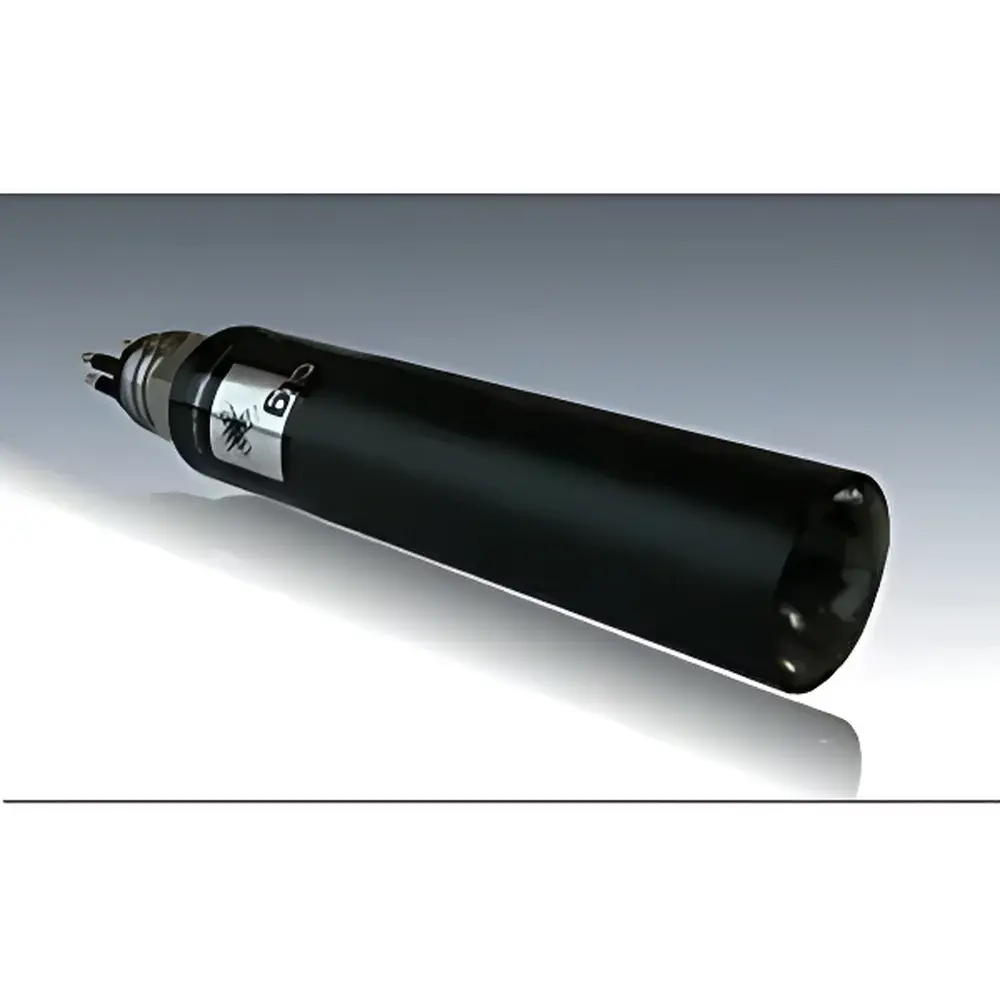
CTG UniLux Single-Parameter Fluorescence Sensor
| Origin | UK |
|---|---|
| Manufacturer Type | Distributor |
| Origin Category | Imported |
| Model | UniLux |
| Price Range | USD 1,400–7,000 (est.) |
| Application | Portable Chlorophyll-a and Organic Contaminant Fluorometer |
| Dimensions | Ø70 × 149 mm |
| Air Weight | 0.8 kg |
| In-Water Buoyant Weight | 0.15 kg |
| Pressure Rating | 600 m |
| Housing Material | Acetal (POM) |
| Electrical Interface | Subcon MCBH6M |
| Supply Voltage | 9–36 V DC |
| Power Consumption | <1 W @ 12 V |
| Operating Temperature | −2 to +40 °C |
| Storage Temperature | −40 to +70 °C |
| Output Options | RS232 (standard), 0–5 V analog (standard), RS422 & SDI-12 (optional) |
| Sampling Frequency | User-selectable, 0.1–3 Hz |
| Excitation Reference Compensation | Yes |
| Ambient Light Rejection | Integrated optical filtering and reference-based correction |
| Dynamic Range | User-adjustable |
| Detection Targets | Chlorophyll-a, PAHs, CDOM, Tryptophan (BOD surrogate), Optical Brighteners, Bacterial Indicators |
Overview
The CTG UniLux is a compact, submersible single-channel fluorescence sensor engineered for continuous, in-situ monitoring of organic fluorophores in aquatic environments. Developed by Chelsea Technologies Group Ltd. (CTG), a UK-based leader in marine optical instrumentation, the UniLux operates on the principle of excitation-emission fluorescence spectroscopy using a fixed-wavelength UV or blue LED source (model-dependent configuration) and a matched photodiode detector with narrow-band optical filtering. Its core measurement capability targets chlorophyll-a — a key proxy for phytoplankton biomass — as well as dissolved organic matter markers including tryptophan-like fluorescence (a recognized indicator of microbial activity and potential BOD loading), polycyclic aromatic hydrocarbons (PAHs), colored dissolved organic matter (CDOM), optical brighteners, and bacterial metabolites. Designed for deployment in wastewater treatment plants, drinking water reservoirs, estuarine systems, and coastal monitoring networks, the UniLux delivers real-time, quantitative fluorescence intensity data directly in engineering units (e.g., µg/L Chl-a, RFU, or user-calibrated concentration equivalents), minimizing post-processing requirements while maintaining analytical traceability.
Key Features
- Submersible stainless-steel and acetal housing rated to 600 m depth, enabling long-term moored or profiling deployments in both freshwater and seawater.
- Integrated excitation reference channel that dynamically compensates for LED intensity drift and fouling-induced signal attenuation, ensuring measurement stability over extended field intervals.
- Optical architecture optimized for ambient light rejection: dual-wavelength detection logic combined with pulsed excitation and synchronous demodulation suppresses solar-induced background noise without requiring mechanical shuttering or dark-cycle sampling.
- User-configurable sampling frequency (0.1–3 Hz) supports high-resolution event detection (e.g., stormwater runoff plumes) or low-power battery-operated operation for months.
- Low-power design (<1 W at 12 V DC) compatible with solar-charged battery systems and telemetry platforms such as cellular or LoRaWAN gateways.
- Dual-output interface: standard RS232 serial protocol for direct integration with data loggers (e.g., Campbell Scientific CR series, Onset HOBO) and 0–5 V analog output for legacy SCADA or PLC systems; optional RS422 and SDI-12 support broadens interoperability across environmental monitoring ecosystems.
Sample Compatibility & Compliance
The UniLux is validated for use in natural waters (rivers, lakes, estuaries), treated effluents, recycled water streams, and potable supply reservoirs. Its optical path length and detector sensitivity are calibrated for typical turbidity ranges up to 100 NTU; performance beyond this threshold may require empirical correction or co-deployment with a turbidity sensor. While not a certified primary standard instrument, the UniLux conforms to ISO 10264 (water quality — fluorescence measurement — general principles) and supports method development aligned with ASTM D7573 (standard test method for determination of chlorophyll-a in water by fluorescence). Data integrity meets GLP-aligned field practices, and when integrated with time-stamped, audit-trail-enabled data loggers, it satisfies documentation requirements for regulatory reporting under EU Water Framework Directive (WFD) monitoring programs and US EPA Method 445.0 supplemental applications.
Software & Data Management
Raw fluorescence signals from the UniLux are transmitted as ASCII-encoded serial strings (e.g., “CHLA=2.43;TEMP=12.7;REF=0.98”) or scaled analog voltages, permitting seamless ingestion into third-party platforms including AquaManager, HydroSphere, and custom Python/Node-RED pipelines. CTG provides the free UniLux Configuration Utility for Windows, enabling users to adjust gain, offset, sampling interval, and unit scaling via USB-to-serial adapter. For compliance-critical deployments, integration with FDA 21 CFR Part 11–compliant data acquisition software (e.g., LabVIEW with audit trail modules or ABB Ability™) ensures electronic record integrity, user access control, and versioned calibration history — essential for QA/QC workflows in drinking water utilities and contract environmental laboratories.
Applications
- Real-time chlorophyll-a monitoring for algal bloom early warning in reservoirs and drinking water intakes.
- Tryptophan fluorescence tracking as a rapid surrogate for biochemical oxygen demand (BOD) and fecal contamination in wastewater influent and tertiary effluent.
- PAH and optical brightener detection in urban runoff and industrial discharge points to identify illicit connections or accidental spills.
- CDOM characterization in watershed studies to assess terrestrial organic loading and carbon cycling dynamics.
- Battery-powered buoy networks for unattended coastal eutrophication surveillance with hourly telemetry.
- Calibration reference for larger multi-parameter fluorometers (e.g., TriOS RAMSES, Turner Designs Cyclops) during field intercomparison campaigns.
FAQ
Is the UniLux suitable for drinking water compliance monitoring?
Yes — while not a standalone certified method, it is widely deployed by water utilities for trend analysis, alarm triggering, and process optimization in accordance with internal QA protocols and WFD Annex V guidelines.
Can the UniLux be deployed in turbid or sediment-laden water?
It functions reliably up to ~100 NTU; above this, signal attenuation requires concurrent turbidity correction or empirical site-specific calibration.
Does the sensor require annual factory recalibration?
No scheduled recalibration is mandated; however, field verification using stable fluorescent standards (e.g., quinine sulfate solutions) every 3–6 months is recommended for critical applications.
What is the expected service life in continuous submersed operation?
With routine cleaning and antifouling measures (e.g., copper band or slow-release biocide), operational longevity exceeds 24 months in temperate freshwater; seawater deployments typically achieve 12–18 months before maintenance.
Can multiple UniLux sensors be daisy-chained on one RS485 bus?
Only with RS422 or SDI-12 option enabled; standard RS232 is point-to-point, but RS422 supports multi-drop configurations up to 1,200 m cable length with proper termination.







