
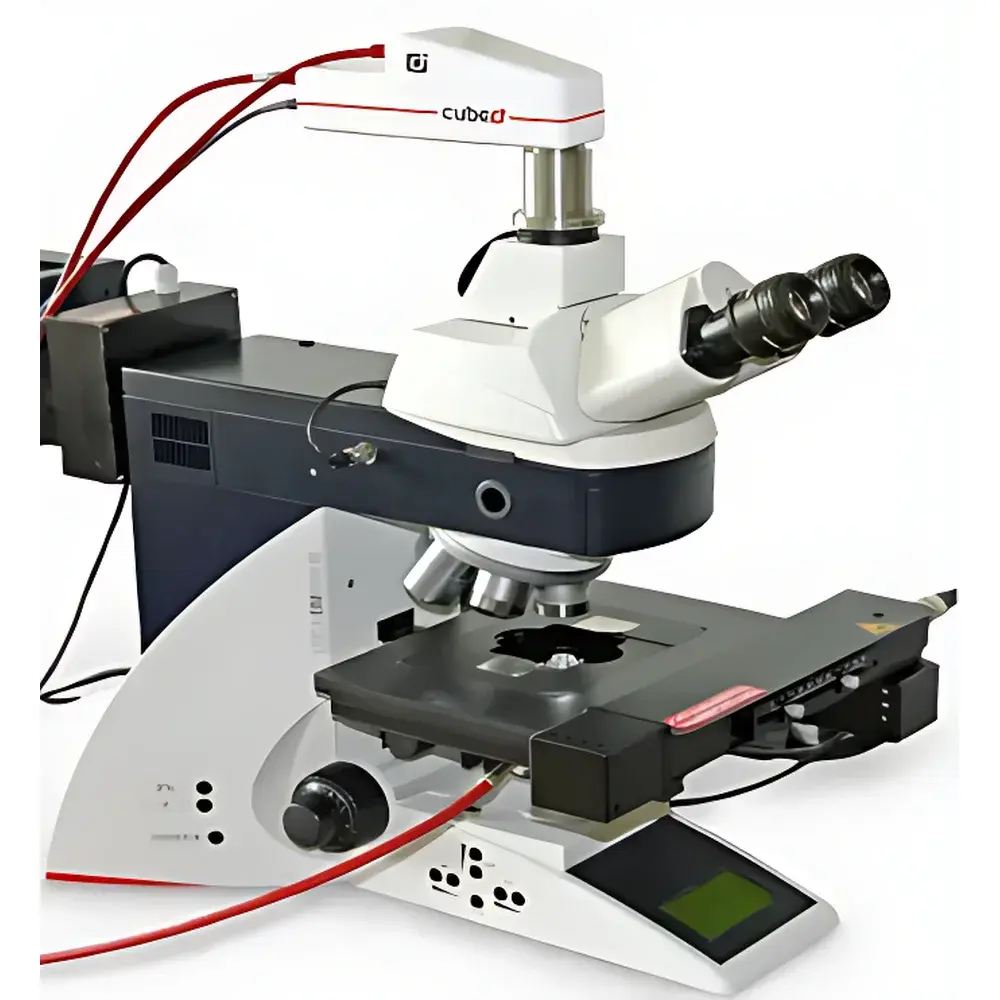
Cubert M185 Snapshot Hyperspectral Imaging Camera
| Brand | Cubert |
|---|---|
| Origin | Germany |
| Model | M185 |
| Operating Principle | Snapshot (FPA-based) |
| Imaging Modality | 3D Hyperspectral Cube Acquisition |
| Platform Compatibility | Ground-based & Airborne |
| Spectral Range | 450–950 nm |
| Spectral Resolution | 8 nm @ 532 nm |
| Frame Rate | 15 Cubes/s |
| Spatial Detector | 2 × 1 MP Si CCD |
| Spectral Channels | 125 |
| Sampling Interval | 4 nm |
| Bit Depth | 12-bit |
| Dynamic Range | 68 dB (typ.) |
| Exposure Time | 0.1–1000 ms |
| Interface | Dual Gigabit Ethernet |
| Lens Mount | C-mount |
| Power | 12 V DC, 8 W |
| Operating Temperature | −10 to +50 °C |
| Humidity | Non-condensing |
| Weight | 500 g |
Overview
The Cubert M185 is a high-performance snapshot hyperspectral imaging camera engineered for laboratory, clinical, and field-deployable applications requiring simultaneous high spatial fidelity, spectral precision, and temporal resolution. Unlike conventional push-broom or scanning systems, the M185 employs a patented focal-plane array (FPA)-based snapshot architecture—eliminating all mechanical scanning components and enabling full 3D hyperspectral cube acquisition in a single exposure (as fast as 1 ms). This design ensures zero motion artifacts, making it uniquely suited for dynamic biological processes, live-cell fluorescence monitoring, rapid chemical reaction tracking, and real-time material classification. Its visible-to-near-infrared (VNIR) spectral coverage (450–950 nm) with 125 contiguous spectral bands and 4 nm sampling interval supports robust spectral unmixing and quantitative reflectance/fluorescence analysis under ambient or controlled illumination. The system operates on fundamental principles of spatial-spectral encoding via integrated micro-optical filter arrays directly bonded to dual silicon CCD sensors—ensuring intrinsic pixel registration and radiometric stability across all bands.
Key Features
- True snapshot acquisition: Captures complete hyperspectral cubes (x, y, λ) without scanning—enabling artifact-free imaging of transient phenomena.
- VNIR optimization: 450–950 nm spectral range with 8 nm resolution at 532 nm and 4 nm average sampling interval—ideal for pigment analysis, tissue oxygenation mapping, and mineral identification.
- High-speed performance: Sustained acquisition rate of up to 15 hyperspectral cubes per second—compatible with high-throughput screening and time-resolved kinetics studies.
- Microscopy-integrated design: Standard C-mount interface enables direct coupling to upright/inverted optical microscopes—preserving native magnification and parfocality.
- Robust industrial-grade architecture: Compact 500 g form factor, wide operating temperature range (−10 to +50 °C), non-condensing humidity tolerance, and low-power 12 V DC operation support benchtop, mobile lab, and UAV-mounted deployments.
- Dual GigE interface: Enables synchronized data streaming, hardware triggering, and integration into automated workflows compliant with IEEE 802.3 standards.
Sample Compatibility & Compliance
The M185 is compatible with diverse sample types—including unstained and fluorescently labeled cells, tissue sections, pharmaceutical tablets, agricultural leaves, geological thin sections, and painted surfaces—without requiring vacuum, cryogenic cooling, or external illumination synchronization. Its snapshot nature eliminates scan-induced misregistration, ensuring pixel-accurate co-location of spectral and spatial information critical for quantitative histopathology and GLP-compliant spectral library generation. The instrument complies with CE marking requirements for electromagnetic compatibility (EMC Directive 2014/30/EU) and low-voltage safety (LVD Directive 2014/35/EU). While not certified as medical device (Class IIa/III), its output data meets foundational requirements for ISO 13485-aligned analytical method validation when used within validated laboratory information management systems (LIMS). Spectral calibration traceability follows NIST-traceable reference standards (e.g., HG/Ne and tungsten-halogen lamps), supporting ASTM E275, ISO 18365, and USP spectral measurement guidelines.
Software & Data Management
Cubert’s proprietary uSpectra software provides end-to-end workflow control—from real-time cube preview and exposure optimization to batch spectral extraction, PCA-based dimensionality reduction, and supervised/unsupervised classification (e.g., SVM, K-means). Raw data is saved in vendor-neutral ENVI-compatible BIL format with embedded wavelength and radiometric metadata. Export modules support CSV, HDF5, and MATLAB .mat formats for integration with Python (scikit-learn, SciPy), R, or MATLAB-based chemometric pipelines. Audit trail functionality logs user actions, acquisition parameters, and calibration timestamps—supporting ALCOA+ principles (Attributable, Legible, Contemporaneous, Original, Accurate) required under FDA 21 CFR Part 11 for regulated environments. Optional SDKs (C/C++, Python) enable custom algorithm deployment and integration into automated QC platforms.
Applications
- Live-cell dynamics: Tracking intracellular calcium flux, mitochondrial membrane potential shifts, and pH-dependent fluorophore behavior at sub-second temporal resolution.
- Clinical histopathology: Label-free discrimination of tumor margins, collagen cross-linking states, and hemoglobin saturation gradients in fresh-frozen or FFPE tissue.
- Pharmaceutical QA/QC: Quantitative assay of API distribution homogeneity, coating thickness uniformity, and polymorphic phase mapping in solid dosage forms.
- Agricultural phenotyping: Early detection of biotic/abiotic stress via chlorophyll fluorescence red-edge shift, anthocyanin accumulation, and water-band absorption indices.
- Mineralogical surveying: Field-portable identification of clay species, iron oxides, and hydroxides using diagnostic absorption features between 700–950 nm.
- Forensic document analysis: Non-destructive differentiation of ink formulations, erased annotations, and substrate aging signatures.
FAQ
Is the M185 suitable for fluorescence lifetime imaging (FLIM)?
No—the M185 captures intensity-based hyperspectral cubes only; it does not provide time-correlated single-photon counting (TCSPC) or gated detection capability required for FLIM.
Can the M185 be calibrated for absolute radiance measurements?
Yes—using NIST-traceable integrating sphere sources and optional factory calibration service, users can generate radiometrically corrected data compliant with ISO 20653 and ASTM E275 protocols.
What microscope objectives are recommended for optimal spatial sampling?
Objectives with numerical aperture ≥0.4 and magnification 10×–40× yield optimal sampling at the sensor Nyquist limit; oil-immersion objectives require careful evaluation of spectral transmission below 480 nm.
Does the system support external triggering for synchronization with other instruments?
Yes—TTL-compatible trigger input/output ports allow precise coordination with lasers, shutters, or stage controllers, enabling pump-probe or multi-modal acquisition schemes.
How is spectral crosstalk minimized in the FPA architecture?
Cubert employs proprietary micro-filter array fabrication with <1% out-of-band leakage and pixel-level spectral response characterization—validated during final system calibration and reported in each unit’s certificate of conformance.
Related Products






