
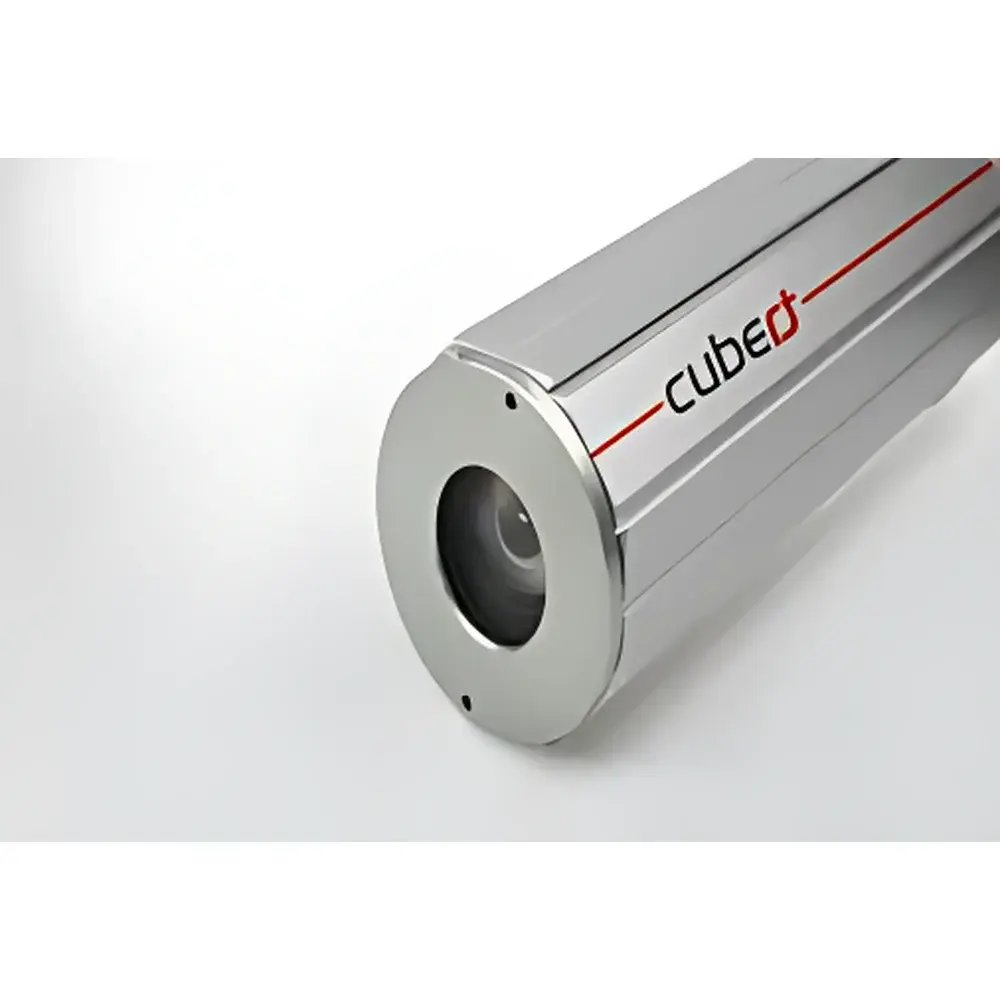
Cubert Q285 Snapshot Hyperspectral Imaging Camera
| Brand | Cubert |
|---|---|
| Origin | Germany |
| Model | Q285 |
| Operating Principle | Snapshot (Frame-based) |
| Imaging Modality | 3D Hyperspectral Cube Acquisition |
| Deployment | Ground-based |
| Spectral Range | 450–950 nm |
| Spectral Resolution | 8 nm @ 532 nm |
| Instantaneous Field of View (IFOV) | 1/1000 |
| Frame Rate | 20 Cubes/s |
| Spectral Sampling Interval | 4 nm |
| Number of Spectral Bands | 125 |
| Detector | Dual Si CMOS Area Sensor (2 × 1 MP) |
| Dynamic Exposure Range | 0.1–1000 ms |
| Data Interface | Dual Gigabit Ethernet |
| Bit Depth | 14-bit |
| Spectra per Cube | 2500 |
| Shutter Type | Global Shutter |
| Lens Mount | C-mount |
| IP Rating | IP65 |
| Operating Temperature | −10 to +50 °C |
| Weight | 3000 g |
| Power Supply | DC 12 V, 8 W |
| Lens Options | 10 mm, 16 mm, 23 mm, 35 mm focal length |
Overview
The Cubert Q285 is a high-performance, frame-based hyperspectral imaging camera engineered for real-time, distortion-free acquisition of full 3D spectral data cubes (x, y, λ). Unlike conventional push-broom or scanning systems, the Q285 employs Cubert’s proprietary snapshot technology—optically splitting incoming light across two synchronized silicon area sensors via a micro-optical image slicer and dispersive element. This architecture eliminates mechanical motion, enabling simultaneous capture of all spatial and spectral channels within a single exposure. The system operates across the visible to near-infrared (VNIR) range (450–950 nm) with 125 discrete bands sampled at 4 nm intervals and a nominal spectral resolution of 8 nm at 532 nm. Its global shutter and dual-CMOS design ensure temporal coherence across all bands—critical for measuring rapidly moving targets or operating from dynamic platforms such as ground vehicles, marine vessels, or UAV-mounted gimbals. With a native acquisition speed of up to 20 spectral cubes per second and sub-millisecond exposure control (0.1–1000 ms), the Q285 delivers quantitative, radiometrically stable hyperspectral data under field conditions where motion artifacts, lighting variability, and environmental stress would compromise traditional scanning instruments.
Key Features
- Snapshot acquisition: Full spectral cube captured in a single integration time—no line-by-line scanning, no motion-induced misregistration
- Dual 1-megapixel CMOS sensors with 14-bit digitization and global shutter synchronization for high-fidelity temporal alignment
- IP65-rated ruggedized housing: Dust-tight, water-resistant (low-pressure jets), and shock-damped for long-term operation in outdoor, agricultural, maritime, or industrial environments
- Modular C-mount lens interface supporting interchangeable focal lengths (10 mm, 16 mm, 23 mm, 35 mm) to adapt field-of-view and working distance
- Dual GigE Vision-compliant interfaces for deterministic, low-latency data streaming and synchronized multi-camera deployment
- Real-time onboard processing capability for embedded dark-current correction, flat-field normalization, and spectral calibration lookup
- Compact form factor (3000 g) and low power consumption (12 V DC, 8 W) optimized for mobile and battery-powered deployments
Sample Compatibility & Compliance
The Q285 is designed for non-contact, reflectance- or radiance-based measurement of heterogeneous surfaces—including vegetation canopies, soil substrates, food commodities, painted materials, geological outcrops, and cultural heritage objects. Its VNIR sensitivity supports widely adopted vegetation indices (e.g., NDVI, PRI, MCARI), pigment quantification (chlorophyll-a/b, anthocyanin), moisture mapping, and material classification tasks. The system complies with industrial environmental standards (IEC 60529 IP65) and adheres to electromagnetic compatibility requirements per EN 61326-1. While not certified for medical or aerospace safety-critical applications, its radiometric stability and traceable calibration protocol align with best practices defined in ASTM E2792 (Standard Guide for Hyperspectral Imaging) and ISO 17025-accredited laboratory workflows when used with NIST-traceable reference panels.
Software & Data Management
Cubert’s proprietary UHD Spectral Studio software provides end-to-end support for acquisition, preprocessing, visualization, and quantitative analysis. It enables batch export of calibrated spectra, georeferenced hypercubes (GeoTIFF/HDR), and classified maps using supervised (SVM, Random Forest) and unsupervised (k-means, PCA) algorithms. Built-in tools support automated vegetation index computation (e.g., NDVI, EVI, SAVI), spectral angle mapper (SAM) matching, and time-series cube alignment for longitudinal monitoring. All processing steps are logged with timestamped metadata, satisfying auditability requirements for GLP-aligned research and quality assurance documentation. Export formats include ENVI .hdr/.dat, HDF5, and CSV-compatible spectral libraries—ensuring interoperability with MATLAB, Python (scikit-learn, spectral), and commercial GIS platforms. The SDK supports custom integration into LabVIEW, ROS, and enterprise data pipelines via TCP/IP or shared memory protocols.
Applications
- Precision agriculture: In-field crop health assessment, nutrient deficiency detection, yield prediction, and irrigation optimization
- Environmental monitoring: Surface water quality analysis (chlorophyll-a, suspended solids, CDOM), wetland mapping, and invasive species identification
- Plant phenotyping: High-throughput trait extraction (leaf area index, canopy structure, biochemical composition) in greenhouse and field trials
- Food safety & quality control: Detection of surface contaminants, bruising, ripeness staging, and adulteration in fruits, grains, and processed products
- Cultural heritage documentation: Pigment identification, underdrawing revelation, and degradation mapping of paintings and manuscripts
- Industrial inspection: Coating uniformity verification, polymer sorting, and counterfeit detection in pharmaceutical packaging and electronics
- Dynamic scene analysis: Real-time tracking of moving targets (e.g., wildlife, vehicles) with spectral signature persistence across frames
FAQ
How does the Q285 differ from push-broom hyperspectral cameras?
Unlike push-broom systems that require platform motion to build a spectral cube line-by-line, the Q285 captures the entire x-y-λ volume in one snapshot—eliminating spatial-spectral misalignment caused by vibration or velocity changes.
Can the Q285 be mounted on a moving vehicle or drone?
Yes. Its snapshot architecture, IP65 enclosure, and shock-isolated optical train make it suitable for vehicular, marine, and stabilized airborne deployments—provided appropriate motion compensation is applied during post-processing.
What calibration standards are supported?
The system ships with factory radiometric calibration and supports user-defined calibration using NIST-traceable reflectance panels (e.g., Labsphere Spectralon®) and irradiance standards. Calibration files are embedded in each acquired cube.
Is spectral data export compatible with third-party analysis tools?
All raw and processed data are exported in open, well-documented formats (ENVI, HDF5, CSV), ensuring seamless ingestion into Python, R, MATLAB, ArcGIS, and ENVI software environments.
Does the Q285 meet regulatory requirements for scientific data integrity?
While not FDA 21 CFR Part 11-certified out-of-the-box, its immutable metadata logging, version-controlled calibration, and audit trail functionality enable compliance with GLP/GMP data governance frameworks when deployed within validated laboratory information management systems (LIMS).
Related Products




