
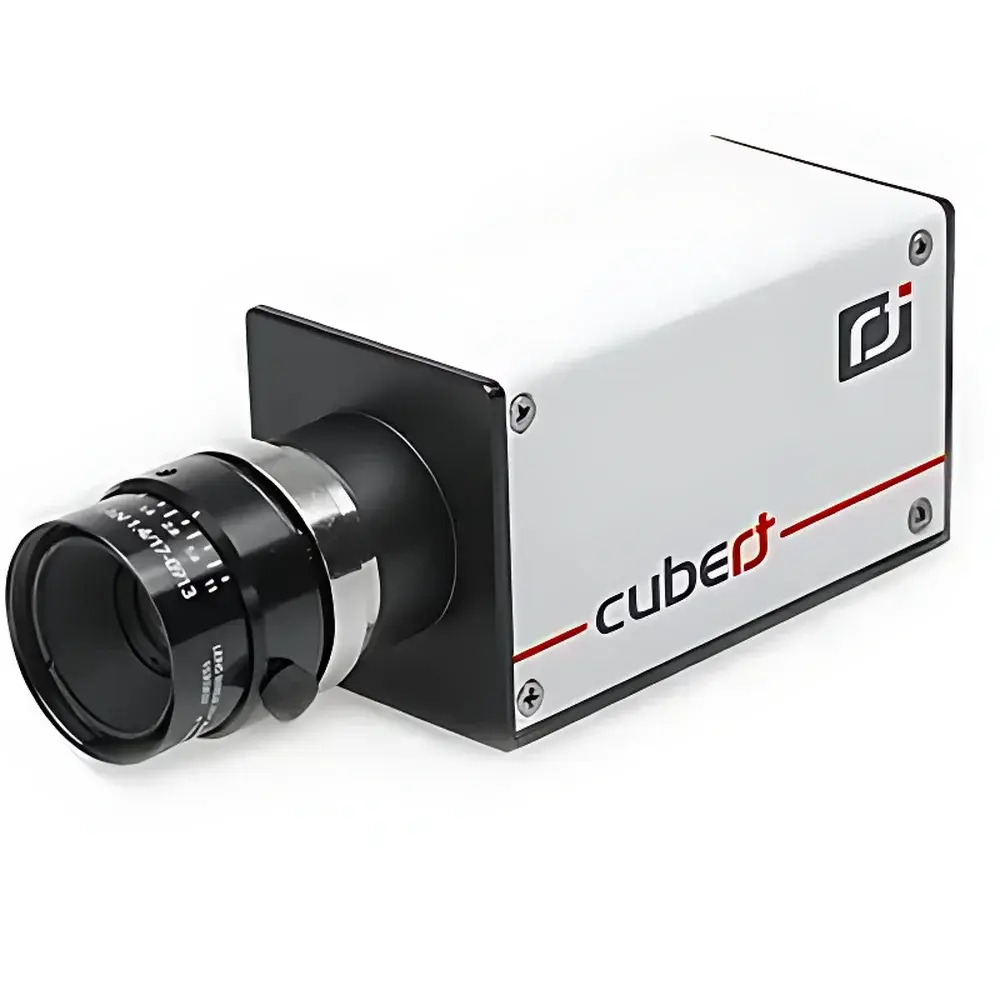
Cubert S128/S137 Multichannel Snapshot Hyperspectral Imaging Spectrometer
| Brand | Cubert |
|---|---|
| Origin | Germany |
| Model | S128 / S137 |
| Spectral Range | S128: 470–630 nm (16 channels), S137: 600–1000 nm (25 channels) |
| Spectral Resolution | 20 nm |
| Spatial Resolution | S128: 512 × 272 px, S137: 410 × 218 px |
| Frame Rate | 10 fps |
| Imaging Modality | Snapshot (single-lens, multichannel, full-frame) |
| Detector | Si CMOS, 10-bit/8-bit digitization |
| Interface | USB 3.0, GigE, hardware trigger |
| Onboard Storage | microSD card |
| Power Supply | DC 9–24 V, 15 W |
| Operating Temperature | 0–40 °C |
| Weight | 350 g |
| Lens Mount | C-mount (interchangeable 10 mm / 23 mm / 35 mm FOV options) |
| Compliance | CE, RoHS |
Overview
The Cubert S128 and S137 are snapshot hyperspectral imaging spectrometers engineered for high-speed, spatially registered spectral data acquisition in field-deployable and airborne configurations. Unlike scanning or push-broom systems, these instruments employ a monolithic, single-lens, filter-wheel-free architecture based on patented micro-patterned linear variable filter (LVF) array technology integrated directly onto the CMOS sensor surface. This enables true simultaneous capture of all spectral bands across the entire field of view—eliminating motion-induced misregistration, temporal drift, and geometric calibration complexity inherent in multi-optic or scanning approaches. The S128 operates in the visible range (470–630 nm) with 16 discrete 20-nm spectral channels, while the S137 covers the red-edge to shortwave infrared (600–1000 nm) with 25 channels. Both models deliver frame-synchronous hyperspectral cubes at up to 10 Hz, making them suitable for real-time monitoring, UAV-based remote sensing, and dynamic process analysis where spectral fidelity and spatial coherence are non-negotiable.
Key Features
- Snapshot Multispectral Architecture: Single-lens, full-frame acquisition ensures pixel-level spectral-spatial correspondence without image registration or interpolation.
- Onboard Intelligence: Integrated ARM processor enables autonomous operation—including real-time preview, SD-card storage, and trigger-synchronized capture—without external computing.
- Modular Optical Design: C-mount lens interface supports interchangeable Schneider optics (10 mm, 23 mm, 35 mm focal lengths) to adapt instantaneous field of view (IFOV) and ground sampling distance (GSD) for ground or aerial deployment.
- Dual-Mode Operation: Functions as a standalone smart camera or integrates seamlessly with PC via USB 3.0 or Gigabit Ethernet for remote control, live streaming, and synchronized multi-instrument setups.
- Robust Environmental Design: Sealed aluminum housing rated for non-condensing environments; operational temperature range of 0–40 °C; power-efficient (15 W max) for extended battery-powered UAV missions.
- High Temporal Fidelity: Global shutter CMOS detector with sub-100 µs exposure time ensures minimal motion blur during high-speed platform movement or rapid biological responses.
Sample Compatibility & Compliance
The S128/S137 is designed for reflective surface imaging of heterogeneous natural and engineered materials—including vegetation canopies, soil substrates, industrial surfaces, and laboratory samples—under ambient or controlled illumination. Its spectral band selection aligns with established vegetation indices (e.g., NDVI, PRI, CIred-edge), mineral absorption features, and pigment diagnostics. While not intended for transmission or fluorescence spectroscopy, its high signal-to-noise ratio (SNR) and radiometric stability support quantitative reflectance calibration using NIST-traceable standards. The system complies with EU directives CE 2014/30/EU (EMC) and 2011/65/EU (RoHS), and meets IEC 60529 IP52 ingress protection specifications for dust resistance and limited water exposure. Data integrity workflows—including timestamping, metadata embedding (GPS, IMU, exposure parameters), and lossless 10-bit raw cube export—are compatible with GLP-aligned documentation requirements.
Software & Data Management
Cubert provides two complementary software environments: Cubert Utils, a Windows-based desktop application for advanced acquisition control, radiometric correction, spectral library matching, and batch processing; and Cubert SmartCam, a lightweight embedded UI accessible via web browser over Ethernet or Wi-Fi for field configuration and live preview. All spectral cubes are stored in standard ENVI-compatible .hdr/.raw format with embedded geotags and sensor metadata. SDKs (C/C++, Python) support integration into custom data pipelines, including those compliant with ISO 17025 traceability frameworks or FDA 21 CFR Part 11–enabled audit trails when deployed in regulated QC/QA environments. Raw data may be exported for third-party analysis in MATLAB, ENVI, or Python-based libraries (scikit-image, hylite, pysptools).
Applications
- Precision Agriculture: In-field detection of nitrogen stress, water deficit, and early-stage fungal infection via red-edge and NIR spectral shifts.
- Plant Phenotyping: High-throughput screening of genetic traits through spectral response profiling under controlled growth chamber or greenhouse conditions.
- Environmental Monitoring: Mapping invasive species, chlorophyll-a concentration in inland waters, and post-fire vegetation recovery using multispectral indices derived from calibrated reflectance cubes.
- Industrial Quality Control: Real-time verification of coating uniformity, pigment consistency, and surface contamination on moving production lines.
- Geospatial Research: UAV-mounted deployment for terrain classification, mineral prospecting, and archaeological site surveying with centimeter-scale GSD achievable at low-altitude flight.
- Academic Remote Sensing: Validation of atmospheric correction models, sensor fusion experiments, and development of novel spectral unmixing algorithms.
FAQ
What distinguishes the S128 and S137 from push-broom hyperspectral cameras?
The S128/S137 acquires all spectral bands simultaneously per frame using a patterned filter array on the sensor, whereas push-broom systems require platform motion to build a hyperspectral cube line-by-line—introducing spatial misalignment risks and limiting use on unstable or slow-moving platforms.
Can the instrument perform radiometric calibration in the field?
Yes—using optional calibrated reflectance panels (e.g., Spectralon®), users can apply empirical line-of-sight correction within Cubert Utils to convert raw digital numbers to apparent reflectance, supporting quantitative analysis.
Is GPS/IMU data embedded in the hyperspectral cube files?
When connected to an external GNSS+IMU unit via serial or PPS trigger, position, orientation, and timestamp metadata are automatically embedded in the ENVI header and binary file structure.
What is the maximum sustainable frame rate for continuous recording to SD card?
At full resolution, sustained write speeds of ≥90 MB/s are required for uninterrupted 10 fps capture; Class 10 UHS-I or UHS-II microSD cards are recommended.
Does the system support triggering from external sources such as LiDAR or RTK-GNSS pulses?
Yes—the hardware trigger input accepts TTL-level signals for precise synchronization with auxiliary sensors, enabling tightly coupled multi-modal data acquisition.




