
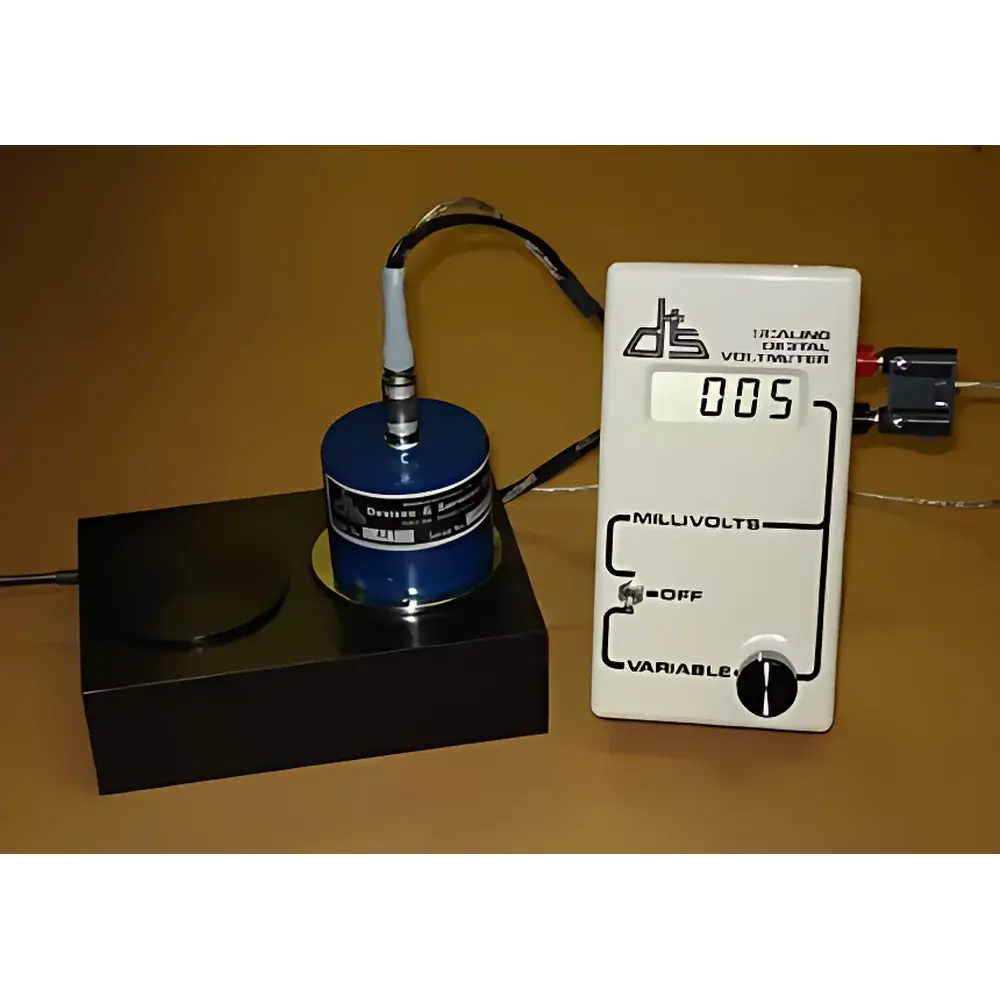
SurfaceOptics AE1/RD1 Total Hemispherical Emissometer
| Brand | SurfaceOptics (SOC) |
|---|---|
| Origin | USA |
| Model | AE1/RD1 |
| Emissivity Measurement Range | 0.05–0.95 |
| Repeatability | ±0.01 |
| Measurement Time per Sample | ≤10 s |
| Sample Temperature Range | Up to 54 °C (130 °F) |
| Standard Blackbody Cavity Temperature Control | Required for thermal equilibrium |
| Detector Output Linearity Error | <±0.01 over full emissivity range |
| Output Signal | 2.4 mV at 25 °C, ε = 0.9, 150 Ω load |
| Power Supply | 100–240 VAC, 50–60 Hz → 12 VDC adapter |
| Optional Battery Pack | 12 V, 12 h continuous operation |
| Minimum Flat Sample Diameter | 5.7 cm (2.25 in) |
| with AE-AD1 | 2.54 cm (1.0 in) |
| with AE-AD3 | 1.9 cm (0.75 in measurement area) |
| Compliance | Designed for ASTM C1371, ISO 18434-1, and ASTM E1933-compliant emissivity validation workflows |
Overview
The SurfaceOptics AE1/RD1 Total Hemispherical Emissometer is a precision laboratory instrument engineered for the direct, contactless measurement of total hemispherical spectral emissivity (ε) of solid surfaces at near-ambient to moderately elevated temperatures (up to 54 °C). Based on the principle of comparative radiometric substitution, the AE1 employs a thermopile-based detector calibrated against traceable high- and low-emissivity reference standards. It operates under the fundamental assumption that, at thermal equilibrium, the net radiative heat flux between a sample and a blackbody cavity is linearly proportional to its emissivity—enabling absolute emissivity determination without requiring knowledge of absolute temperature or spectral response calibration. Unlike infrared spectrometers or FTIR-based methods, the AE1 delivers rapid, repeatable ε-values for engineering-grade thermal modeling, spacecraft thermal control verification, and industrial coating qualification—where traceability, reproducibility, and operational simplicity are prioritized over spectral resolution.
Key Features
- High repeatability of ±0.01 emissivity units across repeated measurements on identical samples under controlled thermal conditions.
- Electrically heated detector eliminates need for sample heating or external temperature sensors—only requires thermal equilibration between sample and reference cavity via the included blackbody槽 (heat sink).
- Direct analog voltage output (2.4 mV @ ε = 0.9, 25 °C) with intrinsic linearity (<±0.01 deviation), enabling straightforward calibration using D&S RD1 micro-digital voltmeter.
- Modular probe architecture: Standard AE1 head accommodates flat samples ≥5.7 cm diameter; optional AE-AD1 and AE-AD3 adapters extend capability to 2.54 cm and 1.9 cm minimum diameters respectively.
- Customizable geometry support: AE-ADP adapter enables reliable measurement on curved, low-conductivity, or rough-surfaced specimens—including cylindrical surfaces with radius >5 cm.
- Complete traceable calibration suite: Supplied with two high-ε (≥0.95) and two low-ε (≤0.15) reference standards—dual sets ensure ongoing verification and long-term drift monitoring per ISO/IEC 17025 practices.
Sample Compatibility & Compliance
The AE1/RD1 system is validated for use with non-transmissive, opaque solid materials including metals, ceramics, paints, anodized coatings, thermal control films, and composite substrates. Samples must be thermally stable and exhibit uniform surface emissivity over the measurement aperture. The instrument complies with core requirements of ASTM C1371 (Standard Test Method for Determination of Emissivity of Materials Near Room Temperature Using a Portable Infrared Emissometer) and supports workflows aligned with ISO 18434-1 (Condition monitoring — Thermography — Part 1: General procedures) and ASTM E1933 (Standard Test Methods for Measuring and Compensating for Emissivity Using Infrared Imaging Systems). While not inherently 21 CFR Part 11 compliant, audit trails and calibration records generated during operation may be integrated into GLP/GMP documentation systems when paired with validated laboratory information management software (LIMS).
Software & Data Management
The AE1/RD1 is a hardware-calibrated analog system with no embedded firmware or onboard data logging. Emissivity values are read directly from the RD1 digital voltmeter’s front-panel display and recorded manually or via external analog-to-digital acquisition (e.g., LabVIEW, MATLAB, or custom SCADA interfaces). The RD1 supports optional 10× gain extension (RD1-10X), improving resolution to 0.001 ε units for high-precision applications such as space-grade thermal coating certification. All calibration constants, standard body serial numbers, and measurement protocols are documented in the provided technical manual—facilitating compliance with internal QA procedures and third-party audit readiness.
Applications
- Thermal design validation of satellite radiators, MLI blankets, and optical baffles in aerospace R&D labs.
- Quality assurance of high-emissivity thermal control paints (e.g., Z-93, Chemglaze A276) and low-emissivity metallic coatings (e.g., vapor-deposited Al, Ag).
- Characterization of ceramic matrix composites (CMCs) and refractory materials used in turbine engine components.
- Verification of emissivity stability after environmental exposure testing (thermal cycling, humidity, UV).
- Supporting ASTM E1530 (Standard Test Method for Evaluating the Resistance of Materials to Thermal Insulation) through accurate boundary condition input.
- Academic research in radiative heat transfer, surface science, and infrared signature prediction.
FAQ
Does the AE1 require sample temperature measurement?
No—the AE1 does not measure sample temperature directly. It requires only that the sample and reference blackbody cavity reach thermal equilibrium, verified by a contact thermometer or IR spot pyrometer prior to measurement.
Can the AE1 measure transparent or semi-transparent materials?
No—only opaque, non-scattering solids with negligible transmittance in the 3–14 µm band are suitable. Transmissive materials will yield non-physical emissivity values due to unaccounted transmission losses.
Is the RD1 voltmeter NIST-traceable?
The RD1 itself is not NIST-certified, but its calibration is established using the supplied reference standards, which are characterized against NIST-traceable blackbodies. Users may perform periodic verification using accredited metrology services.
What is the role of the blackbody槽 (heat sink)?
The blackbody槽 maintains thermal stability of the reference cavity and ensures consistent background radiation during both standardization and sample measurement—critical for minimizing convection-induced drift.
How often must the reference standards be recalibrated?
SurfaceOptics recommends annual recalibration of reference standards by an ISO/IEC 17025-accredited laboratory, especially if used in regulated environments or after mechanical damage or contamination.




