
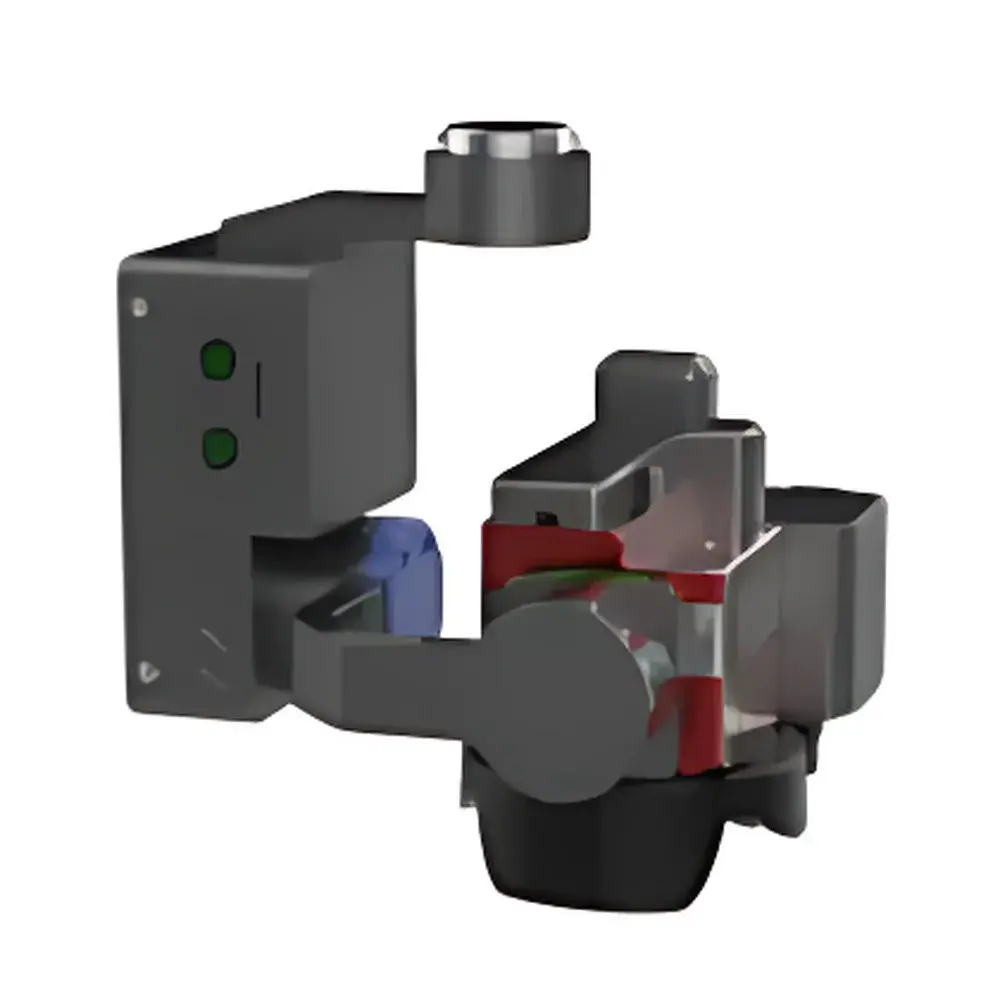
Cubert X20P-IR Hyperspectral Imaging System
| Brand | Cubert |
|---|---|
| Origin | Germany |
| Model | X20P-IR |
| Spectral Range | 350–1000 nm |
| Spectral Resolution | 1886 × 1886 pixels |
| Spatial Resolution (IFOV) | 20 MP high-sensitivity hyperspectral CMOS + Vox infrared sensor + 3.5 MP full-frame complementary detector |
| Field of View (TFOV) | 35° (66 spectral bands) |
| Frame Rate | 12-bit digitization |
| Imaging Modality | Dispersive (snapshot light-field architecture) |
| Platform Compatibility | Ground-based and airborne (UAV-integrated) |
| Detector Integration | Monolithic fused-sensor assembly with synchronized spectral–thermal acquisition |
Overview
The Cubert X20P-IR is a snapshot-based, light-field hyperspectral imaging system engineered for simultaneous acquisition of visible–near-infrared (VNIR) spectral data and thermal infrared imagery in a single optical path. Unlike scanning or push-broom architectures, the X20P-IR employs a monolithic, optically fused sensor design that captures full 1886 × 1886 pixel hyperspectral cubes at native spatial–spectral resolution without motion-induced artifacts. Its core optical engine integrates a high-quantum-efficiency CMOS sensor optimized for 350–1000 nm spectral response, a dedicated 640 × 512 uncooled microbolometer array for long-wave infrared (LWIR) imaging, and a 3.5 MP full-frame complementary detector—all time-synchronized to sub-millisecond precision. This architecture enables true real-time co-registration of spectral reflectance and surface temperature distributions, making the X20P-IR particularly suited for dynamic field deployments where platform motion precludes sequential acquisition.
Key Features
- Snapshot light-field acquisition: Eliminates spatial misregistration between spectral bands caused by platform vibration or translation—critical for UAV-mounted operation.
- Fused VNIR–LWIR sensing: Simultaneous 350–1000 nm hyperspectral cube (1886 × 1886 pixels) and radiometrically calibrated thermal imagery (640 × 512 pixels) acquired within identical exposure timing.
- Monolithic detector integration: No external alignment or post-hoc fusion required; hardware-level pixel-to-pixel correspondence ensures <1-pixel geometric registration accuracy across modalities.
- Airborne-optimized form factor: Compact, lightweight (<1.8 kg), and shock-resistant housing rated to MIL-STD-810G; supports direct integration with DJI Matrice, Autel EVO, or custom fixed-wing autopilot systems.
- Onboard processing & storage: Integrated FPGA-based preprocessing engine performs real-time radiometric correction, dark-current subtraction, and spectral calibration; 512 GB embedded solid-state storage with optional RAID-1 redundancy.
- Brushless gimbal compatibility: Optional integrated 3-axis stabilized gimbal with CAN bus interface for seamless attitude synchronization and georeferencing support.
Sample Compatibility & Compliance
The X20P-IR is designed for non-contact, standoff analysis of heterogeneous surfaces—including vegetation canopies, mineral outcrops, industrial coatings, and urban infrastructure—under ambient daylight or controlled illumination. It complies with EN 61326-1:2013 for electromagnetic compatibility in laboratory and field environments and meets IEC 60529 IP54 ingress protection standards for dust and water resistance during ground-based mobile surveys. Data output conforms to HDF5 v1.10.7 and GeoTIFF formats with embedded GDAL-compliant georeferencing metadata, supporting interoperability with QGIS, ENVI, and ERDAS IMAGINE workflows. The system adheres to ISO 17025 traceability requirements when used with NIST-traceable calibration sources (e.g., SPECTRALON® reference panels and blackbody calibrators).
Software & Data Management
Cubert’s proprietary UHD-Analyzer software suite provides end-to-end workflow management—from flight planning and sensor configuration to radiometric calibration, atmospheric correction (using MODTRAN-derived LUTs), and spectral unmixing via constrained non-negative matrix factorization (CNMF). All raw data are recorded with full audit trail: timestamped sensor logs, GPS/IMU telemetry, and firmware version stamps are embedded in each acquisition file. For regulated environments, optional FDA 21 CFR Part 11-compliant modules provide electronic signatures, role-based access control, and immutable audit logs—fully compatible with GLP and GMP documentation frameworks.
Applications
- Agricultural phenotyping: Quantification of chlorophyll content, water stress indices (NDWI, PRI), and early disease detection through spectral anomaly mapping.
- Mineralogical mapping: Discrimination of clay species, iron oxides, and carbonate minerals using diagnostic absorption features between 400–1000 nm.
- Industrial quality assurance: Detection of coating thickness variation, substrate contamination, or thermal delamination in composite materials.
- Environmental monitoring: Identification of hydrocarbon spills, algal bloom composition, and soil organic carbon gradients via spectral library matching (USGS, ECOSTRESS, and SPECCHIO repositories).
- Defense & security: Camouflage detection, material classification, and concealed object identification leveraging dual-domain (reflectance + emissivity) discriminants.
FAQ
Does the X20P-IR require external cooling for the infrared detector?
No—the integrated Vox microbolometer operates uncooled and maintains thermal stability across −10 °C to +50 °C ambient conditions.
Can spectral calibration be performed in-field?
Yes—onboard white-reference and dark-reference routines enable rapid recalibration using portable integrating spheres or calibrated diffuse reflectance standards.
Is geotagging supported for drone-based acquisitions?
Yes—GPS/IMU data from compatible autopilots (e.g., Pixhawk 4, Cube Orange) are automatically ingested and fused with image metadata using WGS84 datum and UTM projection.
What spectral libraries are natively supported?
The software includes built-in access to USGS, ASTER, and ECOSTRESS spectral libraries; custom libraries in ASCII or ENVI format can be imported and validated against NIST SRM references.
How is radiometric accuracy verified over time?
Annual factory recalibration is recommended; users may perform intermediate verification using NIST-traceable blackbody sources (e.g., CI Systems BB-350) and spectral irradiance standards (e.g., Optronic OL 770).




