
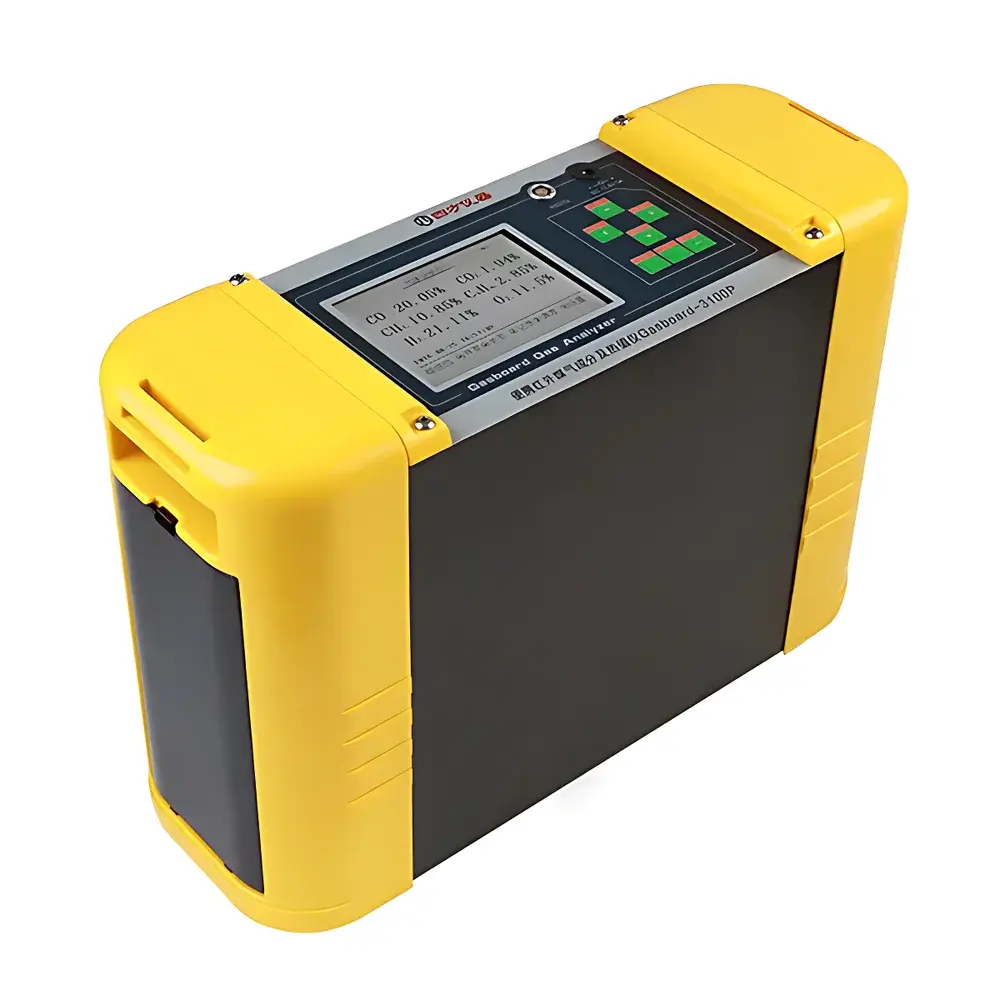

CUBIC Gasboard-3100P Portable Multi-Gas Analyzer for Metallurgical Coke Oven & Blast Furnace Gas
| Brand | CUBIC INSTRUMENTS |
|---|---|
| Origin | Hubei, China |
| Model | Gasboard-3100P |
| Measurement Principle | NDIR (CO, CO₂, CH₄, C₂H₂, C₂H₄, CnHm), TCD (H₂), ECD (O₂) |
| Response Time | T₉₀ < 15 s (NDIR channels) |
| Measurement Ranges | CO/CO₂/CH₄/H₂: (0–100)%, O₂: (0–25)%, C₂H₂/C₂H₄/CnHm*: (0–10)% (optional) |
| Resolution | 0.01% |
| Thermal Value Output | kcal/m³ and MJ/m³ (user-selectable) |
| Flow Rate | (0.7–1.2) L/min |
| Inlet Pressure | (2–50) kPa |
| Dimensions (L×W×H) | 412 × 152 × 294 mm |
| Weight | 9 kg |
| Power | Rechargeable Li-ion battery, external 12.6 V charger |
| Interface | RS-232 |
| Display | LCD |
| Auto-diagnostic capability | Yes |
| Sample Requirements | Dust-free, dry, oil-free gas |
Overview
The CUBIC Gasboard-3100P is a portable, multi-parameter gas analyzer engineered for real-time, in-situ analysis of industrial fuel gases in iron and steel metallurgy—specifically coke oven gas (COG), blast furnace gas (BFG), converter gas (LDG), producer gas, and syngas streams. It integrates three complementary analytical technologies within a single robust platform: non-dispersive infrared (NDIR) spectroscopy for CO, CO₂, CH₄, C₂H₂, C₂H₄, and total non-methane hydrocarbons (CnHm); thermal conductivity detection (TCD) for H₂; and electrochemical detection (ECD) for O₂. This hybrid architecture enables simultaneous, interference-free quantification of up to eight gas components—including oxygen and combustible species—while computing higher heating value (HHV) in real time using ASTM D3588-17–derived stoichiometric algorithms. Unlike calorimetric or chromatographic alternatives, the Gasboard-3100P delivers thermodynamic equivalence without combustion, calibration drift, or consumables—making it suitable for continuous process monitoring, safety verification, and energy efficiency auditing in high-dust, variable-flow environments typical of metallurgical plants.
Key Features
- Multi-technology sensor fusion: Independent NDIR, TCD, and ECD channels eliminate cross-sensitivity—e.g., CnHm does not bias CH₄ readings; CO/CO₂/CH₄ do not affect H₂ measurement; flow fluctuations within specification range have negligible impact on TCD stability.
- Real-time gross calorific value (GCV) calculation: Computes HHV in both kcal/m³ and MJ/m³ units directly from volumetric composition, traceable to ISO 6976:2016 and GB/T 22723–2008 standards for gaseous fuels.
- Portable field-deployable design: 9 kg mass, integrated sampling pump, and battery-powered operation support both pipeline insertion (via heated probe option) and offline bag sampling—ideal for shift-based QA/QC, maintenance diagnostics, and furnace commissioning.
- Intelligent power management: Soft-start circuitry and state-of-charge monitoring prevent low-voltage operation; battery runtime exceeds 6 hours at nominal flow, with hot-swappable charging via 12.6 V DC input.
- No consumables or reagents: Eliminates dependency on carrier gases, chemical absorbents, or column replacements—reducing total cost of ownership versus Orsat, GC, or paramagnetic analyzers.
- Embedded diagnostics: Continuous self-check of sensor zero/span, optical path integrity, pump performance, and battery health; error codes map directly to maintenance protocols per IEC 61508 functional safety guidelines.
Sample Compatibility & Compliance
The Gasboard-3100P is validated for use with raw, cooled, and filtered industrial gas streams meeting ISO 8573-1 Class 4 particulate and Class 3 moisture specifications. Optional inline sample conditioning—comprising particulate filtration (1 µm), condensate removal, and pressure regulation—ensures long-term reliability when interfacing with wet or particulate-laden ducts (e.g., BFG main headers). All measurements comply with ASTM D1945 (gas analysis by GC), ASTM D1946 (analysis of fuel gases), and EN 15403 (biogas quality) for reporting consistency. Data logging and configuration settings adhere to GLP audit trail requirements, with timestamped records stored internally and exportable via RS-232 for integration into DCS/SCADA systems compliant with ISA-88 and ISA-95 frameworks.
Software & Data Management
Onboard firmware supports automatic data logging at user-defined intervals (1 s to 60 min), with storage capacity for >10,000 measurement records. Each entry includes gas concentrations, computed HHV, ambient temperature/pressure, flow rate, and diagnostic flags. Data retrieval is performed via ASCII protocol over RS-232, enabling seamless ingestion into LabVIEW, MATLAB, or enterprise MES platforms. No proprietary software is required: raw output conforms to Modbus RTU register mapping (addressable via standard terminal emulators). Firmware updates are performed via micro-USB—no factory recalibration needed post-update. Audit logs retain operator ID (if configured), parameter changes, and calibration events for 21 CFR Part 11–aligned traceability.
Applications
- Metallurgical process control: Real-time monitoring of coke oven gas composition during by-product recovery; optimization of air-to-gas ratios in reheating furnaces; safety interlock verification for O₂ depletion and H₂ accumulation in confined spaces.
- Fuel gas trading & billing: Accurate HHV determination for contractual settlement of blast furnace gas supply to co-generation units, per ISO 5167 and AGA Report No. 8.
- Biogas and syngas characterization: Quantification of CH₄, CO₂, H₂, and CnHm in anaerobic digestion effluent or biomass gasification output—supporting feedstock optimization and emissions reporting under EU RED II and EPA GHGRP protocols.
- Research & development: High-frequency sampling during combustion experiments in university laboratories; validation of kinetic models for gas-phase reactions in steelmaking off-gas treatment systems.
- Environmental compliance: Continuous emission monitoring system (CEMS) backup for NOₓ/SO₂ precursor assessment—particularly where CO/H₂ profiles correlate with incomplete combustion events.
FAQ
What gas components does the Gasboard-3100P measure simultaneously?
It measures CO, CO₂, CH₄, H₂, O₂, C₂H₂, C₂H₄, and total non-methane hydrocarbons (CnHm) as discrete volume percentages, plus derived higher heating value (HHV) in kcal/m³ or MJ/m³.
Is external sample conditioning required for blast furnace gas?
Yes—raw BFG typically contains tar aerosols and moisture above instrument tolerance. A certified pre-treatment unit (e.g., heated filter + chiller + coalescing separator) is recommended to meet ISO 8573-1 Class 4/3 requirements before inlet.
How is thermal value calculated, and what standards does it follow?
HHV is computed in real time using the measured mole fractions and ideal-gas enthalpy-of-combustion values per ISO 6976:2016 Annex A, with optional correction for actual pressure and temperature per AGA Report No. 8.
Does the instrument support regulatory data integrity requirements?
Yes—internal logging includes timestamps, operator IDs (if enabled), and change history; exported data is plain-text ASCII compatible with 21 CFR Part 11–compliant validation workflows.
What maintenance intervals are recommended for field operation?
Zero/span verification every 30 days; optical window cleaning every 90 days; full sensor verification annually—or after exposure to >500 ppm H₂S or halogenated compounds.
Related Products





