
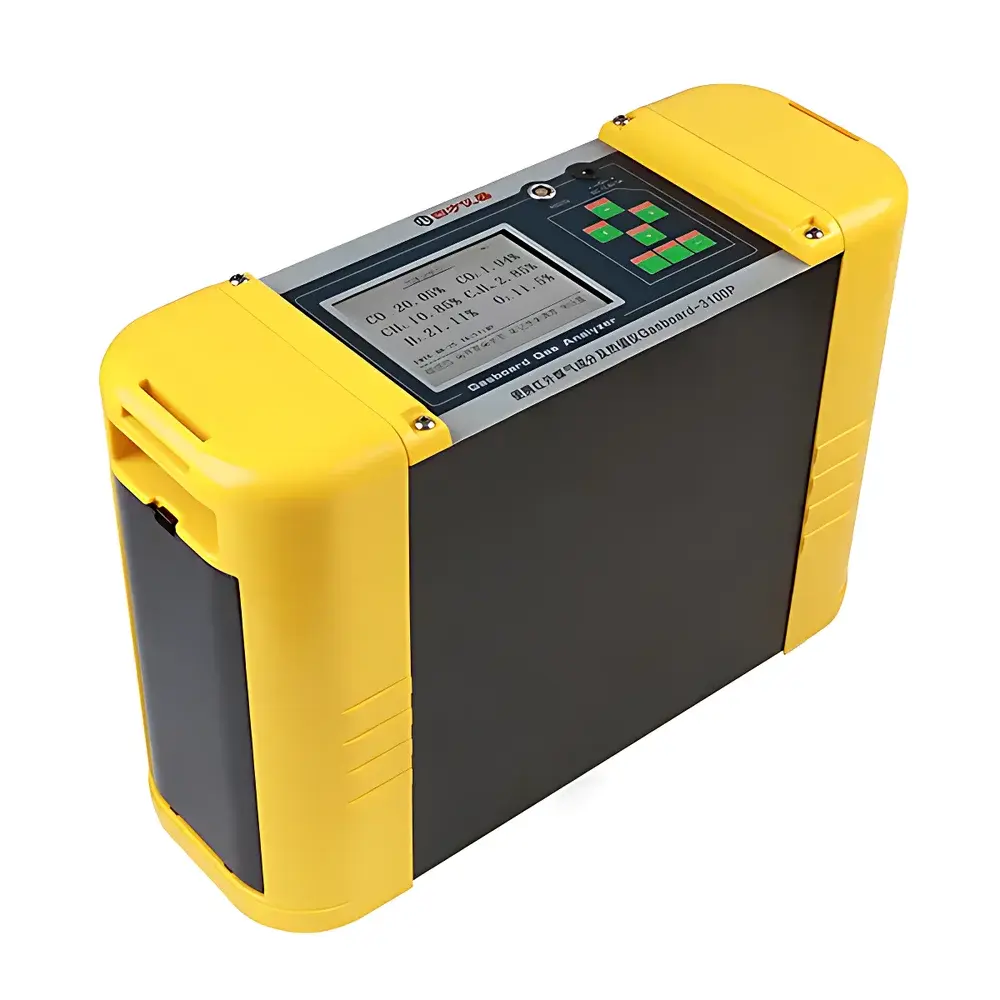
CUBIC Gasboard-3100P Portable NDIR-Based Multi-Gas & Calorific Value Analyzer
| Brand | CUBIC INSTRUMENTS |
|---|---|
| Origin | Hubei, China |
| Model | Gasboard-3100P |
| Response Time | T90 < 15 s (NDIR) |
| Measurement Ranges | CO/CO₂/CH₄/H₂: (0–100) % vol |
| O₂ | (0–25) % vol |
| C₂H₂/C₂H₄/CnHm | (0–10) % vol (optional) |
| Resolution | 0.01 % vol |
| Detection Principles | NDIR (CO, CO₂, CH₄, C₂H₂, C₂H₄, CnHm) |
| Flow Rate | 0.7–1.2 L/min |
| Inlet Pressure | 2–50 kPa |
| Dimensions | 412 × 152 × 294 mm |
| Weight | 9 kg |
| Power | Rechargeable Li-ion battery, 12.6 V external charger |
| Communication | RS-232 |
| Calorific Value Units | kcal/m³ and MJ/m³ (switchable) |
| Self-Diagnostic Function | Yes |
| Sample Requirements | Dust-free, moisture-free, oil-free |
Overview
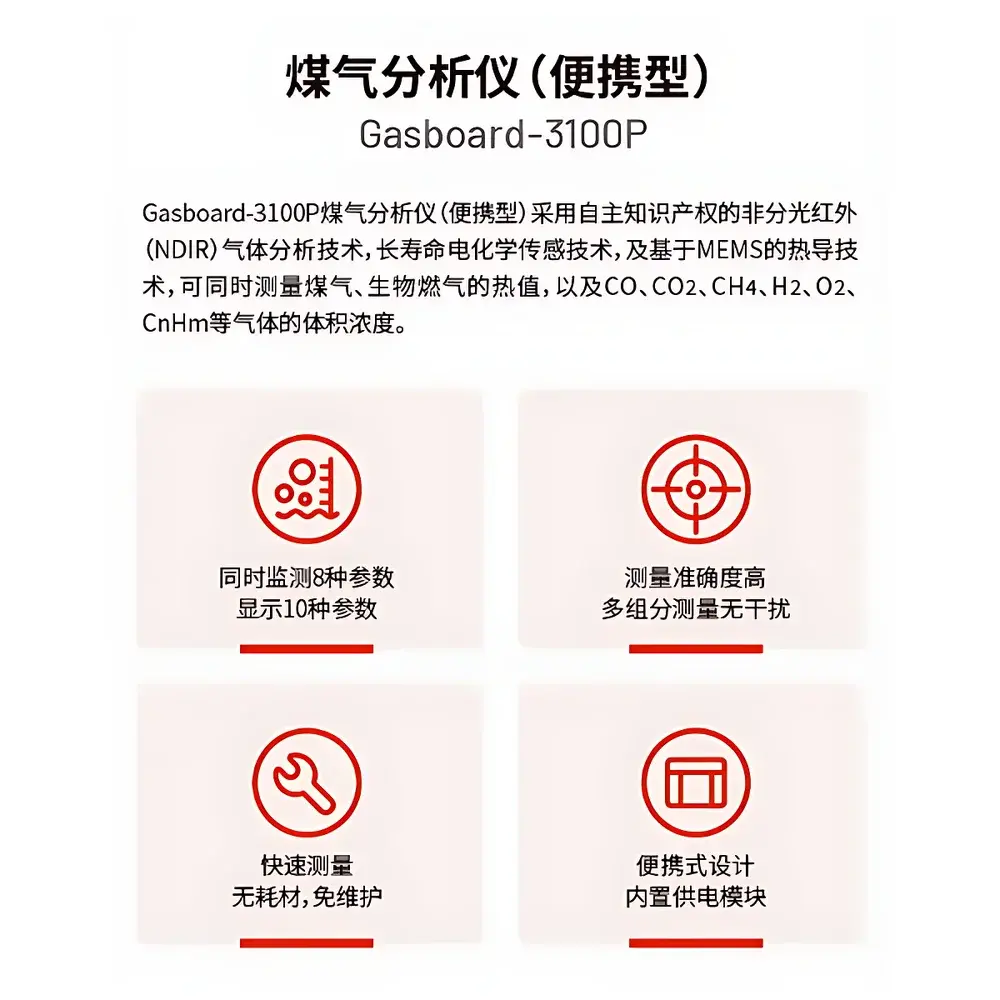
The CUBIC Gasboard-3100P is a field-deployable, multi-parameter gas analyzer engineered for simultaneous quantification of key combustible and inert gases—CO, CO₂, CH₄, H₂, O₂, C₂H₂, C₂H₄, and total non-methane hydrocarbons (CnHm)—alongside real-time calorific value calculation. It integrates three complementary analytical principles within a single ruggedized platform: non-dispersive infrared (NDIR) spectroscopy for CO, CO₂, CH₄, C₂H₂, C₂H₄, and CnHm; thermal conductivity detection (TCD) for H₂; and electrochemical sensing for O₂. This hybrid architecture eliminates cross-sensitivity artifacts common in single-technology systems—e.g., CnHm does not interfere with CH₄ measurement, and CO/CO₂/CH₄ do not affect H₂ quantification—even under variable sample flow conditions (0.7–1.2 L/min). The instrument computes higher heating value (HHV) and lower heating value (LHV) in situ using ASTM D3588-17 and ISO 6976:2016-compliant algorithms, eliminating reliance on empirical correlations or offline bomb calorimetry.
Key Features
- True multi-gas + calorific value analysis in one portable unit—no external computation or secondary instrumentation required.
- NDIR optical modules with thermoelectrically stabilized detectors ensure long-term baseline stability and ≤1% FS linearity error for CO, CO₂, CH₄, C₂H₂, C₂H₄, and CnHm.
- H₂ measurement via MEMS-based TCD maintains ±2% FS accuracy independent of sample flow fluctuations—critical for intermittent or low-pressure biogas sampling.
- Integrated sample pump with adjustable flow control and optional heated/particle-filtered pre-treatment module (for wet, dusty, or condensable-laden streams).
- Intelligent power management: soft-start switch, battery state-of-charge monitoring, and automatic low-power shutdown to prevent sensor drift during under-voltage operation.
- On-device data logging with timestamped records (up to 10,000 entries), searchable by date/time or parameter range, exportable via RS-232 to SCADA, DCS, or LIMS platforms.
Sample Compatibility & Compliance
The Gasboard-3100P is validated for use with raw and conditioned syngas, blast furnace gas, coke oven gas, producer gas, biogas (from anaerobic digestion or thermal gasification), landfill gas, and natural gas blends. Sample conditioning requirements align with ISO 8573-1 Class 4 for particulates, ISO 8573-2 Class 3 for moisture, and ISO 8573-3 Class 3 for oil aerosols. While not certified to ATEX or IECEx, the analyzer meets EN 61000-6-2 (immunity) and EN 61000-6-3 (emissions) for industrial environments. Its measurement traceability follows NIST-traceable calibration protocols, and data integrity supports GLP/GMP-aligned workflows through configurable audit trails and user-access controls (when interfaced with compliant host software).
Software & Data Management
- Embedded firmware supports dual calorific value units (kcal/m³ and MJ/m³) with automatic conversion based on measured composition and standard reference conditions (15 °C, 101.325 kPa).
- Real-time self-diagnostic suite continuously monitors sensor health, optical path integrity, pump performance, and battery voltage—flagging anomalies before measurement degradation occurs.
- Data export supports ASCII CSV format compatible with Excel, MATLAB, and industry-standard analytics tools (e.g., PI System, Ignition SCADA).
- No proprietary software lock-in: RS-232 serial protocol documentation is publicly available, enabling custom integration into plant-wide automation architectures without vendor middleware.
Applications
The Gasboard-3100P serves as a primary analytical tool across energy-intensive and process-critical sectors. In metallurgy and chemical manufacturing, it enables real-time optimization of blast furnace top-gas recycling, coke oven gas blending ratios, and syngas-to-methanol feedstock control. For biogas upgrading facilities, it verifies CH₄ enrichment efficiency and detects trace C₂+ hydrocarbons that impact membrane or PSA system fouling. In R&D settings—including university combustion labs and national energy institutes—it provides rapid, repeatable composition snapshots for kinetic modeling, flame stability studies, and fuel substitution trials. Its portability supports both direct stack insertion (via probe adapter) and lab-based analysis of Tedlar®-bag or stainless-steel cylinder samples—making it equally suited for commissioning verification, regulatory compliance checks (e.g., EPA Method 3A, EN 15403), and troubleshooting field anomalies.
FAQ
What gas species are measured natively, and which require optional configuration?
CO, CO₂, CH₄, H₂, and O₂ are standard. C₂H₂, C₂H₄, and CnHm (total non-methane hydrocarbons) are factory-configurable options—selected at time of order based on application-specific needs.
Does the analyzer require zero/span calibration before each use?
No. It features automated baseline correction during idle periods and supports user-initiated two-point calibration using certified gas standards. Annual verification against traceable references is recommended per ISO/IEC 17025 guidelines.
Can it operate continuously in high-humidity biogas streams?
Only when paired with the optional heated sample line and Nafion™ dryer module. Direct exposure to condensate or >70% RH unconditioned gas will compromise NDIR optical windows and electrochemical O₂ sensor lifetime.
Is the calorific value calculation compliant with international standards?
Yes. HHV/LHV computation adheres to ISO 6976:2016 (natural gas) and ASTM D3588-17 (gaseous fuels), using ideal gas law corrections and published enthalpy-of-combustion values for each detected component.
What maintenance intervals are recommended for field operation?
Optical filters and TCD filaments require inspection every 6 months; electrochemical O₂ sensors have a typical service life of 24 months under continuous use. Full system verification—including flow rate, pressure drop, and span accuracy—is advised quarterly in critical applications.





