
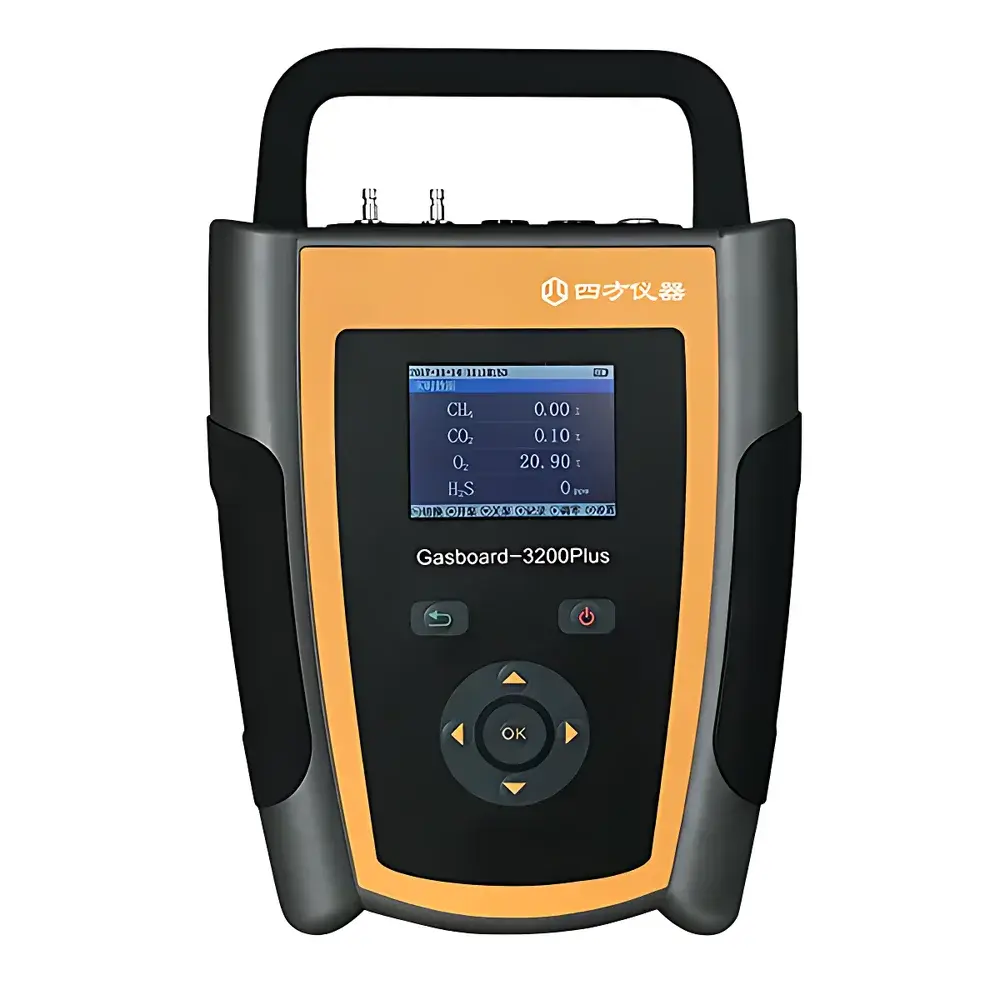
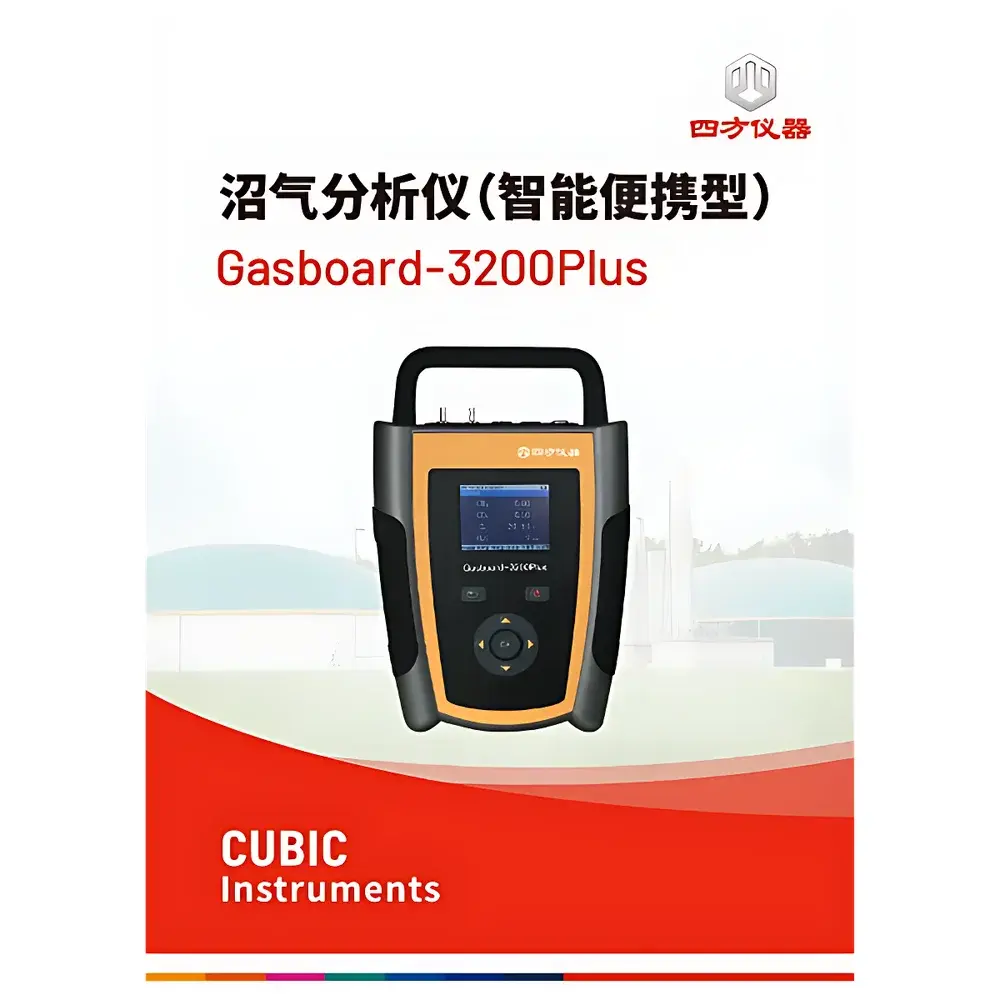
CUBIC Gasboard-3200Plus Portable Biogas Analyzer
| Brand | CUBIC INSTRUMENTS |
|---|---|
| Origin | Hubei, China |
| Model | Gasboard-3200Plus |
| Measurement Principle | CH₄/CO₂ via NDIR |
| Range | CH₄ (0–100)% vol |
| Accuracy | CH₄/CO₂ ±2% FS |
| Power | Rechargeable 18650 Li-ion battery |
| Interface | USB, Bluetooth 4.0 |
| Display | Color LCD |
| Data Storage | Internal logging with query/delete function |
Overview
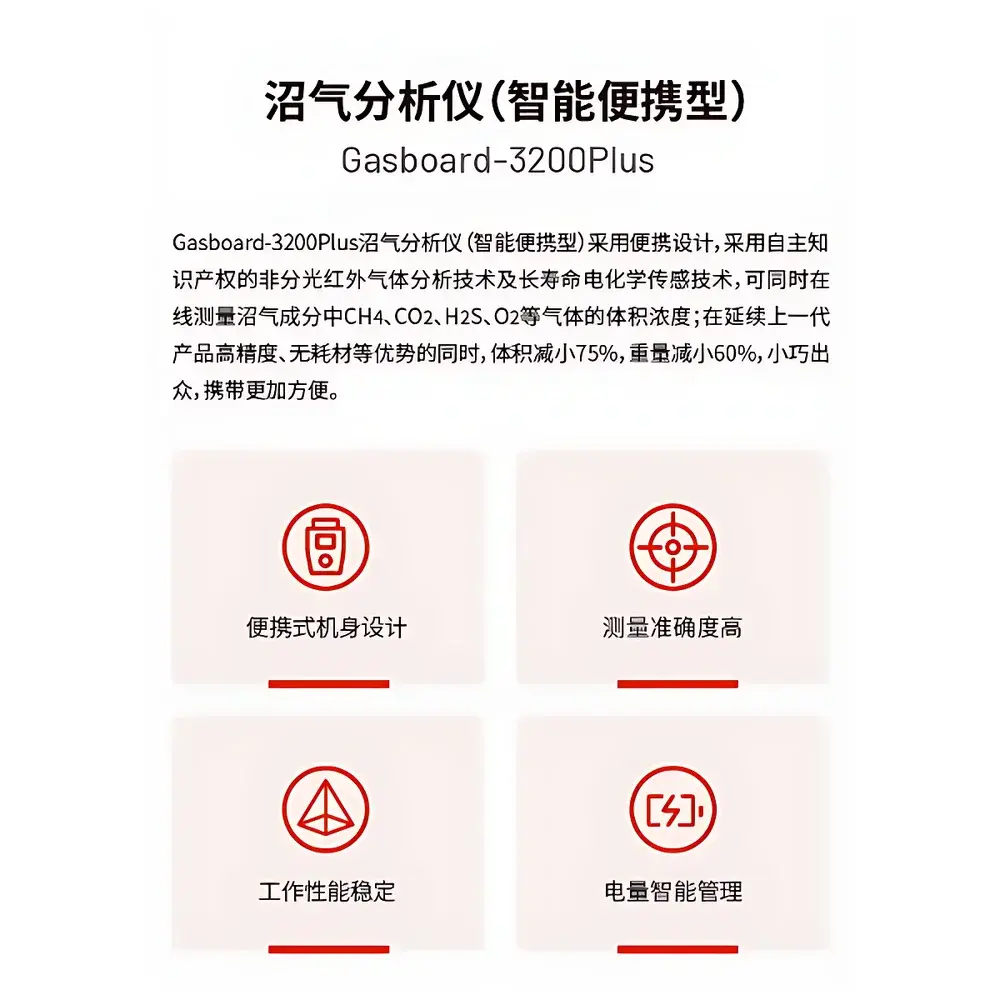
The CUBIC Gasboard-3200Plus is a portable, field-deployable biogas analyzer engineered for real-time, multi-component gas concentration measurement in anaerobic digestion environments. It employs dual-sensing architecture: non-dispersive infrared (NDIR) spectroscopy for high-selectivity, drift-resistant quantification of methane (CH₄) and carbon dioxide (CO₂), and electrochemical detection (ECD) for precise, low-power monitoring of hydrogen sulfide (H₂S) and oxygen (O₂). This hybrid optical-electrochemical design eliminates cross-sensitivity between target gases—critical for reliable operation in complex biogas matrices containing variable humidity, condensate, and trace contaminants. The instrument is calibrated per ISO 14040-compliant life-cycle assessment protocols and supports traceability through factory-certified calibration certificates. Its compact footprint (75% reduction vs. prior generation) and 60% weight reduction enable routine deployment in confined digester access points, landfill wellheads, and mobile lab vans without compromising analytical integrity.
Key Features
- Modular sensor architecture with independent NDIR and ECD channels ensures zero inter-gas interference—validated per ASTM D1945 for biogas composition analysis.
- Dual-channel ECD sensors incorporate temperature-compensated diffusion barriers and integrated reference electrodes to maintain stability under fluctuating ambient conditions (5–45°C, 0–95% RH non-condensing).
- Self-diagnostic firmware continuously monitors sensor baseline, response time, and electrolyte saturation status—triggering audible/visual alerts when performance thresholds are exceeded.
- Intelligent power management system features soft-start circuitry and state-of-charge estimation algorithms to prevent measurement artifacts during low-battery operation.
- Onboard data logger stores up to 100,000 timestamped records (CH₄, CO₂, H₂S, O₂, ambient temperature, pressure) with automatic overwrite protection for critical datasets.
- Bluetooth 4.0 LE module enables secure wireless pairing with the CUBIC Biogas Connect mobile application (iOS/Android) for live telemetry, remote configuration, and PDF report generation.
- Optional integration with handheld thermal anemometers permits concurrent volumetric flow rate calculation—supporting mass flow normalization per EN 15439.
Sample Compatibility & Compliance
The Gasboard-3200Plus is validated for direct sampling of raw, unfiltered biogas streams from municipal wastewater digesters, agricultural co-digestion facilities, landfill gas extraction wells, and pilot-scale anaerobic reactors. Sample inlet accommodates standard 6 mm OD PTFE tubing with integrated hydrophobic particulate filter (0.5 µm pore size) and water trap. Instrument meets IEC 61000-6-2 (immunity) and IEC 61000-6-3 (emissions) for industrial electromagnetic environments. Firmware complies with FDA 21 CFR Part 11 requirements for electronic record integrity—including audit trail logging, user role-based access control, and digital signature support. Calibration procedures align with ISO 6141 and ISO 17025-accredited laboratory practices.
Software & Data Management
Data acquisition and post-processing are managed via CUBIC Biogas Studio desktop software (Windows/macOS), which provides GLP-compliant workflow templates, automated calibration curve fitting (linear, polynomial, or multi-point), and batch export to CSV, Excel, or XML formats compatible with SCADA and LIMS platforms. All measurement sessions include embedded metadata: operator ID, GPS coordinates (when paired with Bluetooth GNSS receiver), atmospheric pressure, and relative humidity. Audit trails record every parameter change, calibration event, and data export action—with immutable timestamps and SHA-256 hashing for forensic verification. Cloud synchronization is optional via encrypted HTTPS API endpoints supporting OAuth 2.0 authentication.
Applications
- Real-time optimization of hydraulic retention time (HRT) and organic loading rate (OLR) in mesophilic/thermophilic digesters.
- Leak detection and fugitive emission quantification at biogas upgrading stations per EPA Method 21.
- Feedstock suitability screening via CH₄/CO₂ ratio trending and H₂S corrosion risk assessment.
- Regulatory reporting for EU Directive 2009/28/EC (Renewable Energy Sources) and U.S. EPA AgSTAR program compliance.
- Validation of membrane separation efficiency and amine scrubber performance in biogas-to-biomethane plants.
- Academic research on syntrophic acetate oxidation and methanogenic pathway dynamics under varying redox potentials.
FAQ
What gas standards are required for field calibration?
Primary calibration requires certified NIST-traceable gas mixtures: 50% CH₄ in N₂, 30% CO₂ in N₂, 100 ppm H₂S in N₂, and 20.9% O₂ in N₂. Zero gas is instrument-grade nitrogen (99.999%).
Can the analyzer operate continuously for extended monitoring?
Yes—battery life supports 12 hours of continuous measurement at 10-second sampling intervals. For unattended operation >24 h, connect to external 5 V DC power with voltage regulation.
Is H₂S measurement affected by high moisture content?
No—the ECD sensor includes a Nafion™-based permeation dryer that maintains <1000 ppmv residual moisture at the electrode surface, preventing electrolyte dilution and signal drift.
Does the device support custom alarm thresholds?
Yes—user-configurable high/low limits for each gas channel trigger visual indicators, audible beeps, and optional relay outputs for process shutdown integration.
How often must the NDIR optical path be cleaned?
Under typical biogas conditions, optical window cleaning is recommended every 6 months. The instrument logs cumulative exposure time and prompts maintenance when dust accumulation exceeds 5% transmittance loss.






