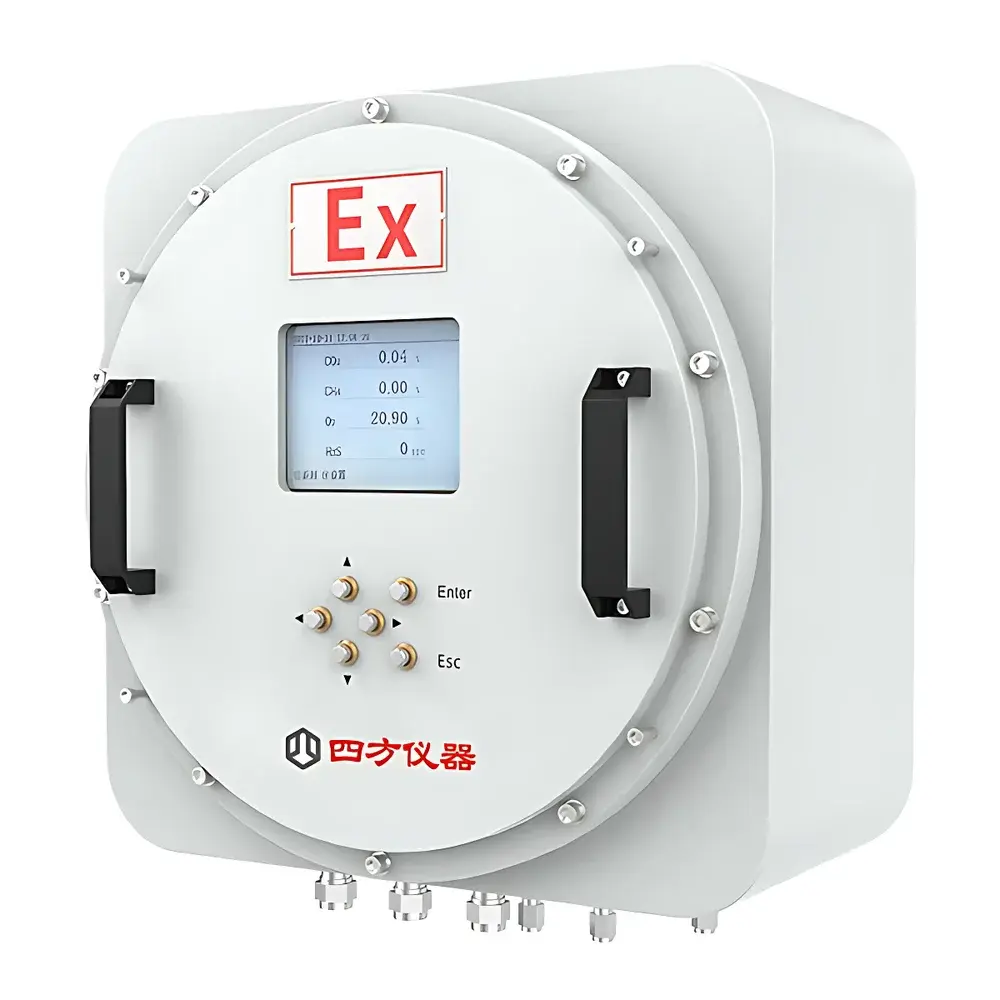
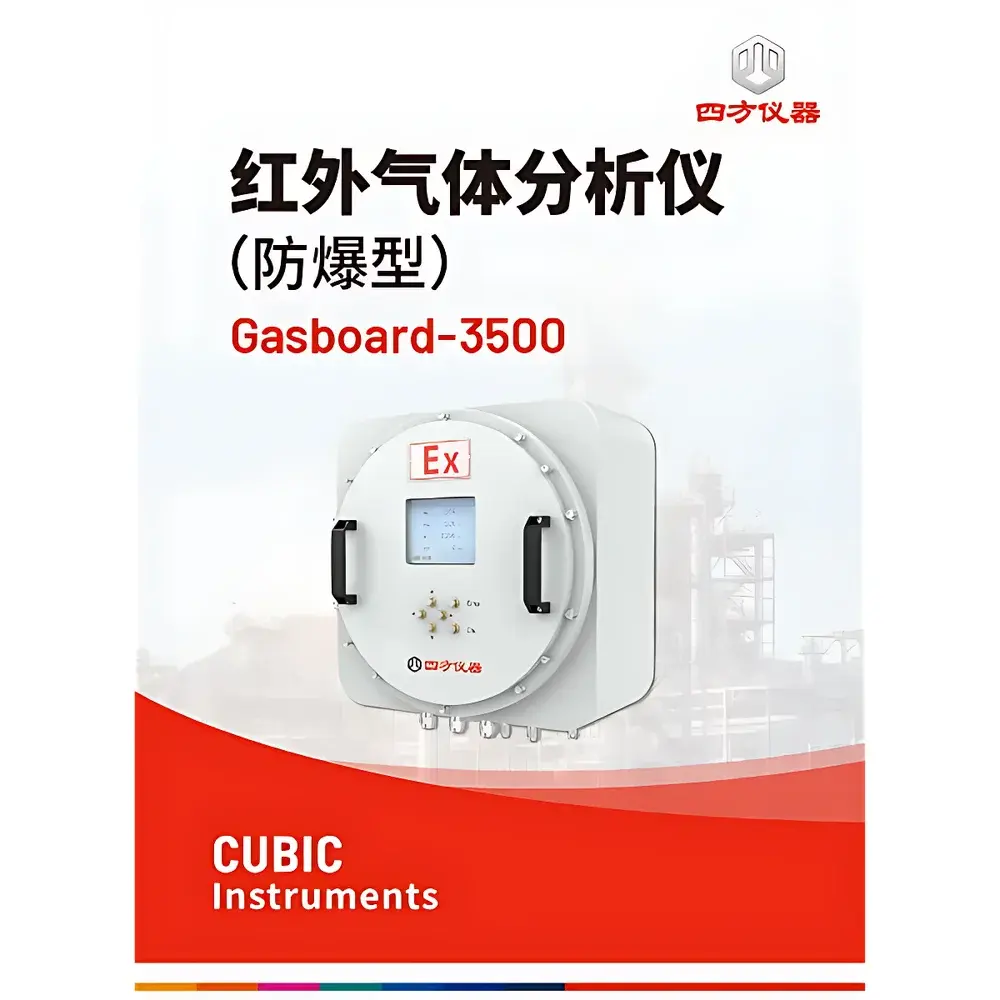
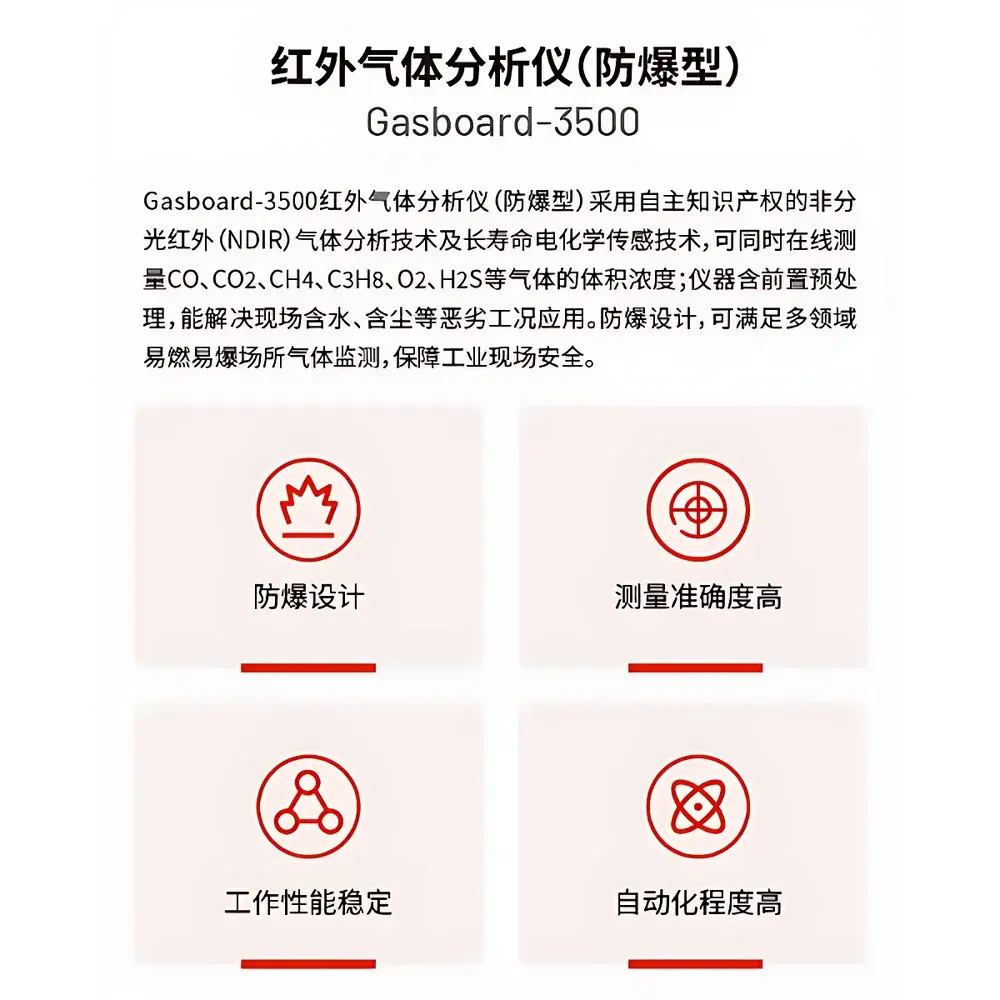
CUBIC Gasboard 3500 TDLAS-Based Ex-Proof Multi-Gas Emission Analyzer for Refinery Stack Monitoring
| Brand | CUBIC INSTRUMENTS |
|---|---|
| Model | Gasboard 3500 |
| Measurement Principle | Tunable Diode Laser Absorption Spectroscopy (TDLAS) |
| Measured Gases | O₂, CO, CO₂, H₂S, CH₄ |
| Accuracy | ±0.5–2% F.S. (gas- and range-dependent) |
| Resolution | 0.01% vol to 1 ppm |
| Response Time | <40 s |
| Sample Flow Rate | 0.7–1.2 L/min |
| Explosion Protection | Ex db IIC T6 Gb / Ex tb IIIC T80°C Db |
| Output Interfaces | RS-485, RS-232, 4–20 mA |
| Power Supply | AC 220 V, 50 Hz |
| Display | LCD |
Overview
The CUBIC Gasboard 3500 is an intrinsically robust, explosion-proof multi-gas emission analyzer engineered for continuous, real-time monitoring of critical combustion and process gases in demanding refinery and petrochemical environments. Utilizing Tunable Diode Laser Absorption Spectroscopy (TDLAS), the instrument delivers selective, interference-free quantification of O₂, CO, CO₂, H₂S, and CH₄ directly in hot, humid, and particulate-laden sample streams—without reliance on extractive conditioning systems that compromise response fidelity. Unlike NDIR or electrochemical sensors, TDLAS operates on wavelength-specific absorption line profiling, enabling ppm-level detection sensitivity with high spectral specificity and immunity to cross-sensitivity from water vapor, hydrocarbons, or acid gases commonly present in flue gas or sour gas streams. Designed for permanent installation at stack outlets, flare headers, and process vents, the Gasboard 3500 meets the stringent reliability and safety requirements of ISO 14064-1 verified GHG reporting, EPA Method 3A/7E compliance workflows, and refinery-wide Process Safety Management (PSM) programs.
Key Features
- True in-situ TDLAS optical path architecture with dual-beam referencing for drift compensation and long-term stability
- Integrated front-end sample conditioning module: heated probe, particulate filter, and coalescing moisture trap—engineered for operation in wet, dusty, and corrosive refinery off-gas streams
- Explosion-proof certification compliant with IEC 60079-0, -1, and -31: Ex db IIC T6 Gb for gas atmospheres and Ex tb IIIC T80°C Db for combustible dust environments
- Automated zero calibration via built-in air pump and programmable zero-cycle scheduling—eliminating manual intervention and reducing operational downtime
- Real-time sensor health diagnostics including laser output power monitoring, photodetector signal-to-noise ratio tracking, and optical path contamination alerts
- Modular hardware design supporting field-upgradable firmware and gas configuration changes without hardware replacement
Sample Compatibility & Compliance
The Gasboard 3500 accommodates raw, unconditioned sample gas streams with up to 95% relative humidity, particulate loading ≤10 mg/m³, and trace oil mist—provided upstream mechanical filtration is implemented per API RP 500 Zone classification guidelines. It complies with EN 15267-3 (QAL1 certified performance criteria for automated measuring systems), meets the functional safety requirements of IEC 61508 SIL 2 for safety-related gas monitoring loops, and supports audit-ready data integrity under FDA 21 CFR Part 11 when integrated with validated SCADA or DCS historian systems. All measurement ranges and accuracy specifications are traceable to NIST-certified gas standards and validated per ISO 13571 Annex B procedures for toxic and combustible gas analyzers.
Software & Data Management
The embedded firmware supports Modbus RTU (RS-485/RS-232) and analog 4–20 mA output protocols for seamless integration into legacy DCS platforms such as Emerson DeltaV, Honeywell Experion PKS, and Siemens PCS 7. Optional Ethernet/IP and OPC UA gateways enable cloud-connected data telemetry via secure TLS 1.2 tunnels. Local LCD interface provides real-time concentration trends, alarm status, diagnostic logs, and calibration history with timestamped entries. Audit trail functionality records all user-initiated actions—including range changes, zero/span adjustments, and firmware updates—with immutable timestamps and operator ID tagging. Data export is supported in CSV format via USB host port for offline QA/QC review and regulatory submission packages.
Applications
- FCC unit and coker heater stack emissions monitoring (O₂, CO, CO₂)
- Sour water stripper and amine regenerator overhead gas analysis (H₂S, CH₄)
- Flare gas composition verification for combustion efficiency and methane slip assessment
- Refinery fuel gas header quality control (CH₄, CO, H₂S)
- Landfill biogas upgrading plant inlet/outlet monitoring (CH₄, CO₂, H₂S)
- Offshore platform vent gas safety interlock systems requiring SIL 2-rated gas detection
FAQ
Does the Gasboard 3500 require external sample conditioning for refinery flue gas applications?
No—it incorporates a heated, pressure-regulated sampling interface with ceramic particulate filtration and thermoelectric condensate removal, enabling direct connection to ducts with temperatures up to 200°C and dew points up to 85°C.
Can multiple gases be measured simultaneously without cross-interference?
Yes—TDLAS employs narrow-linewidth lasers tuned to unique rotational-vibrational absorption lines for each target gas, ensuring orthogonality across O₂, CO, CO₂, H₂S, and CH₄ even in complex hydrocarbon matrices.
Is the device suitable for use in Zone 1 hazardous areas?
Yes—the Ex db IIC T6 Gb rating certifies safe operation in Zone 1 gas environments where explosive mixtures are likely to occur during normal operation.
How is measurement traceability maintained for regulatory reporting?
Each unit ships with a factory calibration certificate referencing NIST-traceable gas standards; users may perform field verification using certified span gases per EPA Performance Specification 18 (PS-18) protocols.
What maintenance intervals are recommended for uninterrupted operation?
Optical path cleaning and laser alignment verification are recommended annually; filter elements require replacement every 6 months under typical refinery duty cycles—documented in the included Maintenance Logbook template compliant with ISO 9001:2015 clause 7.5.3.
Related Products