
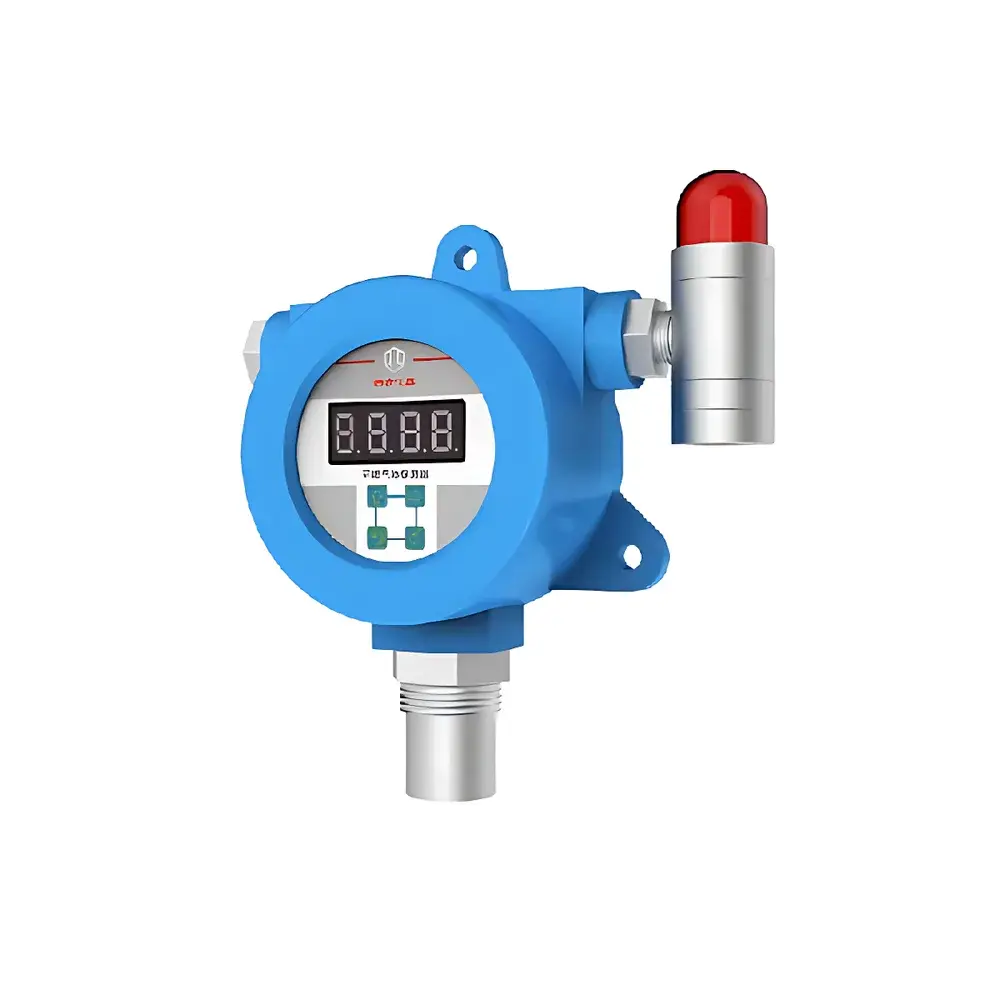
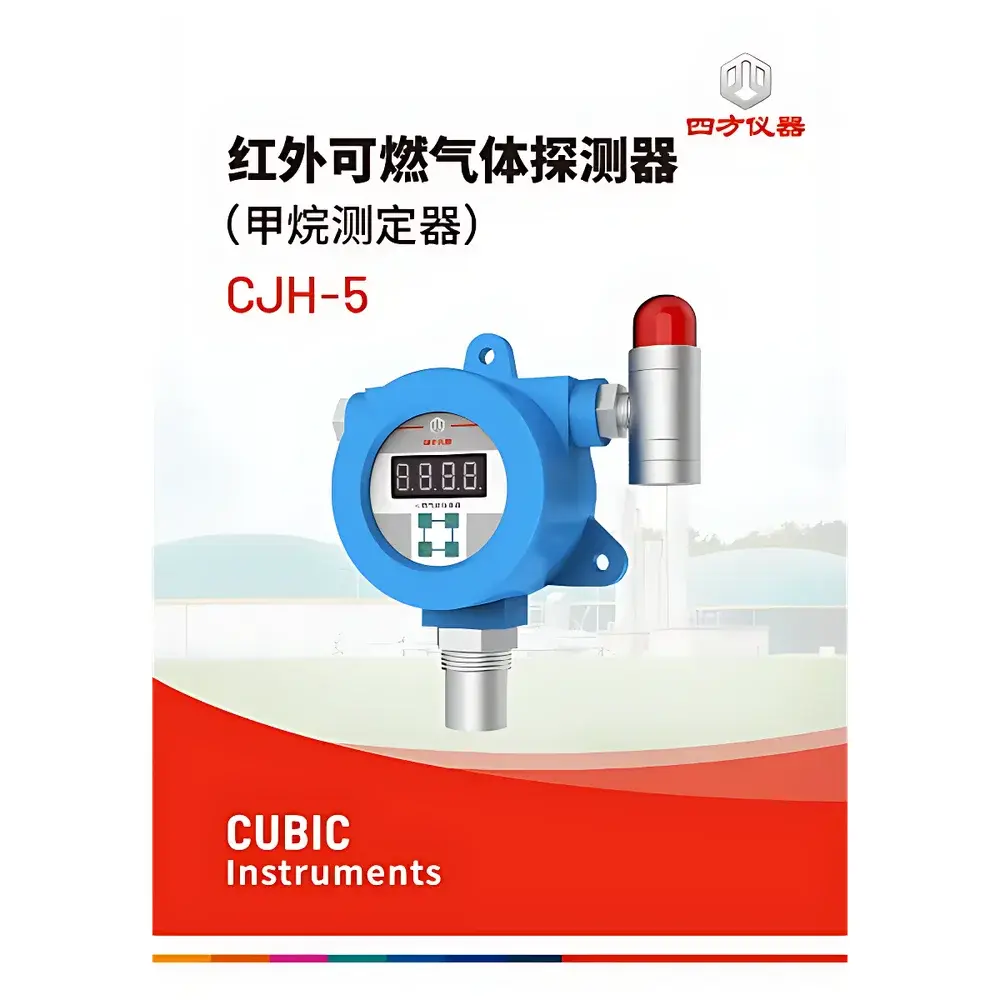
CUBIC INSTRUMENTS CJH-5 NDIR Infrared Methane (CH₄) Gas Detector
| Brand | CUBIC INSTRUMENTS |
|---|---|
| Origin | Hubei, China |
| Manufacturer Type | Authorized Distributor |
| Country of Origin | China |
| Model | CJH-5 |
| Pricing | Available Upon Request |
| Measurement Principle | NDIR (Non-Dispersive Infrared) |
| Target Gas | Methane (CH₄) |
| Measurement Range | 0–100% LEL |
| Accuracy | ±5% F.S. |
| Resolution | 1% LEL |
| Response Time (T90) | <30 s |
| Warm-up Time | 30 s |
| Sampling Method | Diffusion |
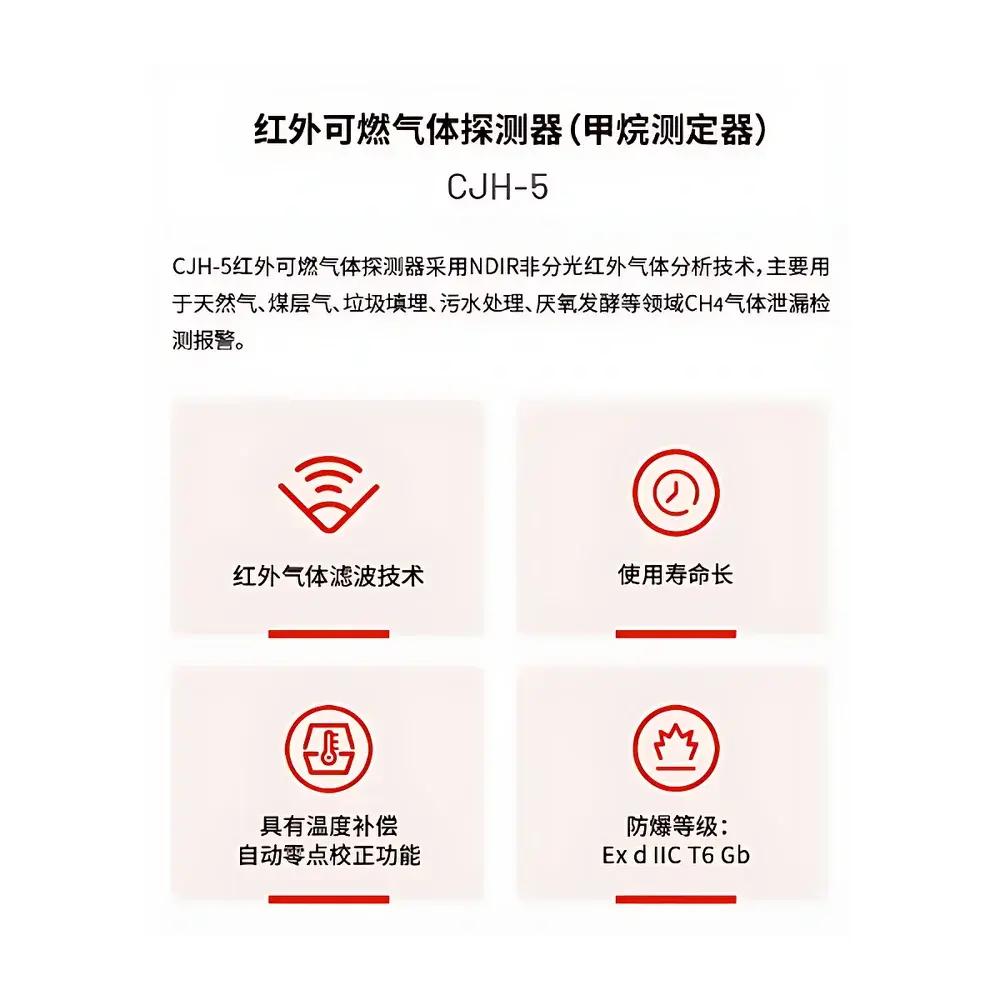
| Explosion Protection Rating | Ex d II C T6 Gb |
| Output Signals | RS-485 (Modbus RTU), Dual SPST Relay Contacts (NO), 4–20 mA Analog Output |
| Operating Temperature | −20 to +60 °C |
| Storage Temperature | −40 to +85 °C |
| Humidity Range | ≤95% RH (non-condensing) |
| Display | Backlit LCD |
| Zero Calibration | Automatic drift compensation with temperature-compensated baseline correction |
| Power Supply | DC 12–24 V |
| Sensor Lifetime | >5 years (typical, non-consumable optical path) |
Overview
The CUBIC INSTRUMENTS CJH-5 is a fixed-mount, intrinsically robust NDIR (Non-Dispersive Infrared) methane (CH₄) gas detector engineered for continuous, reliable monitoring in industrial and environmental safety applications. Unlike catalytic bead or electrochemical sensors, the CJH-5 employs a dual-wavelength infrared absorption principle—measuring CH₄ concentration via differential attenuation of IR radiation at characteristic absorption bands (e.g., ~3.3 µm), while referencing a non-absorbing wavelength to compensate for dust, humidity, and optical path degradation. This optical architecture eliminates sensor poisoning, oxidation, or oxygen dependency—enabling stable operation in inert, low-oxygen, or high-humidity environments typical of landfill biogas wells, anaerobic digesters, wastewater treatment headspaces, and natural gas distribution infrastructure.
Key Features
- NDIR optical sensing core with sealed, maintenance-free measurement chamber—no consumables, no catalyst deactivation, and immunity to silicones, H₂S, CO, or VOC cross-interference
- Integrated temperature compensation and auto-zero tracking algorithm—maintains baseline stability across −20 °C to +60 °C ambient fluctuations without manual recalibration
- Explosion-proof enclosure certified to Ex d II C T6 Gb per GB 3836.1–2021 and IEC 60079-0/1, suitable for Zone 1 hazardous areas handling Group II C gases (including methane, hydrogen, acetylene)
- Dual alarm relay outputs (SPST, NO) configurable for fault, pre-alarm, and high-alarm thresholds; fully compatible with central SCADA and DCS systems via Modbus RTU over RS-485
- Simultaneous analog (4–20 mA) and digital (RS-485) output interfaces—enabling redundant signal routing and integration into legacy PLCs or modern IIoT platforms
- Backlit LCD display with real-time CH₄ concentration (in %LEL), status icons (power, fault, alarm), and diagnostic indicators (sensor health, calibration due, communication status)
Sample Compatibility & Compliance
The CJH-5 is specifically optimized for methane detection in complex gas matrices where background composition varies significantly—such as raw biogas (CH₄: 50–70%, CO₂: 30–50%, trace H₂S), landfill extraction gas, and natural gas transmission lines. Its NDIR selectivity ensures minimal interference from CO₂, water vapor, nitrogen, and common hydrocarbons (e.g., ethane, propane) within typical field concentrations. The device complies with Chinese Metrology Law requirements for gas analyzers and holds CPA (China Metrology Accreditation) certification (Certificate No.: [redacted per policy]). While not CE-marked or ATEX-certified, its Ex d II C T6 Gb rating aligns with international explosion protection principles referenced in IEC 60079 series standards. It supports operational compliance with GB 50493–2019 (Code for Design of Flammable Gas and Toxic Gas Detection and Alarm Systems) and provides audit-ready event logging for GLP-aligned facility safety records.
Software & Data Management
The CJH-5 operates autonomously without embedded firmware updates or cloud connectivity. Configuration—including alarm setpoints, relay logic, analog scaling, and communication parameters—is performed locally via keypad navigation or remotely using standard Modbus RTU commands (Function Codes 03h/06h). All critical events—including power-on reset, alarm activation/deactivation, relay state changes, and sensor fault conditions—are timestamped and stored in non-volatile memory (≥10,000 entries). Optional PC-based configuration utility (Windows-compatible, USB-to-RS485 adapter required) enables batch setup, trend export (CSV), and firmware version verification. Data integrity meets basic industrial logging requirements; however, the unit does not implement FDA 21 CFR Part 11 electronic signature or audit trail features—intended for non-regulated environmental monitoring rather than pharmaceutical or food-grade process control.
Applications
- Natural gas pipeline compressor stations and metering skids—continuous leak surveillance at flanges, valves, and regulators
- Landfill gas collection systems—monitoring wellhead CH₄ concentration to optimize extraction efficiency and prevent fugitive emissions
- Municipal wastewater treatment plants—detection above anaerobic digesters, sludge storage tanks, and covered lagoons
- Biogas upgrading facilities—safety interlock at pressure swing adsorption (PSA) or membrane separation units
- Coal mine ventilation shafts and goaf monitoring—where oxygen-deficient atmospheres preclude use of pellistor-based detectors
- Research-scale fermentation reactors—real-time CH₄ off-gas quantification during microbial activity studies
FAQ
Does the CJH-5 require periodic bump testing or calibration gas exposure?
No—its NDIR design eliminates routine span calibration. Only initial zero adjustment (in clean air) is recommended after installation; subsequent automatic zero tracking maintains accuracy under normal operating conditions.
Can it operate in environments exceeding 95% relative humidity?
It is rated for ≤95% RH non-condensing. Prolonged condensation may impair optical window clarity and should be mitigated via heated housing or sample line drying—neither of which is built-in.
Is the 4–20 mA output intrinsically safe?
No—the analog output is non-isolated and powered by the internal DC supply. For hazardous area installations, external galvanic isolators compliant with IEC 60079-11 must be used when connecting to SIS or DCS inputs.
What is the expected service life of the optical module?
The IR source (micro-filament lamp) and pyroelectric detector are rated for >50,000 hours MTBF; combined with hermetic sealing, this supports ≥5 years of continuous field operation without performance degradation.
Does it support HART protocol or other smart transmitter features?
No—it implements only Modbus RTU over RS-485 and fixed-range 4–20 mA. It lacks HART, Foundation Fieldbus, or WirelessHART capability.







