
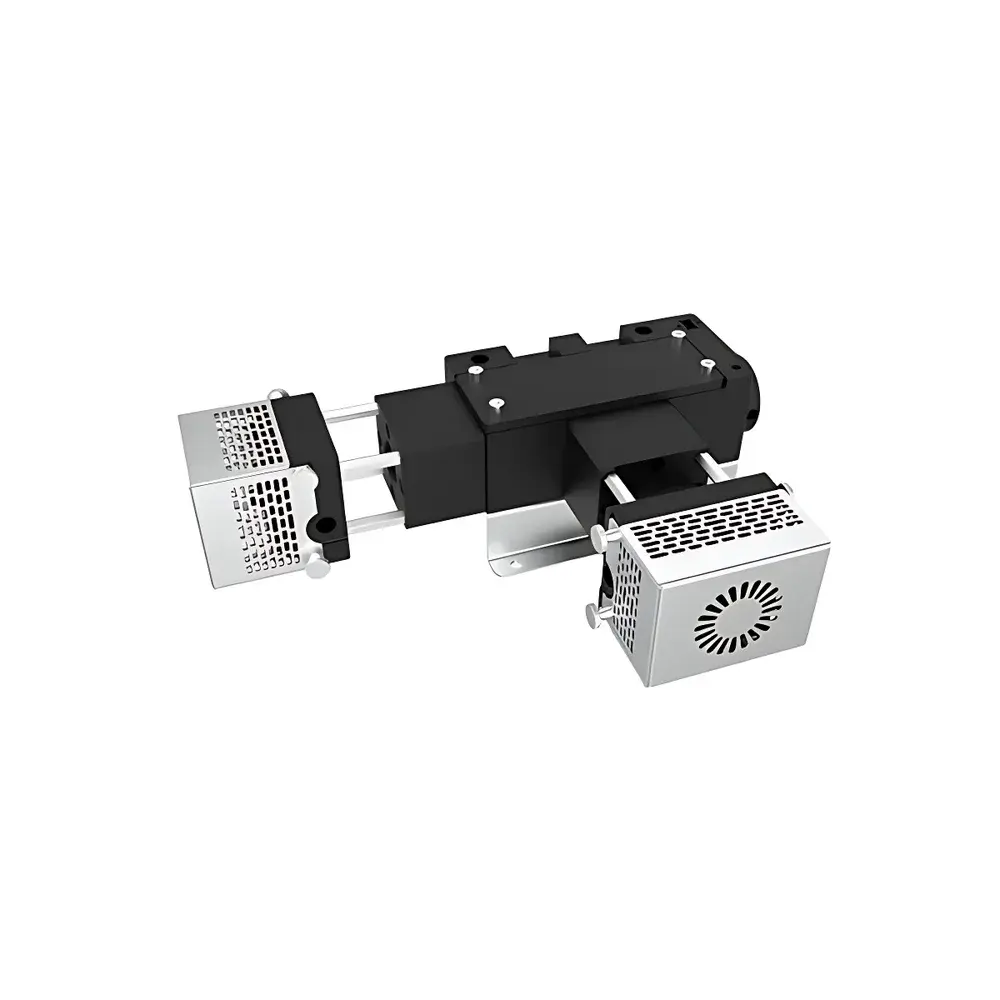
CUBIC INSTRUMENTS DUST-PM Sensor Module for Flue Gas Monitoring
| Brand | CUBIC INSTRUMENTS |
|---|---|
| Origin | Hubei, China |
| Measurement Principle | Optical Light Scattering |
| Safety Classification | Non-Explosion-Proof |
| Range | 0–20 mg/m³ |
| Accuracy | ≤ ±10% F.S. |
| LOD | 0.01 mg/m³ |
| Zero Drift | ±2% F.S./24h |
| Span Drift | ±2% F.S./24h |
| Operating Temp. | −20 to 50°C |
| Humidity | 5–95% RH (non-condensing) |
| Flue Gas Temp. Tolerance | <300°C |
| Data Update Rate | 1 Hz |
| Power Supply | DC 12 V ±0.5 V (ripple <100 mV) |
| Avg. Current Draw | <500 mA |
| Interface | UART_TTL (3.3 V logic) |
| Dimensions (W×H×D) | 272 × 111 × 193 mm |
| Anti-Clogging | Pneumatic Air Curtain Protection |
| Enclosure Rating | IP65-equivalent (based on module integration context) |
Overview
The CUBIC INSTRUMENTS DUST-PM Sensor Module is an OEM-grade optical particulate matter sensor engineered for continuous, real-time monitoring of suspended particulate mass concentration in industrial flue gas streams. It operates on the principle of forward-scattered laser light detection—where aerosol particles passing through a precisely stabilized, temperature-controlled measurement chamber intercept a collimated 650 nm diode laser beam. The resulting Mie-scattered light intensity is captured by a high-linearity photodiode array and converted into a proportional analog voltage signal. This raw signal undergoes digital compensation for temperature, humidity, and optical path degradation, then applies a factory-calibrated transfer function traceable to NIST-traceable reference aerosols (e.g., ISO 12103-1 A2 test dust) to output a linearized PM mass concentration value in mg/m³. Designed specifically for integration into CEMS (Continuous Emission Monitoring Systems), the module meets the metrological and functional requirements specified in HJ 76–2017, China’s national technical standard for flue gas CEMS validation and performance testing—including dynamic range verification, zero/span stability assessment, and response time evaluation under simulated stack conditions.
Key Features
- Optical design optimized for low-concentration flue gas applications, with a verified limit of detection (LOD) of 0.01 mg/m³ at 1σ confidence level, enabling compliance with stringent emission thresholds for coal-fired boilers and waste incinerators.
- Integrated thermostatic control maintains the optical chamber at a constant 50 ± 2 °C—suppressing water vapor condensation and minimizing refractive index variability caused by flue gas cooling, thereby enhancing long-term baseline stability.
- Modular mechanical architecture (272 × 111 × 193 mm) supports direct mounting into OEM analyzers or standalone probe housings; includes standardized mechanical interfaces and electrical pinouts compliant with IPC-7351B footprint guidelines.
- Pneumatic air curtain system actively isolates the optical window from particulate deposition, reducing maintenance frequency and extending calibration interval to ≥90 days under typical operation (verified per HJ 76–2017 Section 7.4.2).
- Low-power DC 12 V operation with ripple-immune analog front-end ensures stable performance in electrically noisy plant environments; UART_TTL (3.3 V) interface enables seamless integration with ARM-based data loggers or PLCs without level-shifting circuitry.
Sample Compatibility & Compliance
The DUST-PM Sensor Module is validated for use with dry or semi-dry flue gases containing particulates ranging from submicron soot (e.g., EC/OC carbon aggregates) to coarse fly ash (d50 ≈ 10–30 µm). It is not intended for wet-stack applications without upstream conditioning (e.g., heated sample line + permeation dryer). The module conforms to HJ 76–2017 for type approval testing—including zero drift (<±2% F.S./24 h), span drift (<±2% F.S./24 h), and linearity deviation (<±5% of reading across 0–100% range). While not certified to IEC 60079 for hazardous areas, its non-explosion-proof classification aligns with installation in Zone 2 or non-classified enclosures per GB 50058. For regulatory reporting, outputs are compatible with data acquisition systems meeting HJ 212–2017 communication protocol requirements.
Software & Data Management
The sensor provides ASCII-formatted serial output at 1 Hz via UART_TTL, supporting configurable baud rates (9600–115200 bps). Raw scattering intensity, compensated PM concentration, internal temperature/humidity readings, and diagnostic flags (e.g., optical window contamination status, heater fault) are transmitted in a fixed-field packet structure. Integration libraries (C/C++, Python) are available for embedded firmware development. When deployed within a full CEMS, the module’s output feeds into central data management platforms compliant with GLP/GMP audit trails and 21 CFR Part 11 electronic record requirements—provided the host system implements timestamped data logging, user access controls, and change history tracking.
Applications
- Continuous particulate monitoring in coal-, biomass-, and waste-fired power plants per national emission limits (e.g., GB 13223–2011).
- OEM integration into portable stack testers and mobile emission inspection units used by provincial EPBs.
- Real-time feedback control of electrostatic precipitators (ESPs) and fabric filter cleaning cycles.
- Process optimization in cement kilns and sintering furnaces where PM generation correlates with thermal efficiency.
- Research-grade measurement in laboratory-scale combustion rigs simulating post-SCR or post-FF flue gas conditions.
FAQ
Is this sensor suitable for high-humidity or saturated flue gas?
No—direct exposure to condensing moisture will impair optical performance. It must be paired with a heated sampling line (≥120 °C) and/or a Nafion dryer to maintain dew point below the chamber temperature.
Can the module be calibrated using standard reference materials?
Yes—traceable calibration is performed using polydisperse ISO 12103-1 A2 test dust aerosols generated via fluidized bed generator, with gravimetric reference established per ISO 11997-1 procedures.
What is the recommended maintenance schedule?
Optical window inspection every 30 days; full calibration verification every 90 days; air curtain filter replacement every 180 days under continuous operation in typical coal-fired flue gas (≤10 mg/m³ average load).
Does the module support analog voltage output (e.g., 4–20 mA)?
Not natively—but external signal converters compliant with IEC 61000-4-5 surge immunity can be interfaced via the UART stream; CUBIC provides protocol documentation for custom OEM conversion modules.
Is firmware upgrade capability available?
Yes—field-upgradable via UART bootloader; version history, checksums, and release notes are provided under NDA for qualified OEM partners.







