
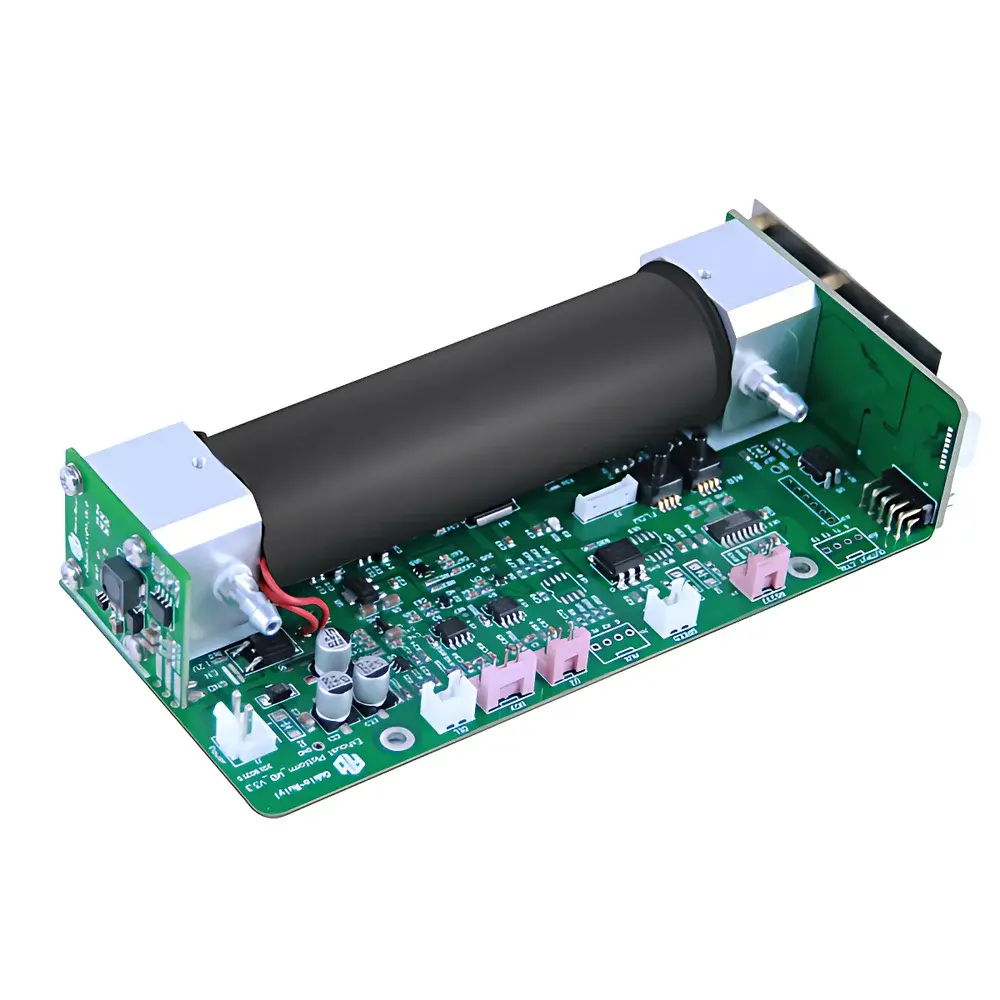
CUBIC INSTRUMENTS Gasboard-2000 Infrared Exhaust Gas Optical Platform
| Brand | CUBIC INSTRUMENTS |
|---|---|
| Origin | Hubei, China |
| Manufacturer Type | Authorized Distributor |
| Country of Origin | China |
| Model | Gasboard-2000 |
| Pricing | Available Upon Request |
| Measurement Principle | Dual-beam NDIR (Non-Dispersive Infrared) Spectroscopy |
| Measured Gases | CO, CO₂, HC (hydrocarbons), optional O₂ and NO |
| HC Range | (0–2000)×10⁻⁶ (ppm), CO: (0.00–10.00)×10⁻² (% vol), CO₂: (0.0–16.0)×10⁻² (% vol), NO (optional): (0–4000)×10⁻⁶ (ppm), O₂ (optional): (0.0–25.0)×10⁻² (% vol) |
| Accuracy | Complies with GB 18285–2018, ISO 3930, OIML R99 |
| Resolution | HC/NO: 1 ppm |
| CO/CO₂/O₂ | 0.001%/0.01%/0.01% vol |
| Response Time (T₉₀) | ≤4.5 s (NDIR) |
| Output Interface | RS-232 |
| Operating Voltage | 12 V ±0.2 V, 3.2 A |
| Environmental Compensation | Automatic temperature & pressure correction |
| Design | Modular sensor architecture, heated optical path |
Overview
The CUBIC INSTRUMENTS Gasboard-2000 is a high-stability infrared exhaust gas optical platform engineered for precision multi-gas analysis in regulatory-compliant emission testing environments. Based on dual-beam non-dispersive infrared (NDIR) spectroscopy, the platform exploits the characteristic mid-infrared absorption bands of target gas molecules—specifically CO (2170 cm⁻¹), CO₂ (2350 cm⁻¹), and hydrocarbons (HC) in the 3.3–3.5 µm range—to quantify concentration via Beer–Lambert law-based photometric detection. Unlike single-beam configurations, the dual-beam architecture actively compensates for source drift, window fouling, and ambient thermal fluctuations by referencing a dedicated compensation channel, ensuring long-term baseline stability and measurement reproducibility across variable operating conditions. Designed to meet the stringent metrological requirements of GB 18285–2018 (China’s Motor Vehicle Emission Inspection Standard), ISO 3930:2000 (Road Vehicles — Exhaust Gas Analyzers — Performance Requirements and Test Methods), and OIML R99 (Class 0.5 accuracy class for automotive exhaust analyzers), the Gasboard-2000 serves as a core optical engine for OEM integration into roadside inspection systems, chassis dynamometer setups, and continuous emissions monitoring systems (CEMS) for industrial stack applications.
Key Features
- Dual-beam NDIR optical design with active reference channel for real-time drift correction and enhanced signal-to-noise ratio
- Modular sensor architecture enabling flexible integration into third-party analyzers, test benches, or portable emission measurement units (PEMUs)
- Integrated thermostatically controlled optical path (heated to 45–50 °C) to prevent condensation and ensure consistent gas-phase measurement integrity
- On-board temperature and barometric pressure compensation algorithms compliant with ISO 3930 Annex B and GB 18285–2018 Section 6.3.2
- Standard RS-232 serial interface supporting ASCII protocol for seamless communication with host controllers, data loggers, or PC-based acquisition software
- Low-power 12 V DC operation optimized for mobile and field-deployable instrumentation platforms
Sample Compatibility & Compliance
The Gasboard-2000 is validated for direct analysis of raw and diluted exhaust gas streams from gasoline, diesel, and LPG-powered internal combustion engines. Its optical cell accommodates sample gas flow rates of 0.5–2.0 L/min at standard temperature and pressure (STP), with inlet/outlet ports conforming to ISO 3930-defined 6 mm OD tubing specifications. All stated accuracy specifications—including absolute error limits for HC (±4 ppm below 2000 ppm), CO (±0.02% vol below 10.00%), and CO₂ (±0.3% vol below 16.0%)—are verified per ISO 3930 calibration procedures using certified reference gases traceable to NIST SRMs. Optional O₂ and NO measurement channels utilize electrochemical and paramagnetic (O₂) or electrochemical (NO) sensing modules that share common mechanical mounting and electrical interfaces, maintaining system-level traceability under GLP-aligned validation protocols.
Software & Data Management
The platform operates autonomously without embedded firmware requiring user configuration; all operational parameters—including zero/span calibration coefficients, temperature/pressure compensation tables, and alarm thresholds—are stored in non-volatile EEPROM and accessible via standardized RS-232 commands (e.g., “READ_DATA”, “CAL_ZERO”). When integrated into larger analytical systems, the Gasboard-2000 supports audit-trail-ready data logging when paired with host software compliant with FDA 21 CFR Part 11 requirements (electronic signatures, change control, and secure archive). Raw analog outputs (0–5 V or 4–20 mA) are available upon request for legacy analog DAQ integration. Calibration history, sensor health diagnostics, and environmental parameter logs can be exported in CSV format for QA/QC review and regulatory submission.
Applications
- Automotive emission testing stations (I/M programs) requiring GB 18285–2018 or ISO 3930-certified analyzer cores
- OEM integration into chassis dynamometer control systems for R&D and homologation testing
- Portable emission measurement systems (PEMS) used in real-driving emissions (RDE) campaigns
- Industrial stack monitoring where CO/CO₂/HC ratios serve as combustion efficiency indicators
- Research laboratories developing next-generation aftertreatment catalysts and engine control strategies
- Environmental monitoring networks requiring modular, field-serviceable gas detection nodes
FAQ
Does the Gasboard-2000 require periodic factory recalibration?
No—its dual-beam NDIR architecture and stable IR source enable extended calibration intervals. Field zero/span verification using certified gases is recommended every 90 days per ISO 3930 Section 7.2.
Can the unit operate continuously in high-humidity exhaust environments?
Yes—the heated optical path (45–50 °C) prevents water vapor condensation and maintains optical clarity without desiccant cartridges or membrane dryers.
Is firmware upgrade support available for new regulatory updates?
Firmware revisions are provided exclusively to authorized system integrators under NDA and require hardware-level compatibility verification prior to deployment.
What documentation is supplied for regulatory compliance validation?
Each unit ships with a Factory Calibration Certificate (traceable to CNAS-accredited standards), ISO 3930 Conformance Statement, GB 18285–2018 Technical Compliance Report, and RoHS/CE Declaration of Conformity.
Are custom analog output ranges or protocol extensions supported?
Yes—custom I/O configurations (e.g., 0–10 V, Modbus RTU over RS-485) are available under OEM agreement with minimum order quantities and engineering service fees applied.







