
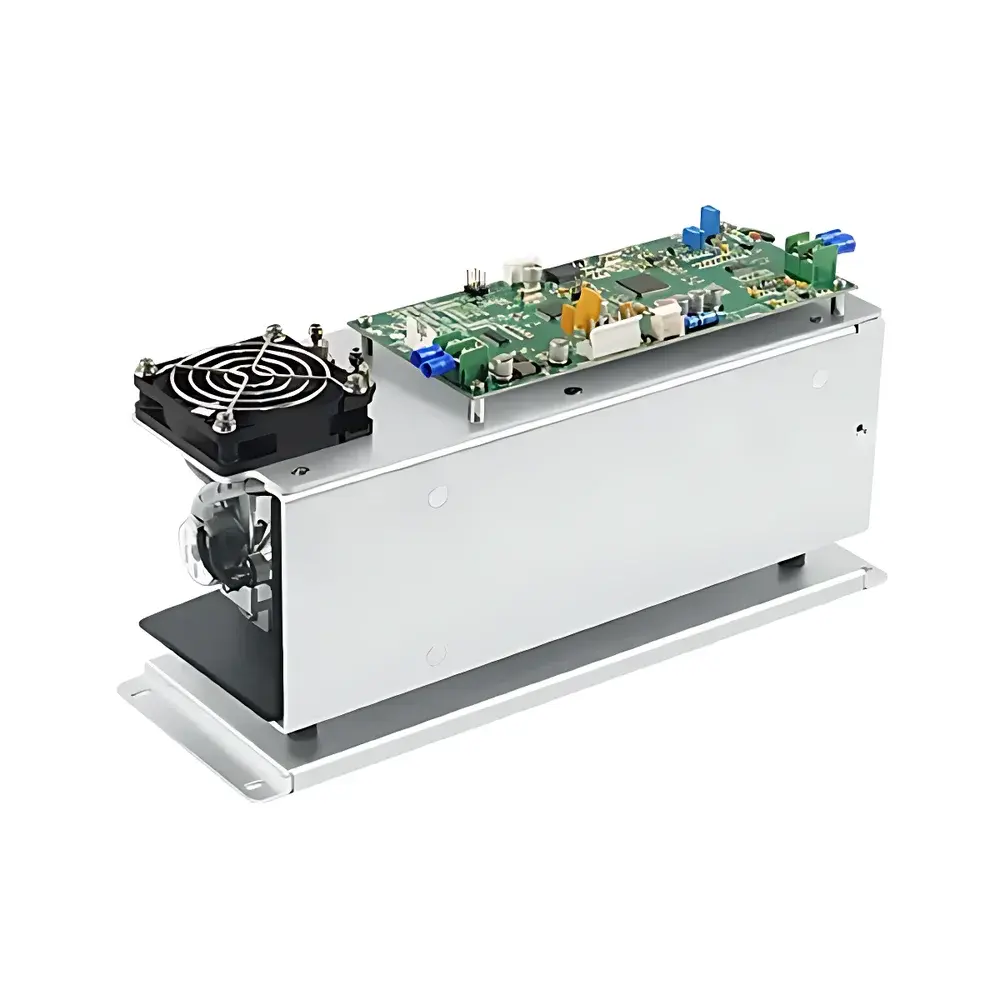
CUBIC INSTRUMENTS Gasboard-2105 Microflow NDIR Gas Sensor Module
| Brand | CUBIC INSTRUMENTS |
|---|---|
| Origin | Hubei, China |
| Manufacturer Type | Authorized Distributor |
| Product Origin | Domestic (China) |
| Model | Gasboard-2105 |
| Price | Upon Request |
| Measurement Principle | Microflow Non-Dispersive Infrared (NDIR) with Dual-Chamber (Sample + Reference) Architecture |
| Target Gases | CO, NO, SO₂, CO₂, CH₄ |
| Moisture Compensation | Integrated Humidity Compensation Module |
| Temperature & Pressure Compensation | Automatic Real-Time Compensation |
| Heating Control | Thermostatically Controlled Gas Cell |
| Linearity Error | ±2% FS |
| Repeatability | ±2% FS |
| Zero/Full-Scale Drift | <2.5% FS per 7 days |
Overview
The CUBIC INSTRUMENTS Gasboard-2105 is a high-stability, microflow non-dispersive infrared (NDIR) gas sensor module engineered for continuous, selective detection of multiple industrial and environmental gases—including carbon monoxide (CO), nitrogen oxide (NO), sulfur dioxide (SO₂), carbon dioxide (CO₂), and methane (CH₄). Its core sensing architecture employs a patented dual-chamber optical design (PCT/CN2018100767), comprising an active measurement chamber and a sealed reference chamber. This differential configuration enables robust rejection of common-mode interference—such as broadband IR source aging, detector drift, and optical contamination—thereby delivering long-term baseline stability without frequent recalibration. The microflow cell design minimizes sample volume requirements while maintaining laminar flow characteristics essential for consistent light-path interaction and signal reproducibility. Built for deployment in harsh operational environments—including high-humidity exhaust streams, fluctuating ambient temperatures, and particulate-laden industrial ducts—the Gasboard-2105 integrates thermostatic heating of the optical gas cell to suppress thermal-induced refractive index variations and spectral broadening effects that degrade NDIR accuracy.
Key Features
- Patented microflow NDIR architecture with dual-compartment gas cell (measuring + reference), certified under international PCT patent PCT/CN2018100767
- Integrated humidity compensation module mitigates water vapor absorption cross-interference across the 2–5 µm mid-IR band, critical for accurate CO, NO, and SO₂ quantification in wet flue gas
- Real-time temperature and barometric pressure compensation algorithms compliant with ISO 12039 and EPA Method 6C correction protocols
- Thermostatically controlled gas cell maintains ±0.5 °C setpoint stability, minimizing thermal lensing and spectral shift artifacts
- Modular mechanical and electrical interface (standard 24 VDC input, analog 4–20 mA + digital RS485 Modbus RTU output) facilitates seamless integration into OEM analyzers, CEMS platforms, and portable emission testers
- Designed for >24 months continuous operation under industrial duty cycles, with mean time between failures (MTBF) exceeding 30,000 hours
Sample Compatibility & Compliance
The Gasboard-2105 operates effectively across gas matrices with up to 95% relative humidity (non-condensing), particulate loadings ≤10 mg/m³, and operating temperatures from −20 °C to +55 °C. It meets electromagnetic compatibility requirements per IEC 61326-1 (industrial environment) and safety standards IEC 61010-1. While not intrinsically safe certified, it is suitable for installation in Zone 2/Class I Division 2 areas when deployed within approved enclosures. The sensor’s measurement traceability aligns with ISO/IEC 17025-accredited calibration practices, and its linear response supports compliance with regulatory frameworks including EU Directive 2010/75/EU (IED), US EPA 40 CFR Part 60, and China’s HJ 75–2017 and HJ 76–2017 technical specifications for CEMS.
Software & Data Management
The module communicates via industry-standard RS485 Modbus RTU protocol (slave ID configurable), enabling direct integration with SCADA systems, PLCs, and custom data acquisition software. Analog 4–20 mA outputs are individually scalable per gas channel with user-defined zero/span points. Firmware supports remote diagnostics—including signal-to-noise ratio monitoring, heater status reporting, and internal temperature logging—with timestamped event records stored in non-volatile memory. All calibration and maintenance actions are logged with audit-trail timestamps, supporting GLP/GMP-aligned documentation requirements. Optional firmware updates include enhanced drift-correction algorithms trained on field-deployed datasets from coal-fired, marine diesel, and biogas applications.
Applications
- Continuous emissions monitoring systems (CEMS) for low-concentration stack gas analysis (e.g., CO <50 ppm in biomass combustion)
- Marine exhaust gas cleaning systems (EGCS) and IMO Tier III NOₓ compliance verification on auxiliary engines
- OBD-II and portable emissions measurement systems (PEMS) for real-world driving emissions (RDE) testing
- In-situ boiler and furnace combustion optimization via multi-gas feedback control loops
- Biogas quality monitoring in anaerobic digesters (CH₄/CO₂ ratio tracking for upgrading control)
- Process gas analysis in chemical synthesis, fertilizer production, and semiconductor fab ambient monitoring
- OEM integration into handheld gas analyzers, drone-mounted environmental survey platforms, and smart city air quality nodes
FAQ
What gases does the Gasboard-2105 detect, and how is cross-sensitivity managed?
The module simultaneously measures CO, NO, SO₂, CO₂, and CH₄ using discrete narrow-band IR filters and wavelength-specific photodetectors. Cross-sensitivity is minimized through spectral deconvolution algorithms and the differential dual-chamber design, which inherently cancels out broadband interferences.
Can the measurement ranges be customized for specific applications?
Yes—standard configurations support multiple range options (e.g., CO: 0–500 ppm or 0–5000 ppm); custom full-scale spans and filter sets are available upon engineering consultation.
Is factory calibration traceable to national standards?
All units undergo multi-point calibration against NIST-traceable gas standards (±1% uncertainty) prior to shipment; calibration certificates include gas mixture composition, pressure, temperature, and uncertainty budgets.
Does the module support digital communication for remote configuration?
Yes—RS485 Modbus RTU enables remote readout, span adjustment, zero calibration initiation, and firmware updates without physical access.
What maintenance intervals are recommended for long-term reliability?
No routine optical cleaning or consumable replacement is required; annual functional verification with certified span gas is recommended per ISO 14001 and EPA PS-17 guidelines.
Related Products







