
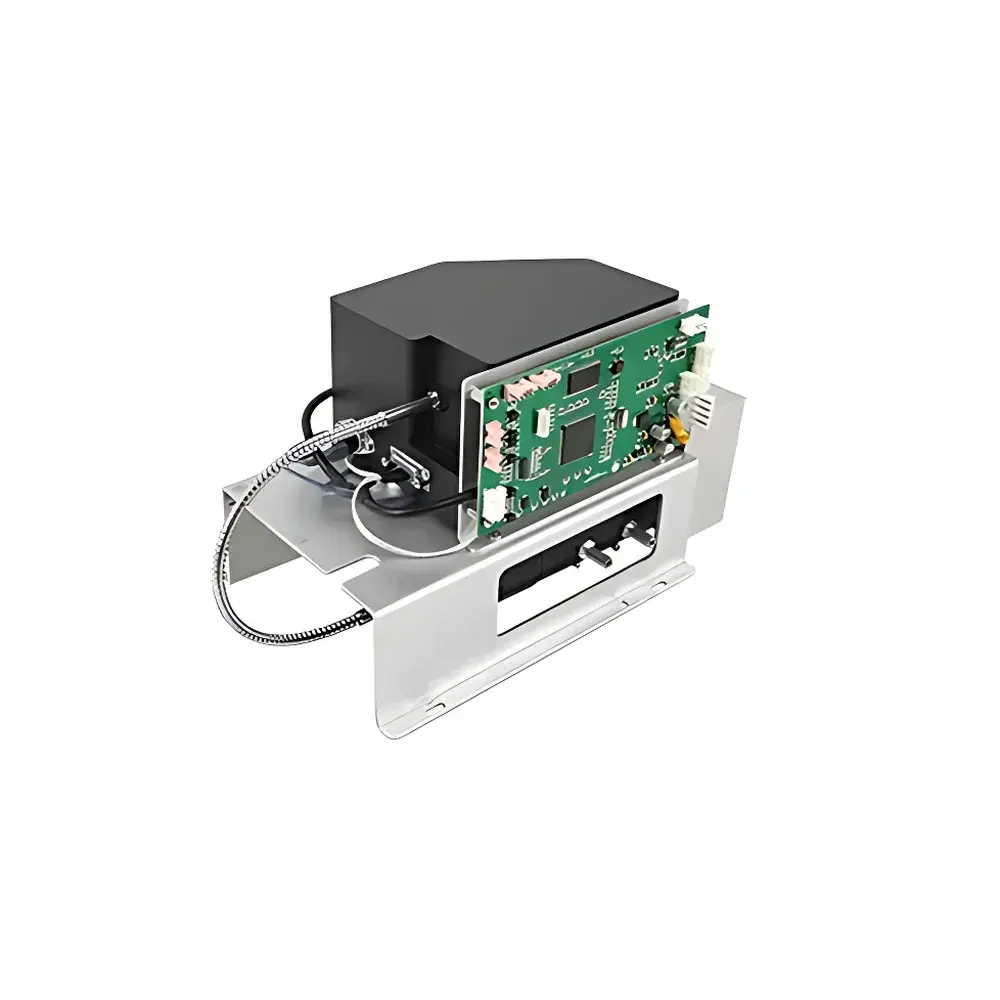
CUBIC INSTRUMENTS Gasboard-2200 UV-DOAS Gas Sensor Module
| Brand | CUBIC INSTRUMENTS |
|---|---|
| Origin | Hubei, China |
| Manufacturer Type | Authorized Distributor |
| Country of Origin | China |
| Model | Gasboard-2200 |
| Price | Upon Request |
| Measurement Principle | UV Differential Optical Absorption Spectroscopy (UV-DOAS) |
| Target Gases | SO₂, NO, NO₂ |
| SO₂/NO Range | 0–100 / 0–2000 ppm (configurable) |
| NO₂ Range | 0–500 / 0–5000 ppm (configurable) |
| Linearity Error | ±2% F.S. |
| Repeatability | ±2% F.S. |
| Zero/Full-Scale Drift | <2.5% F.S. per 7 days |
| Light Source | Pulsed Xenon Lamp |
| Compensation | Automatic Temperature & Pressure Compensation |
| Output Interface | Analog (4–20 mA) and Digital (RS485/Modbus RTU) |
| Module Form Factor | OEM-integrated sensor unit |
Overview
The CUBIC INSTRUMENTS Gasboard-2200 is a compact, OEM-ready UV Differential Optical Absorption Spectroscopy (UV-DOAS) gas sensing module engineered for high-fidelity, in-situ measurement of sulfur dioxide (SO₂), nitric oxide (NO), and nitrogen dioxide (NO₂) in industrial and environmental exhaust streams. Unlike conventional electrochemical or NDIR sensors, the Gasboard-2200 leverages the intrinsic electronic absorption signatures of target gases in the ultraviolet spectral region (190–230 nm), enabling selective, interference-resistant quantification without catalytic conversion. Its pulsed xenon lamp provides stable, broadband UV illumination with minimal thermal drift and extended operational lifetime (>2 years typical). The optical path employs a reflective multi-pass cell architecture to enhance effective path length—critical for achieving sub-ppm detection limits in low-concentration applications such as marine scrubber effluent monitoring or biogas upgrading processes.
Key Features
- True UV-DOAS methodology: Direct, simultaneous quantification of SO₂, NO, and NO₂—no NO-to-NO₂ converter required, eliminating cross-sensitivity and calibration drift associated with thermal oxidation units.
- Robust optical design: Sealed, temperature-stabilized measurement cell with quartz windows and corrosion-resistant internal surfaces suitable for hot, humid, and particulate-laden flue gas environments.
- Real-time compensation: Integrated temperature and barometric pressure sensors feed into embedded algorithms to correct for gas density variations—ensuring traceable concentration reporting under dynamic process conditions.
- OEM-optimized form factor: Modular 3U-height chassis (160 × 120 × 220 mm) with standardized mechanical mounting points and dual-output interface (4–20 mA analog + RS485 Modbus RTU) for seamless integration into analyzers, CEMS platforms, or portable emission testing systems.
- Low maintenance operation: No consumables, zero reagents, and no moving parts—designed for unattended operation over extended intervals compliant with EN 15267-3 and EPA Method 6C verification requirements.
Sample Compatibility & Compliance
The Gasboard-2200 is validated for use with dry and wet flue gases containing up to 15% v/v water vapor, with no signal quenching or baseline shift attributable to humidity—a key differentiator from IR-based technologies. It meets electromagnetic compatibility (EMC) per IEC 61326-1 and carries CE marking for industrial instrumentation. While not certified as a standalone CEMS analyzer, its core measurement module satisfies performance criteria aligned with ISO 12039 (SO₂/NOₓ determination in stationary source emissions) and ASTM D6522 (standard test method for determination of nitrogen oxides in engine exhaust). When integrated into full-system configurations, it supports audit-ready data logging compatible with GLP/GMP workflows and 21 CFR Part 11-compliant software architectures.
Software & Data Management
The sensor operates autonomously but interfaces with host systems via open-protocol Modbus RTU, enabling direct ingestion into SCADA, DCS, or cloud-based environmental monitoring platforms. Optional firmware updates support configurable averaging periods (1–60 s), alarm thresholds per gas channel, and diagnostic flagging for lamp intensity decay or optical window fouling. Raw spectral data (absorbance vs. wavelength) is accessible upon request for third-party spectral deconvolution or method validation—facilitating traceability and method transparency in regulatory submissions.
Applications
- Continuous Emission Monitoring Systems (CEMS) for coal-fired, biomass, and waste-to-energy boilers operating under low-load or low-emission regimes.
- Marine exhaust gas cleaning systems (EGCS), where real-time NO₂/SO₂ ratio tracking informs scrubber efficiency and compliance with IMO MARPOL Annex VI Tier III limits.
- On-board diagnostics for heavy-duty diesel engines and locomotives during PEMS (Portable Emission Measurement System) testing per EU Regulation 2016/427.
- In-line monitoring of anaerobic digestion biogas streams for H₂S-free SO₂/NOₓ verification prior to upgrading to biomethane.
- Process control in chemical synthesis reactors and thermal incinerators requiring stoichiometric feedback on oxidant consumption and byproduct formation.
FAQ
Does the Gasboard-2200 require periodic calibration with span gas?
Yes—while zero stability is maintained via internal reference channels, quarterly span calibration using certified SO₂/NO/NO₂ standard gases (traceable to NIST or equivalent national standards) is recommended per ISO 14064-3 and EN 14181 QA/QC protocols.
Can it operate in high-dust environments without filtration?
No—particulate loading >10 mg/m³ requires upstream heated probe filtration (e.g., ceramic sintered filter with purge air) to prevent optical window deposition; optional heated sample line kits are available.
Is the sensor compatible with explosion-proof enclosures?
The core module is intrinsically safe (II 3G Ex nA IIC T4 Ga) when installed within certified ATEX/IECEx-rated housings—full system certification must be performed by the integrator.
What is the minimum detectable concentration (MDL) for NO₂ at 1-second response time?
Typical MDL is 0.5 ppm (3σ) under laboratory conditions; field MDL increases to ~1.2 ppm due to vibration, thermal transients, and optical alignment tolerances.
Does firmware support custom spectral fitting algorithms?
Yes—via UART debug interface, users may load user-defined absorption cross-section libraries and polynomial baseline correction models, subject to validation per ISO/IEC 17025 clause 7.7.
Related Products







